Ricard Brand Guidelines
Paul Ricard’s blue-and-yellow pastis from Marseille.
Aa
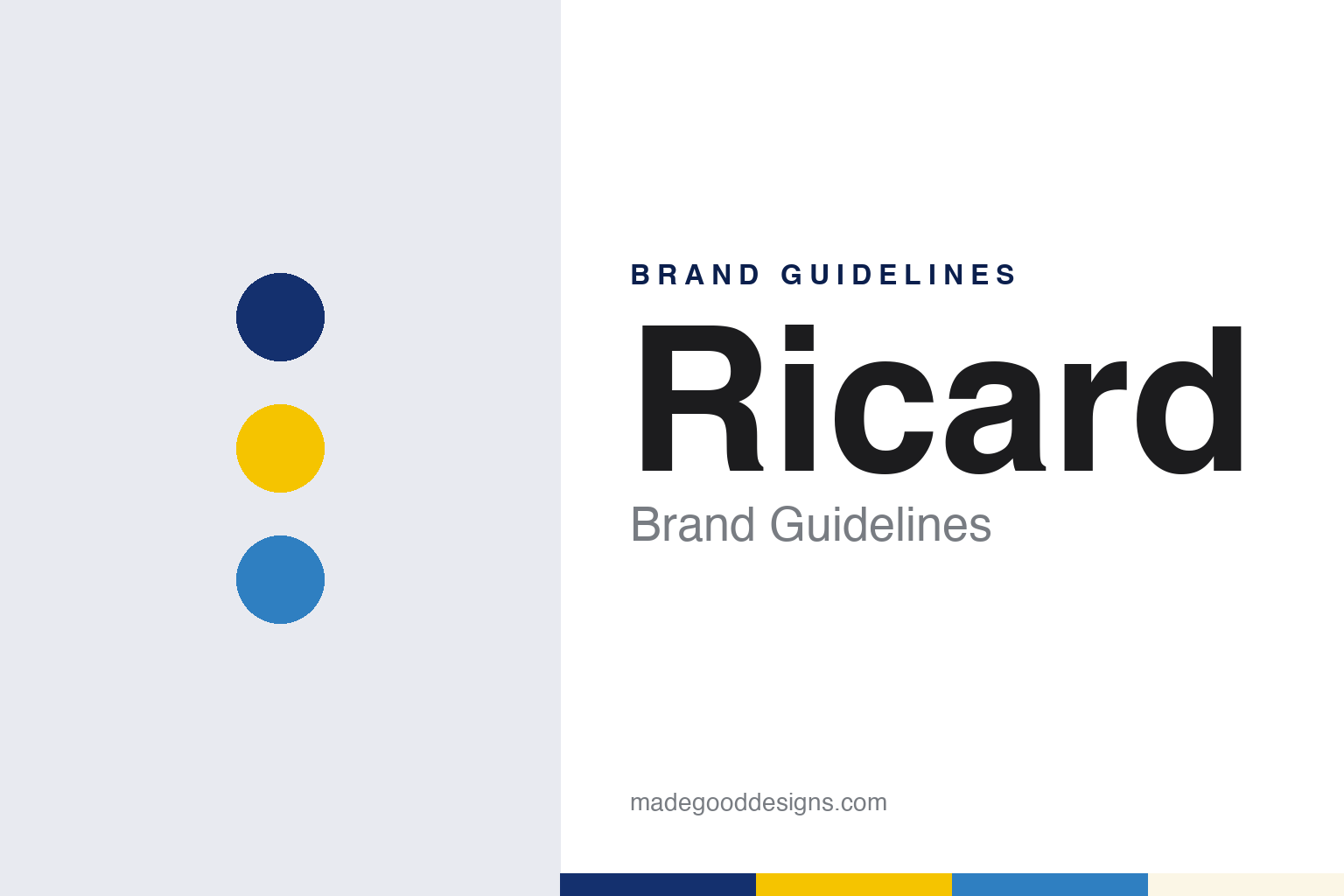
Two constants: a Marseille blue, sun yellow and cream palette and a bold café sans register. Abstract homage — not a Ricard product or mark; no bottle, jug, label or logo is reproduced.
The real pastis of Marseille
A wine merchant’s son, a home laboratory and a 1932 decree.
Ricard is a Marseille drink, and its maker has rarely let anyone forget it. French Wikipedia, citing the business magazine Histoire d’entreprises (2007), dates the company to 17 July 1932, when Paul Ricard, then 23, founded it in Marseille to sell an anise and liquorice apéritif under his own name. He grew up in the city’s Sainte-Marthe district, the son of a wine merchant, and French Wikipedia says he had wanted to study at Marseille’s fine-arts school before his father brought him into the family trade.
The drink came out of a change in the law. France banned absinthe by a law of 16 March 1915, and anise apéritifs were tightly restricted afterwards. French Wikipedia says Paul Ricard worked on his own recipe in a makeshift home laboratory, blending star anise, green anise and a touch of liquorice, and tried it out in local cafés before a decree of 7 April 1932 allowed anise drinks at 40% to be made and sold. He launched it with the line “Ricard, le vrai pastis de Marseille” — the real pastis of Marseille — and French Wikipedia says it was the first time the word pastis, Provençal for a mixture, appeared on the label of an anise apéritif.
Growth was quick. French Wikipedia puts early sales at 250,000 bottles in eight months and describes a first large advertising campaign in Lyon in 1936 and the drink’s arrival in Paris in 1939; Brand Republic’s “Champions of Design” series reported in 2012 that annual sales had reached 2.4 million litres by 1938. Under the Vichy government pastis at 45% was banned in 1940, and Ricard returned to sale in 1951, French Wikipedia says, citing Franceinfo.
Colour
Blue, yellow and a water jug.
Paul Ricard was his own art director. Brand Republic, writing in its “Champions of Design” series in September 2012, described him as a budding painter and student of fine art who created the brand’s blue and yellow imagery, taking his inspiration from the sky and the sun of Marseille. French Wikipedia says he drew the first posters that decorated the company’s delivery lorries and designed the spouted water jug, which Brand Republic dates to 1935.
The jug became a strategy. A law of 6 January 1951 barred press and poster advertising for anise apéritifs, French Wikipedia says; Brand Republic reported that the exceptions were material sent to distributors, displays in bars and decals on delivery vans. Ricard filled the gap with barware — jugs, decanters, glasses, ashtrays, clocks and playing cards — many of which became fixtures of French cafés and later collectors’ items. Brand Republic quoted Paul Ricard’s autobiography describing the ban as a secret advantage that obliged the company to use its imagination. In the same piece Andy Knowles, chairman of the design agency JKR, judged the bottle itself neither original nor memorable but credited the brand with turning humble barware into an advertising medium of its own. Branded pieces have also been commissioned from designers including Garouste & Bonetti, Marc Newson and the Bouroullec brothers, the magazine said.
Sponsorship carried the colours further. French Wikipedia says vehicles in Ricard’s yellow and blue joined the Tour de France publicity caravan in 1948, and that during the 1956 Suez fuel shortage the company delivered Ricard in Paris by camel, the “caravane de la soif.” Brand Republic dates the slogan “Un Ricard, sinon rien” — a Ricard or nothing — to 1984, the year the billionth bottle was sold; the first limited-edition bottle design to 1993; and a redesign aimed at younger drinkers to 2011.
Typography
Design and documentation.
The seven brands in this group are all spirit names from Mexico, France, Greece and Spain: José Cuervo, Patrón, Ricard, Pernod, Metaxa, Ouzo 12 and Licor 43. Spirit brands in general sit at many different points in the trade, from family firms that still carry a founder’s name to names that now belong to much larger drinks groups, and a single brand can be sold everywhere from a neighbourhood bar to a duty-free shelf.
A spirit brand’s identity is usually carried less by a single bottle than by a label, a name and the drink or ritual it promises, because the company behind the name may have changed hands, moved its production or grown far beyond the place where it started. That makes the questions behind each name worth asking plainly: who started it, who owns it now, and where its spirits are actually made and bottled.
Each guide separates what independent sources record from what the company says about itself — its founding story, its owners over time, where its spirits are made and how its bottles and advertising have changed — and marks plainly what rests only on the company’s own word.
Aa
A bold café sans for a brand built on posters, jugs and bar signs. (Specimen set in Archivo, a sans STAND-IN; NOT the Ricard logo.)
Ricard
A family firm inside Pernod Ricard.
Ricard has been part of a larger group for half a century. The business was listed on the Paris stock exchange in 1962, Brand Republic reported. Paul Ricard stepped back from running it in 1968, and his son Patrick Ricard became managing director in 1972, The Independent reported in 2012. In 1975 Ricard merged with its old rival Pernod to form Pernod Ricard; Patrick Ricard led the group as chairman and chief executive from 1978 until his death in August 2012, Brand Republic and The Independent reported. Paul Ricard died in 1997, The New York Times reported.
Today Ricard SAS is a Pernod Ricard subsidiary with its head office at Les Docks in Marseille, French Wikipedia says; it makes Ricard, Pacific and Lillet and sells other group brands in France. English Wikipedia says the pastis is produced in Bessan, in the Hérault, with blending and bottling also carried out in Bordeaux and Lille. Pernod Ricard says the recipe has not changed since 1932 and names star anise, fennel, liquorice and aromatic plants from Provence among its ingredients. It bottles Ricard at 45%, and the company says it added an organic lemon range in 2020, alongside a version made with anise from fresh plants grown in Haute-Provence. Citing the trade title Rayon Boissons, French Wikipedia calls Ricard the world’s best-selling pastis, with 37.1 million litres sold in 2020, and Stratégies reported in 2019 that, according to Nielsen, the one-litre bottle was the top product by value in French retail in 2017 and 2018.
For a design guide, Ricard shows how a founder’s two colours, a slogan and a water jug can carry a brand when posters are off-limits. Compare it with its partner in the group, Pernod, and with a Greek anise spirit, Ouzo 12. For this guide we use Marseille blue, sun yellow and cream with a sans, an unofficial interpretation; no product or logo is reproduced.
Explore & save
Keep Ricard’s identity on hand — save it to a board in the Made Good inspiration library.
Ricard identity set
Pin the Ricard Marseille blue, sun yellow and cream palette and the bold café sans register to your own board.