The Macallan Brand Guidelines
The Speyside single malt built on sherry oak.
Aa
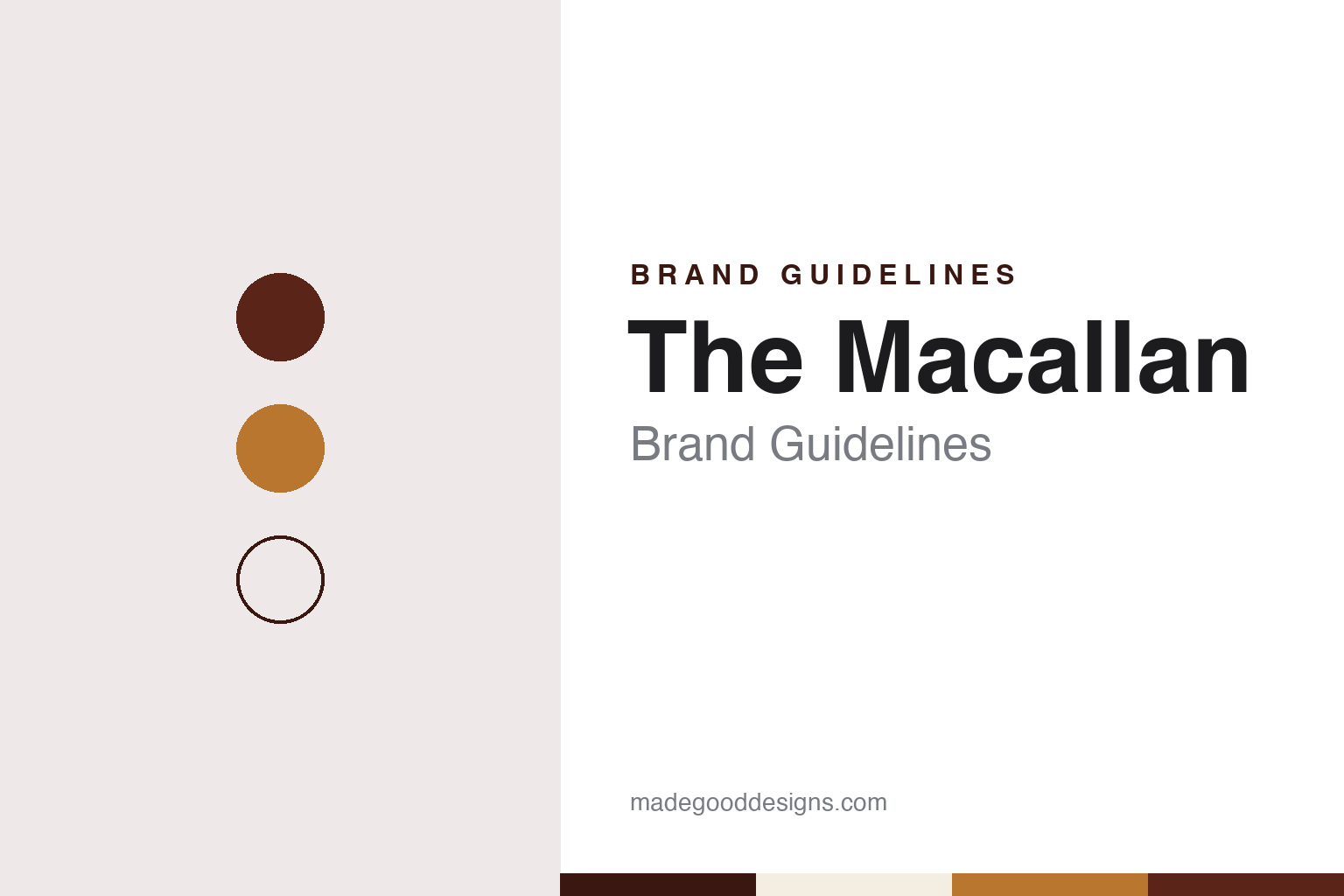
Two constants: a sherry oak, amber and parchment palette and a classical serif register. Abstract homage — not a Macallan product or mark; no bottle, label or logo is reproduced.
A farm distillery on the Spey
A licence in 1824, a new owner in 1892 and a rule about casks.
The Macallan is made on the Easter Elchies estate near Craigellachie, in Moray, in the Speyside whisky region of north-east Scotland. Its recorded history starts in 1824, when Alexander Reid obtained a licence to distil there, the company history published by FundingUniverse says. English Wikipedia, citing Dorling Kindersley’s 2008 book Whisky, describes the first operation as a farm distillery and says the name joins the Gaelic magh, “fertile ground,” with allan, a reference to a local stream.
The distillery changed shape under Roderick Kemp, who bought it in 1892, rebuilt it and renamed the business R. Kemp Macallan-Glenlivet, according to FundingUniverse. Blair Bowman’s Pocket Guide to Whisky (Birlinn, 2017), as cited by English Wikipedia, dates the distillery’s first large copper pot still to the same year. Kemp also set the house rule that became the brand’s best-known idea: FundingUniverse says he insisted on maturing the whisky in Spanish oak casks that had held sherry, and English Wikipedia adds that the casks were brought to the distillery from Jerez de la Frontera.
Kemp’s family kept control for most of the twentieth century. In the 1930s, English Wikipedia says, again citing the Dorling Kindersley book, the distillery began ageing its whisky for longer, setting its 12-Year-Old apart from rivals that relied on younger spirit. The company went public in 1968 to pay for expansion and for laying down stock, and renamed itself Macallan-Glenlivet in 1970, FundingUniverse says; in 1977 it opened a restored manor house on the estate to visitors. By the mid-1990s the family’s stake had fallen to about a fifth.
Colour
From Highland Distillers to Edrington.
Control passed to larger groups in the 1990s. In January 1996 Highland Distillers bought Rémy Cointreau’s 26% stake, and in July that year Highland and Suntory, which held 25%, pooled their shares in a joint venture called HS Distillers that controlled 51% of the company, FundingUniverse says; English Wikipedia records that Highland Distillers acquired the distillery in 1996.
Three years later Highland Distillers itself changed hands. In 1999 the Glasgow-based Edrington group bought it in partnership with William Grant & Sons, English Wikipedia says, and The Macallan Distillers Ltd is now a wholly owned Edrington subsidiary. Edrington traces its roots to Robertson & Baxter, founded in Glasgow in 1861, and since 1961 all of its voting shares have been held by The Robertson Trust, a Scottish charity set up by the three Robertson sisters, according to English Wikipedia. Edrington’s other single malts are Highland Park and The Glenrothes, and its holdings have included a majority of the Dominican rum maker Brugal since 2008.
The range has been rebuilt around casks. In 2004 The Macallan added a Fine Oak series that mixed whisky from bourbon casks with sherry-matured whisky, according to an archived copy of the company’s website cited by English Wikipedia; in 2018 that series was renamed Triple Cask Matured. The sherry-oak expressions remain, alongside the Double Cask range. The company has also taken control of part of its cask supply: in September 2023 the Macallan business bought Vasyma, a sherry cooperage in Jerez, English Wikipedia says.
Some of its most visible releases have been built around collaborations with photographers and glassmakers. English Wikipedia lists a Masters of Photography series whose contributors included Rankin, Albert Watson and Annie Leibovitz, and several limited editions presented in Lalique crystal decanters. In 2001 the Speaker of the House of Commons, Michael Martin, chose The Macallan 10 Years Old as the Speaker’s official Scotch, The Times reported that March.
Typography
Design and documentation.
The seven brands in this group are all whisky names from Ireland and Scotland: Bushmills, Tullamore D.E.W., Glenfiddich, The Glenlivet, The Macallan, Chivas Regal and The Famous Grouse. Irish and Scotch whisky brands in general sit at many different points in the trade, from names that still carry a founder’s or a place’s name to names that now belong to much larger drinks groups, and a single brand can be sold everywhere from a local bar to an airport shop.
A whisky brand’s identity is usually carried less by a single bottle than by a label, a name and the place it promises, because the company behind the name may have changed hands, moved its production or grown far beyond the place where it started. That makes the questions behind each name worth asking plainly: who started it, who owns it now, and where its whisky is actually made and bottled.
Each guide separates what independent sources record from what the company says about itself — its founding story, its owners over time, where its whisky is made and how its packaging has changed — and marks plainly what rests only on the company’s own word.
Aa
A classical serif for a single malt that leans on age and casks. (Specimen set in Cormorant Garamond, a serif STAND-IN; NOT The Macallan logo.)
The Macallan
A distillery built into the hillside.
The most visible change to The Macallan in recent years is architectural. In 2018 a new distillery and visitor experience opened on the Easter Elchies estate, designed by Rogers Stirk Harbour + Partners and built by the Robertson Group, English Wikipedia says, citing the company; English Wikipedia’s list of the practice’s work dates the project from 2012 to 2018. The building holds 36 stills — 12 wash stills and 24 spirit stills — the retailer Master of Malt reported when it opened in May 2018.
The building has been recognised by the architecture world. In July 2019 it was shortlisted for the RIBA Stirling Prize, the BBC reported. That October it won the RIAS Andrew Doolan Best Building in Scotland Award, chosen over a shortlist that included Kengo Kuma’s V&A Dundee, The Architects’ Journal reported; the jury, chaired by Sadie Morgan, called it “the undisputed winner” and praised “the consistency and control of aesthetic decisions,” singling out the locally made copper stills, mash tanks and pipework.
Before construction began, the site was excavated by AOC Archaeology in 2014. Their report, published in the Scottish Archaeological Internet Reports series in 2017, found evidence of people working on the land in the Middle Bronze Age, settlements in the Late Bronze Age and Iron Age, and roundhouses from between the ninth and twelfth centuries AD, English Wikipedia says.
The Macallan is generally counted as the second or third best-selling single malt Scotch, after Glenfiddich and by some accounts The Glenlivet, according to The Herald and The Scotsman in 2009. Our note on the Macallan font looks at its lettering.
For a design guide, The Macallan shows how one rule about casks, a named estate and a piece of contemporary architecture can carry a Speyside single malt for two centuries. Compare Glenfiddich, another Speyside single malt, and Brugal, the Dominican rum house that Edrington also controls. For this guide we use a sherry-oak brown, an amber and a parchment cream with a classical serif, an unofficial interpretation; no product or logo is reproduced.
Explore & save
Keep The Macallan’s identity on hand — save it to a board in the Made Good inspiration library.
The Macallan identity set
Pin The Macallan sherry oak, amber and parchment palette and the classical serif register to your own board.