The Famous Grouse Brand Guidelines
The Perth blend that William Grant bought in 2025.
Aa
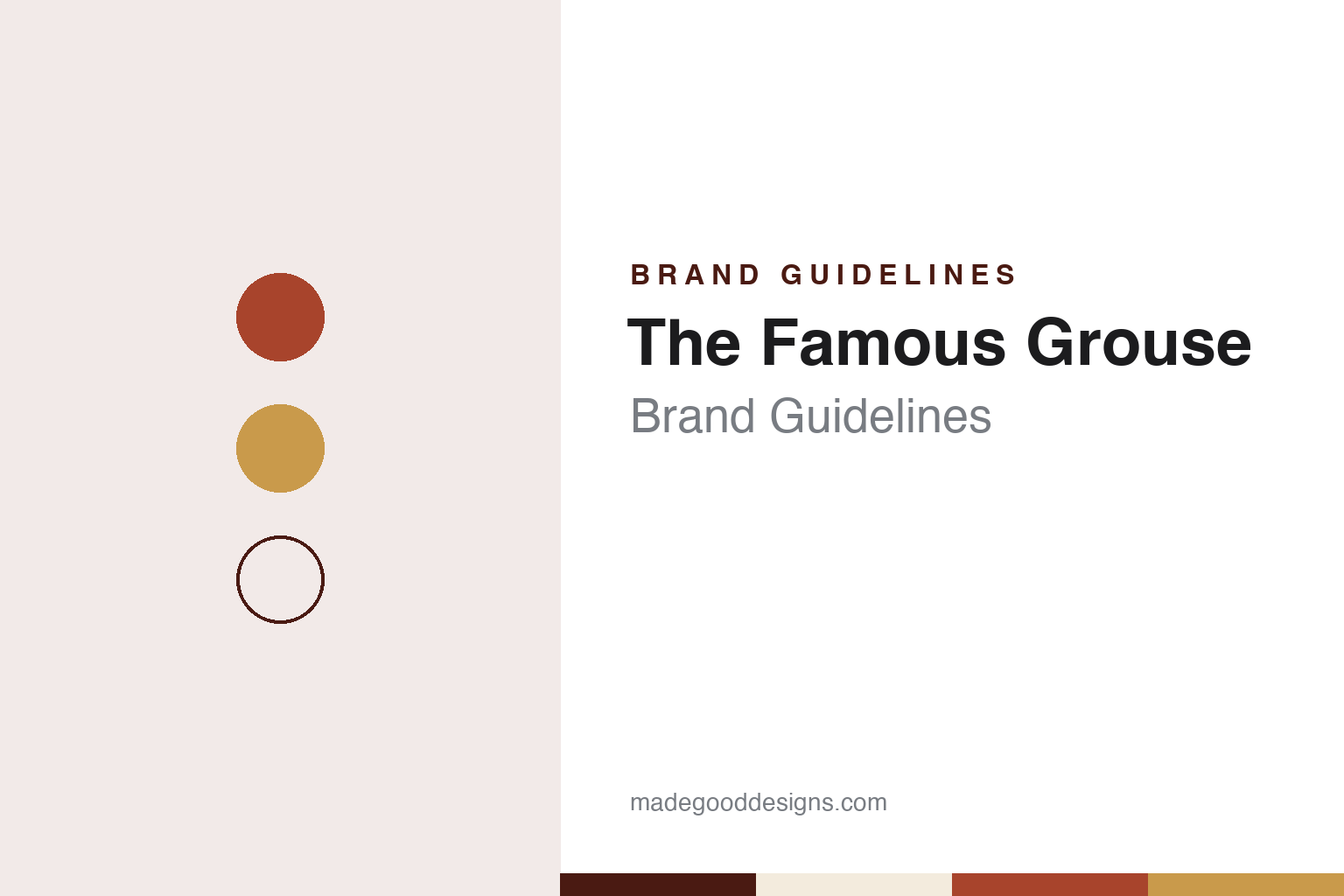
Two constants: a grouse russet, amber and label cream palette and a Victorian label serif register. Abstract homage — not a Famous Grouse product or mark; no bottle, label, bird or logo is reproduced.
A Perth wine merchant
A grocer’s shop on Atholl Street and a blend called The Grouse.
The Famous Grouse began with a family of merchants in Perth. English Wikipedia, citing a Perth Post Office directory of 1850, records Matthew Gloag as a grocer and wine merchant on Atholl Street, a business that at first dealt mainly in wines and ports from France, Spain and Portugal. His son William Gloag took the firm over in 1860, the same article says.
In 1896, according to the Dorling Kindersley reference Whisky Opus (2012), as cited by English Wikipedia, William’s nephew, also named Matthew Gloag, took over the family business and created a new blended whisky called The Grouse. Perth directories cited in the same article show the shop had by then spread into neighbouring premises on Atholl Street.
Two changes followed in 1905. The business became a limited company, Matthew Gloag & Son, and the blend was renamed The Famous Grouse, Whisky Opus says. The company later moved to new premises on Kinnoull Street in Perth, according to a directory of that year.
The brand stayed in the family until 1970, when Matthew Gloag & Son was sold to Highland Distillers, the whisky company founded in 1887. Under its new owner the blend grew quickly: Whisky Opus says it had become the best-selling whisky in Scotland by 1980 and the second best-selling in the United Kingdom, and that it was awarded a Royal Warrant in 1984.
Colour
A red grouse, a family hand and a stable of variants.
The brand’s emblem is the red grouse, which English Wikipedia calls Scotland’s national game bird. According to Whisky Opus, as cited by English Wikipedia, it was Matthew Gloag’s daughter Philippa who first designed the grouse for the label.
The grouse has since been adapted for the brand’s variants, English Wikipedia records. In 2007 a peated version developed for the Swedish market, The Black Grouse, was released with a black grouse on its pack in place of the usual red bird; in 2015, citing The Spirits Business, the article says it was rebranded The Famous Grouse Smoky Black. The Snow Grouse, a version meant to be served chilled, followed in 2008, according to the same article, citing the Moodie Davitt Report.
A premium blend, The Naked Grouse, arrived in 2011. It became a blended malt in 2017 and was renamed Naked Malt in 2021, and a Cask Series with Bourbon Cask and Ruby Cask expressions followed in 2018 and a Sherry Cask Finish in 2022, English Wikipedia says, citing The Spirits Business.
Behind the blend sits a blending team. When Edrington named Craig Johnstone master blender in August 2022, The Spirits Business said he would be based at the company’s “106 Sample Room” in Glasgow, where the blenders nose up to 600 samples a day; English Wikipedia, citing the brand’s own site, says the malts in the blend include Highland Park and The Glenrothes.
The brand has a long record in sports sponsorship. It sponsored the Perth football club St Johnstone in two spells between 1986 and 1998, English Wikipedia says, and it has backed Scottish Rugby since 1990. For the partnership’s 35th year, The Spirits Business reported in October 2025, it released a limited-edition bottle, “Time To Celebrate,” whose design took cues from the Scottish flag and showed a rugby ball on a tee. In February 2026 the same title covered “The Get Together,” a video series with the actor Martin Compston made around the Scotland–England Six Nations match.
Typography
Design and documentation.
The seven brands in this group are all whisky names from Ireland and Scotland: Bushmills, Tullamore D.E.W., Glenfiddich, The Glenlivet, The Macallan, Chivas Regal and The Famous Grouse. Irish and Scotch whisky brands in general sit at many different points in the trade, from names that still carry a founder’s or a place’s name to names that now belong to much larger drinks groups, and a single brand can be sold everywhere from a local bar to an airport shop.
A whisky brand’s identity is usually carried less by a single bottle than by a label, a name and the place it promises, because the company behind the name may have changed hands, moved its production or grown far beyond the place where it started. That makes the questions behind each name worth asking plainly: who started it, who owns it now, and where its whisky is actually made and bottled.
Each guide separates what independent sources record from what the company says about itself — its founding story, its owners over time, where its whisky is made and how its packaging has changed — and marks plainly what rests only on the company’s own word.
Aa
A Victorian label serif for a blend first named in a Perth wine merchant’s shop in 1896. (Specimen set in Playfair Display, a serif STAND-IN; NOT The Famous Grouse logo.)
The Famous Grouse
From Highland Distillers and Edrington to William Grant.
Ownership above the brand changed again in 1999, when Edrington acquired Highland Distillers through a partnership in which William Grant & Sons took a minority interest, the vehicle being The 1887 Company, English Wikipedia says. The UK Competition and Markets Authority later described The 1887 Company as a joint venture owned 70 per cent by Edrington and 30 per cent by William Grant & Sons.
On 23 September 2024, The Spirits Business reported, Edrington agreed to sell The Famous Grouse and Naked Malt to William Grant & Sons for an undisclosed sum, saying it wanted to leave the blended Scotch category and concentrate on its ultra-premium brands. The CMA opened a merger inquiry on 29 January 2025 and cleared the deal on 6 March 2025. Its published decision says the brands were bought from Highland Distillers Limited, and that William Grant & Sons expected to use its own distilleries and bottling facilities to produce the whisky. The Spirits Business reported on 2 July 2025 that the purchase had been completed.
The Famous Grouse now sits beside Glenfiddich, The Balvenie and Monkey Shoulder in the William Grant portfolio. The new owner calls it Scotland’s best-selling whisky, and its chief executive, Søren Hagh, said at completion that the company would work to “evolve the brand into a true global icon.” The lettering on the label is looked at separately in our guide What Font Does The Famous Grouse Use?
For a design guide, The Famous Grouse shows how a single drawn bird, first set on a Perth merchant’s label, can carry a brand through a renaming, three owners and a run of variants, one of which swapped the red bird for a black one. Compare Glenfiddich, the single malt of its new owner, and The Macallan, the flagship of Edrington, its owner until 2025. For this guide we use a grouse russet, an amber tone and a label cream with a serif, an unofficial interpretation; no product or logo is reproduced.
Explore & save
Keep The Famous Grouse’s identity on hand — save it to a board in the Made Good inspiration library.
The Famous Grouse identity set
Pin The Famous Grouse russet, amber and label cream palette and the Victorian label serif register to your own board.