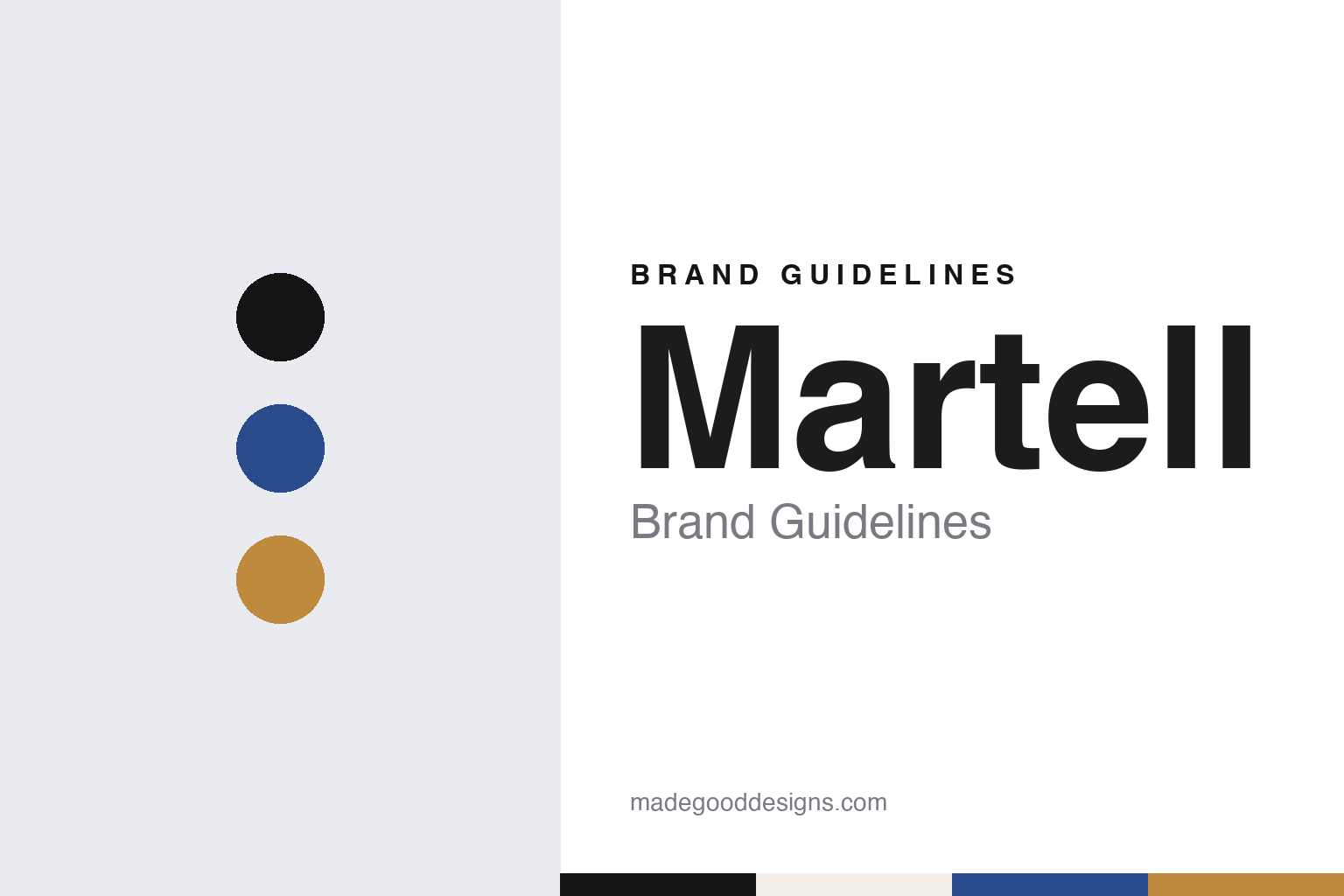
Martell Brand Guidelines
The 1715 Cognac house of the swift.
Aa
Two constants: a cellar black, Cordon blue and cognac amber palette and a high-contrast heraldic serif register. Abstract homage — not a Martell product or mark; no bottle, label or logo is reproduced.
The swift of Jersey
A Channel Island merchant, a coat of arms and a river trade.
Martell is the oldest of the “big four” cognac houses, the British weekly The Week reported in 2017, alongside Hennessy, Rémy Martin and Courvoisier. Its founder, Jean Martell, was born on the Channel Island of Jersey in 1694, according to Difford’s Guide and English Wikipedia, into a merchant family on an island then known for smuggling. In 1715 he set up a brandy-trading business in Cognac, on the banks of the Charente. Difford’s Guide says he began by buying casks of cognac and wine from the Borderies to ship to buyers in the Channel Islands, the Netherlands, Germany and Scandinavia; a French heritage-inventory file cited by French Wikipedia says the house was exporting to Hamburg, Liverpool and London from 1720.
The house’s emblem goes back to that start. Difford’s Guide says Jean Martell took his family’s coat of arms as its logo in 1715: a swift with three hammers, under a crest bearing the bird’s outline. With few changes, it says, the device has since appeared on everything from letterheads and bottle labels to shipping cases, and English Wikipedia says variations of the swift and the coat of arms have been in use ever since. Difford’s reads both elements as plays on the family name: the hammers on the French word for a hammer, and the swift because its French name, “martinet,” is close to Martell.
The firm soon put down roots in the town. Difford’s Guide dates Jean Martell’s purchase of the land and buildings at Gâtebourse to 1728; the heritage file cited by French Wikipedia gives 1750 for the clos de Gâtebourse. The founder’s house there is now a museum surrounded by the firm’s ageing cellars, Difford’s says. From 1753 the business was run by his widow, Rachel Lallemand, and from 1775 by his sons Jean and Frédéric, French Wikipedia says. As J&F Martell it had become the leading cognac house in England by 1814, and in 1820 it took the name Martell & Cie.
Colour
VSOP, Cordon Bleu and a medallion label.
Martell built its range on English-language grades. It created its first VSOP, “very superior old pale,” in 1831, The Week reported, and such English names reflected aged cognac’s status as an export product. Difford’s Guide says the house began exporting its cognac in bottles rather than barrels in 1848 and was shipping to China and Hong Kong by 1868. The VSOP Médaillon label carries a gold medallion engraved with a portrait of Louis XIV, according to Difford’s, which dates the line to 1874. The long rivalry with Hennessy was also an alliance: marriages between the two families in 1795 and 1865 tied the houses together, the historian L. M. Cullen writes, and the Oxford Companion to Spirits and Cocktails says they took some decisions jointly, such as introducing the star grading system at the same time.
The house’s best-known cognac came in 1912. Cordon Bleu, created by Édouard Martell, was launched at the Hôtel de Paris in Monaco and was the first Martell cognac made after the phylloxera crisis, according to English and French Wikipedia and Difford’s Guide. The company says it was served at the coronation of George V, on the maiden voyage of the liner Queen Mary and aboard Concorde. Its centenary was celebrated at the same Monaco hotel in 2012, French Wikipedia says.
Martell draws on four crus of the Cognac region: the Borderies, Grande Champagne, Petite Champagne and Fins Bois. The Borderies is the smallest of the Cognac crus, French Wikipedia says. In 1953 the house bought the Gallienne estate at Javrezac, in the Borderies, to build a new distillery, French Wikipedia says, citing the national heritage inventory; a first distillery opened there in 1963, a second in 1973 and a third, with automated stills, in 1993. Its reception house, the Château de Chanteloup near Cognac, was bought by Théodore Martell in 1838; Maurice Firino-Martell inherited it in 1920 and had it rebuilt by the Cognac architect Jean Chalard.
Typography
Design and documentation.
The seven brands in this group are all cognac and champagne names: Rémy Martin, Martell, Courvoisier, Moët & Chandon, Veuve Clicquot, Dom Pérignon and Bollinger. Cognac and champagne brands in general sit at many different points in the trade, from family houses that still carry a founder’s name to names that now belong to much larger drinks groups, and a single brand can be sold everywhere from a wine merchant to an airport shop.
A cognac or champagne brand’s identity is usually carried less by a single bottle than by a label, a name and the place it comes from, because the company behind the name may have changed hands, bought vineyards or grown far beyond the town where it started. That makes the questions behind each name worth asking plainly: who started it, who owns it now, and where its wines and spirits are actually made.
Each guide separates what independent sources record from what the company says about itself — its founding story, its owners over time, where its wines and spirits are made and how its bottles and labels have changed — and marks plainly what rests only on the company’s own word.
Aa
A high-contrast heraldic serif for a house whose emblem is a coat of arms. (Specimen set in Playfair Display, a serif STAND-IN; NOT the Martell logo.)
Martell
From the Firino-Martells to Pernod Ricard.
Martell stayed with the founding family and its descendants, the Firino-Martells, for more than 250 years. Family members who ran the business included Paul Firino-Martell, a mayor of Cognac, and Maurice Firino-Martell, a co-manager, French Wikipedia says. In the late 1980s the company became the object of a takeover contest. The New York Times reported Seagram’s offer for Martell in December 1987; Difford’s Guide says the Canadian group had bought a 40% stake from the family and took full control in 1988 after a contest with Grand Metropolitan. Le Monde wrote in 1995 that it was René Firino-Martell, president from 1977, who sold the family-controlled company to Seagram.
When Seagram was broken up in 2001, Martell went to the French group Pernod Ricard, the Wall Street Journal reported. It now sits in Pernod Ricard’s Martell Mumm Perrier-Jouët subsidiary and remains based in Cognac. Pernod repositioned the brand with new lines, English Wikipedia says: an XO in 2005 and Création Grand Extra in 2007, in a bottle designed by the artist and glass designer Serge Mansau, which Difford’s Guide describes as triple-arched. Martell joined the Comité Colbert, the association of French luxury houses, in 2006. It sponsored the Grand National horse race from 1992 to 2004, English Wikipedia says, citing the travel-retail title The Moodie Davitt Report, and since 2007 it has supported the Palace of Versailles, funding the restoration of the Queen’s antechamber in 2010, the palace said. For the house’s 300th anniversary, on 20 May 2015, it gathered guests at Versailles for a flypast by the Patrouille de France, Sud Ouest reported.
For a design guide, Martell shows how a heraldic swift chosen in 1715 can still sign a cognac house three centuries later. For its typography see our guide to what font Martell uses. Compare Rémy Martin, the Fine Champagne house founded nine years later, and Courvoisier, another of the big four. For this guide we use a cellar black, a Cordon blue and a cognac amber with a high-contrast serif, an unofficial interpretation; no product or logo is reproduced.
Explore & save
Keep Martell’s identity on hand — save it to a board in the Made Good inspiration library.
Martell identity set
Pin the Martell cellar black, Cordon blue and cognac amber palette and the high-contrast heraldic serif register to your own board.