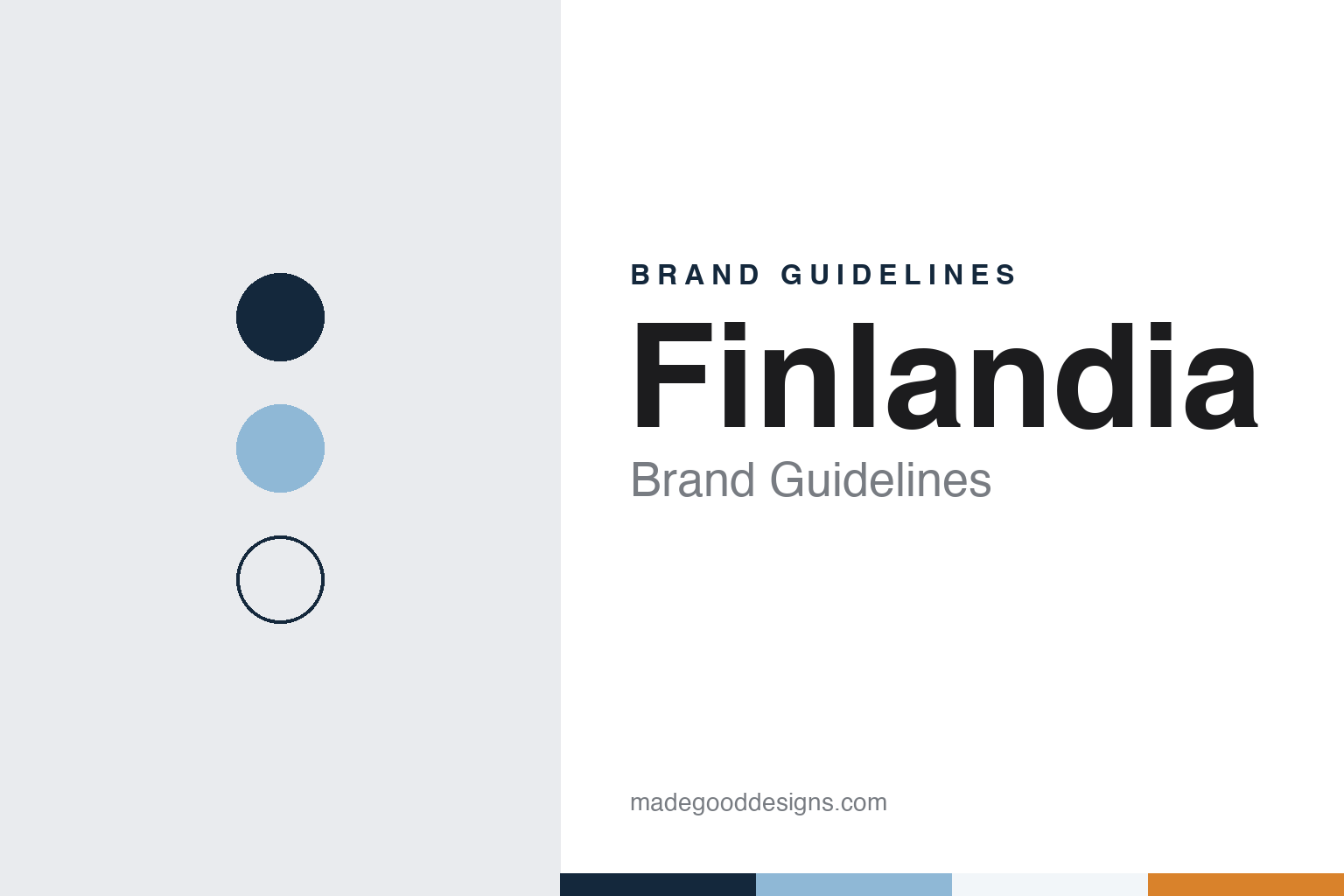
Finlandia Brand Guidelines
The barley vodka from Finland that kept changing its ice.
Aa
Two constants: a Finlandia navy, glacier blue and frost white palette and a Nordic geometric sans register. Abstract homage — not a Finlandia product or mark; no bottle, label or logo is reproduced.
A state brand
A Prohibition-era distillery and a 1970 launch.
Finlandia is a younger name than the place that makes it. The bottling plant at Rajamäki, in the municipality of Nurmijärvi about 45 kilometres north of Helsinki, began as a distillery founded in 1888 by Dr. Wilhelm Juslin beside a spring, according to English Wikipedia, which cites Altia’s 2007 annual report. In 1920, after Finland passed its Prohibition Act, the state bought the distillery to secure alcohol for pharmacies and other non-beverage uses, and when Prohibition ended in 1932 the state took exclusive control of spirits production, Difford’s Guide says.
The brand itself came much later. In 1970 Alko, Finland’s state-owned alcohol company, established the Finlandia vodka name, English Wikipedia says, citing Altia’s 2006 annual report, and Finnish Wikipedia also dates the first Finlandia to 1970. A new plant was built at Rajamäki in 1975.
The vodka is made from barley. English Wikipedia describes the process: the grain is distilled into a neutral spirit at Koskenkorva, in Ilmajoki in western Finland, then carried roughly 315 kilometres south to Rajamäki, where it is diluted with water from the local spring and bottled. The company presents that spring water as glacial, filtered through sand and moraine left by the Ice Age, and has built much of its advertising on the idea. The core vodka is bottled at 40 percent alcohol; flavoured versions followed from 1994, when a cranberry vodka was introduced, and a lime version came in 1999. Later additions listed by English Wikipedia include mango and red berry in 2004 and a stronger Finlandia 101, bottled at 50.5 percent, in 2011, alongside a limited Platinum edition the same year.
Colour
Brown-Forman, then a Coca-Cola bottler.
Finlandia was sold in stages. In June 2000 the Kentucky drinks company Brown-Forman bought 45 percent of Finlandia Vodka Worldwide, The New York Times reported, with the state-owned Altia — the successor to Alko’s production business — keeping the rest. Brown-Forman added a further 35 percent in 2002, Finnish Wikipedia says, and in November 2004 The New York Times reported that it would take the remaining 20 percent and own the brand outright. In 2016 Bloomberg reported that Brown-Forman was considering a sale; the brand stayed with it for several more years.
In June 2023 the Swiss-based bottler Coca-Cola HBC agreed to buy Brown-Forman Finland Oy, the company that owns Finlandia, Helsingin Sanomat reported, and the sale was completed on 1 November 2023, according to The Spirits Business. The trade paper noted that Coca-Cola HBC had distributed Finlandia for more than 17 years, and that the vodka joined a small spirits portfolio that already included Rézangyal pálinka and Zlatni Pelin bitter liqueur.
Ownership has changed; the makers have not. Altia and Brown-Forman extended their production agreement in August 2020 to run until 2035, Altia announced: it covers grain spirit made at Altia’s Koskenkorva distillery and the manufacture, packing and logistics of Finlandia products at the Rajamäki plant. Altia merged with the Norwegian company Arcus in 2021 to form Anora Group, which still distils and bottles Finlandia under that agreement, The Spirits Business reported in 2023.
Typography
Design and documentation.
The seven brands in this group are all vodka names: Belvedere, Ketel One, Stolichnaya, Russian Standard, Finlandia, Tito’s and Żubrówka. Vodka brands in general sit at many different points in the trade, from family firms that still carry a founder’s name to names that now belong to much larger drinks groups, and a single brand can be sold everywhere from a corner shop to a duty-free shelf.
A vodka brand’s identity is usually carried less by the spirit itself than by a bottle, a label and the place it names, because the company behind the name may have changed hands, moved its distilling or grown far beyond the town where it started. That makes the questions behind each name worth asking plainly: who started it, who owns it now, and where its vodka is actually distilled and bottled.
Each guide separates what independent sources record from what the company says about itself — its founding story, its owners over time, where its vodka is made and how its bottles and labels have changed — and marks plainly what rests only on the company’s own word.
Aa
A clean Nordic sans for a brand sold on ice and clarity. (Specimen set in Jost, a geometric sans STAND-IN; NOT the Finlandia logo or label lettering.)
Finlandia
Five bottles, all named after ice.
The bottle is the best-documented part of Finlandia’s design. The first, “Frozen Ice” of 1970, was designed by Tapio Wirkkala, the Finnish glass and industrial designer; its textured glass was meant to look like the surface of an icicle, and its label showed two white reindeer sparring against a low midnight sun, according to English Wikipedia, citing the architect Juhani Pallasmaa’s profile of Wirkkala for the Finland Promotion Board. In 1998 Hansen Design of Philadelphia introduced “Hammered Ice,” which dropped the paper label for lacquered lettering on the glass, Beverage World reported at the time.
In 2003 came “Glacial Ice,” designed by the Finnish designer Harri Koskinen with the New York graphic designers Wallace Church & Co. and Finlandia’s own packaging team. Koskinen worked on its successor too: “Melting Ice,” launched in 2011, was sculpted by the New York industrial designer Kenneth Hirst, the trade magazine Barlife reported. A fifth bottle, “Flowing Ice,” followed in 2018, and the reindeer were still on it, the Finnish newspaper Iltalehti reported. In 2009, after the Karhula glassworks closed, production of the bottles moved to Estonia, Uusi Suomi reported.
The advertising has stayed close to the same themes of cold and clarity. English Wikipedia lists a 1976 line pitching “a vodka for vodka lovers”; “Vodka From the Top of the World” in 1990, revived in 2006; the “Past Lives” campaign of 1998, in which the vodka recalled its life as spring water; a tie-in with the 2002 James Bond film Die Another Day; “Vodka from a Purer Place” in 2005, which The New York Times covered; and “To the life less ordinary,” a 2013 global campaign by Wieden+Kennedy London.
For a design guide, Finlandia shows how a bottle shape can carry a brand through changes of owner: a state product, then an American one, then a bottler’s, with the same ice idea redrawn every decade or so. Compare Fazer, another Finnish name with a well-documented identity, and Belvedere, a vodka that also builds its pack around a place. For this guide we use navy, glacier blue, frost white and a touch of amber with a sans, an unofficial interpretation; no product or logo is reproduced.
Explore & save
Keep Finlandia’s identity on hand — save it to a board in the Made Good inspiration library.
Finlandia identity set
Pin the Finlandia navy, glacier blue and frost white palette and the Nordic geometric sans register to your own board.