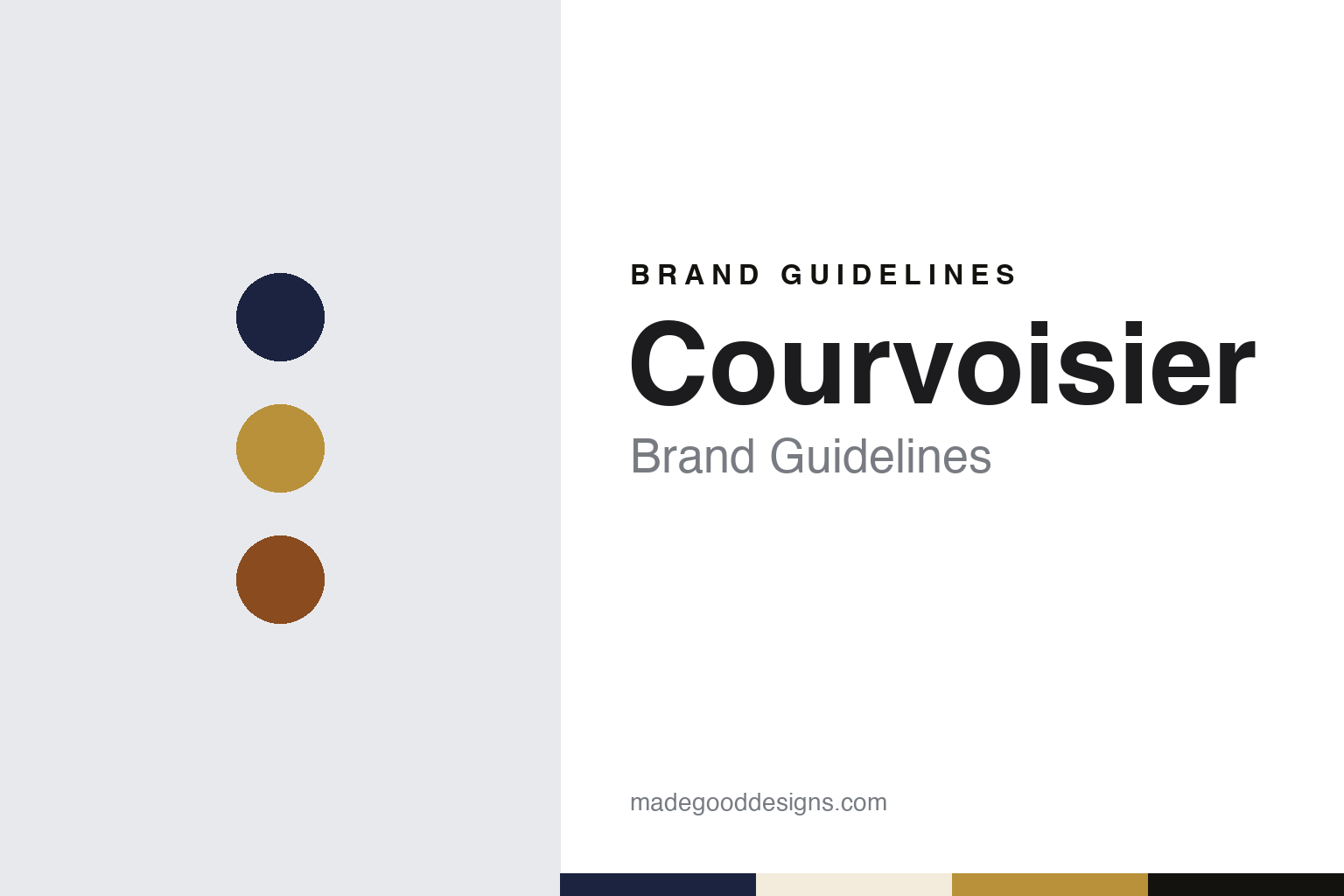
Courvoisier Brand Guidelines
The Jarnac cognac house of the Napoleon silhouette and the Joséphine bottle.
Aa
Two constants: a navy, gold and cask-amber palette and an imperial serif register. Abstract homage — not a Courvoisier product or mark; no bottle, label, silhouette or logo is reproduced.
From Bercy to Jarnac
A Paris wine trade, then a move to the Charente.
Courvoisier traces its story to Bercy, then a wine-trading suburb just outside Paris. The company says that in 1809 Emmanuel Courvoisier and Louis Gallois, the mayor of Bercy, opened a wine and spirit business there, a date French Wikipedia also gives. The house says that in 1811 Napoleon Bonaparte visited the Bercy warehouses, and it tells a legend that in 1815 the exiled emperor took casks of cognac with him to St Helena, where English officers called it the brandy of Napoleon. Those stories became the foundation of its brand.
The next generation moved the business to the cognac country. The company says Félix Courvoisier and Jules Gallois, the sons of the two founders, moved their headquarters to Jarnac, on the Charente, in 1828; English Wikipedia gives the founding year as 1835, and French Wikipedia says the two men set up the first Courvoisier company in Jarnac that year. The house has stayed in Jarnac since, operating from a château on the banks of the Charente that now holds a museum, which the company says opened in 1985.
In 1866 management passed to Félix’s nephews, the Curlier brothers. In 1869, according to the company and both Wikipedias, Napoleon III named Courvoisier an official supplier to the imperial court, a certificate the house still displays in Jarnac.
Colour
An English family, a silhouette and a bottle.
The identity most people recognise was built in the twentieth century. In 1909 the house passed to the Simon family from England: the company says Alfred Simon, its agent in Britain, bought it, and that George Simon moved to Jarnac in 1912 and became managing director in 1923. French Wikipedia credits the Simons with building the brand’s whole identity, creating the Napoleon quality, above VSOP, and adopting the shadow of Napoleon as a logo. The company says it launched its Napoleon cognac in 1910 and that the Napoleon silhouette has appeared on its bottles since; it also says it created a satin-like bottle of opaque glass that other houses later copied.
The best-known pack is the Joséphine bottle, named after Napoleon’s first wife. The company and English Wikipedia date it to 1951; French Wikipedia gives 1950. Its shape, a thin neck over a wide base, has prompted two explanations that the company itself repeats: that it echoes the corseted dresses of Joséphine’s day, or that it is an upside-down brandy glass.
Courvoisier has often turned to artists for special bottles. In 1988 the Art Deco designer Erté created a limited series of seven bottle designs, filled with Grande Champagne cognac from 1892, the year of his birth, English Wikipedia says, citing the company. In 2005 the house released an XO bottle dressed by Vivienne Westwood, limited to 150 bottles and sold through Harvey Nichols. Its advertising has claimed firsts too: the company says it was the first cognac advertised on British television, in 1960, and in 2009 it aired what Talking Retail reported as the first spirits advert in 3D on UK terrestrial television, also shown in cinemas before Avatar. In 2009 it worked with the food designers Bompas & Parr on an “Architectural Punchbowl,” Wired reported.
The company says it received the “Prestige de la France” award in 1983, presented by Jacques Chirac, then mayor of Paris, and that it remains the only cognac house to hold it; a later Beam Suntory page, cited by English Wikipedia, dates the award to 1984. In the 1950s the house also tried a lighter, fruitier cognac for mixing, called Gala, the company says.
Typography
Design and documentation.
The seven brands in this group are all cognac and champagne names: Rémy Martin, Martell, Courvoisier, Moët & Chandon, Veuve Clicquot, Dom Pérignon and Bollinger. Cognac and champagne brands in general sit at many different points in the trade, from family houses that still carry a founder’s name to names that now belong to much larger drinks groups, and a single brand can be sold everywhere from a wine merchant to an airport shop.
A cognac or champagne brand’s identity is usually carried less by a single bottle than by a label, a name and the place it comes from, because the company behind the name may have changed hands, bought vineyards or grown far beyond the town where it started. That makes the questions behind each name worth asking plainly: who started it, who owns it now, and where its wines and spirits are actually made.
Each guide separates what independent sources record from what the company says about itself — its founding story, its owners over time, where its wines and spirits are made and how its bottles and labels have changed — and marks plainly what rests only on the company’s own word.
Aa
A high-contrast imperial serif for a house built on Napoleonic legend. (Specimen set in Cormorant Garamond, a serif STAND-IN; NOT the Courvoisier logo.)
Courvoisier
Four corporate owners, one town.
Courvoisier is the youngest and smallest of the “big four” cognac houses, alongside Hennessy, Rémy Martin and Martell, according to The Oxford Companion to Spirits and Cocktails (2021). The wine writer Nicholas Faith, in his history of cognac, called it the most untypical of the four: it controls each stage of production but does no distilling of its own and has never owned vines, buying in eaux-de-vie instead. English Wikipedia names the crus it draws on as Grande Champagne, Petite Champagne, Borderies and Fins Bois, aged in oak from the Tronçais forest. Its range runs from VS and VSOP through Napoleon to XO and older blends.
Ownership has changed several times. French Wikipedia lists Hiram Walker and then Allied Domecq, which held the brand until 2005; it then passed to Beam Global Spirits & Wine, part of Fortune Brands until that group’s break-up in 2011, and on to Beam Suntory. In December 2023 Campari Group agreed to buy it, the Financial Times and Reuters reported, and on 1 May 2024 Campari announced it had completed the purchase of the French holding company that owns Courvoisier SAS, Wine Intelligence reported. Production and headquarters remain in Jarnac. The name also reached popular culture: Busta Rhymes’s song “Pass the Courvoisier” named it ahead of its rivals, Le Monde noted in 2011.
For a design guide, Courvoisier shows how a borrowed legend, a silhouette and one distinctive bottle shape can carry a brand through a century of changing owners. Compare Rémy Martin and Martell, two other big cognac houses, and see the typeface behind the Courvoisier logo. For this guide we use navy, gold and cask amber with a serif, an unofficial interpretation; no product or logo is reproduced.
Explore & save
Keep Courvoisier’s identity on hand — save it to a board in the Made Good inspiration library.
Courvoisier identity set
Pin the Courvoisier navy, gold and cask-amber palette and the imperial serif register to your own board.