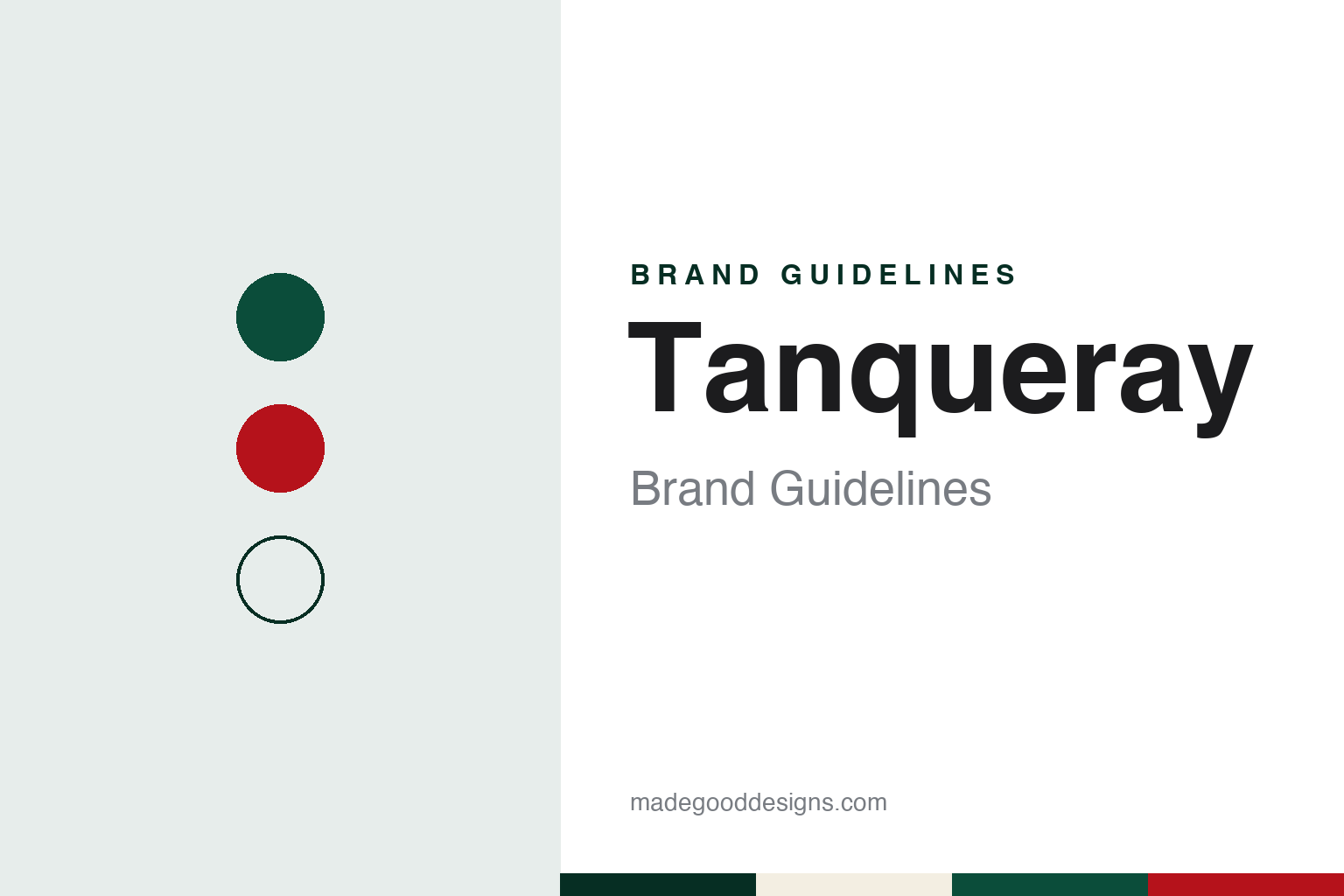
Tanqueray Brand Guidelines
The 1830 Bloomsbury gin in the cocktail-shaker bottle.
Aa
Two constants: a bottle green, seal red and ivory palette and a high-contrast serif register. Abstract homage — not a Tanqueray product or mark; no bottle, label or logo is reproduced.
A Bloomsbury distiller
One founder, four botanicals and a merger with the neighbours.
Tanqueray is a London dry gin, and its owner dates it to 1830. Diageo’s brand page says Charles Tanqueray founded his distillery that year in Bloomsbury, London; Diageo’s bar-trade site, thebar.com, places that first distillery on Vine Street. English Wikipedia, citing Olivia Williams’s 2014 history Gin Glorious Gin and Dave Broom’s Gin: The Manual (2015), gives the same year and district. Diageo tells the founding as a story of patience: it says Charles worked through more than 300 versions of his recipe before settling on the one the brand still sells, built on four botanicals — juniper, coriander, angelica root and liquorice.
The business stayed in the family for most of the nineteenth century. English Wikipedia, again citing Williams, says that in 1868 the distillery passed to his son, Charles Waugh Tanqueray. Thirty years later the firm joined forces with a larger London neighbour. According to the Gordon’s company timeline, as archived in 2015, in 1898 Charles Tanqueray & Co. amalgamated with Gordon & Co. to form Tanqueray Gordon & Co., and all production moved to Gordon’s site on Goswell Road in Clerkenwell. From then on the two gins shared a company and, in time, a long series of owners.
That ownership chain is well documented. The same timeline says Tanqueray Gordon & Co. joined The Distillers Company in 1922. Distillers, an Edinburgh-based whisky group, was taken over by Guinness in 1986 and renamed United Distillers in 1987, English Wikipedia records. Guinness then merged with Grand Metropolitan to form Diageo, whose shares began trading in London on 17 December 1997. Diageo has owned Tanqueray ever since, and the founder’s name lives on in its paperwork: the brand’s 2011 website named Charles Tanqueray & Co. of Norwalk, Connecticut, as its US importer.
Colour
A shaker-shaped bottle, a red seal and a martini gin.
Tanqueray is no longer made in London. Diageo says the gin is now distilled in Scotland, and its bar site names the plant as the Cameronbridge Distillery in Fife. English Wikipedia’s article on Cameronbridge records that in 1998 United Distillers moved its neutral grain spirit operation there from Wandsworth in London, and lists Tanqueray and Gordon’s among the white spirits produced on the site. Diageo says the gin is now enjoyed in more than 180 countries.
The bottle is the brand’s most recognisable design asset. Diageo’s UK bar site, as archived in 2020, said Tanqueray London Dry was recognised worldwide by its “iconic green cocktail shaker-inspired bottle and red wax seal”. The same page said only four people know how the four botanicals are balanced, and described the gin as the number-one imported gin in the United States.
The range has grown around that bottle. Tanqueray No. TEN arrived in 2000, aimed at the martini drinker, and English Wikipedia says it is distilled with whole grapefruit, orange and lime and chamomile flowers. Diageo says it is made in a small copper pot still from the 1950s known as “Tiny Ten”, and calls it master distiller Tom Nichol’s crowning achievement. English Wikipedia also lists Tanqueray Sterling vodka from 1989 (citing USA Today); Tanqueray Rangpur, flavoured with Rangpur limes, ginger and bay leaves, first sold in Maryland, Delaware and Washington, D.C., in summer 2006 (citing the San Francisco Chronicle); and Tanqueray Malacca, launched in 1997, dropped in 2001 and revived as a limited edition in 2013. An alcohol-free Tanqueray 0.0% followed in 2021, Good Housekeeping reported.
Sales have kept pace with the range. The Spirits Business reported in July 2017 that Tanqueray’s volumes rose by more than 15% in 2016 to about 3 million cases, overtaking Pernod Ricard’s Beefeater for the first time. The trade title said the United States was the brand’s biggest market, at just over one million cases, and pointed to growth in Europe, Latin America and the Caribbean.
Typography
Design and documentation.
The seven brands in this group are all gin brands: Tanqueray, Gordon’s, Beefeater, Hendrick’s, Plymouth, Sipsmith and Monkey 47. Gin brands in general sit at many different points in the trade, from small distilleries that still carry a founder’s name to names that now belong to much larger drinks groups, and a single brand can be sold everywhere from a neighbourhood bar to a supermarket shelf.
A gin brand’s identity is usually carried less by a single product than by a bottle, a label and a name, because the company behind the name may have changed hands, moved its production or grown far beyond the place where it started. That makes the questions behind each name worth asking plainly: who started it, who owns it now, and where its gin is actually distilled and bottled.
Each guide separates what independent sources record from what the company says about itself — its founding story, its owners over time, where its gin is made and how its bottles and labels have changed — and marks plainly what rests only on the company’s own word.
Aa
A high-contrast serif for a gin with a founder’s name on the bottle. (Specimen set in Playfair Display, a serif STAND-IN; NOT the Tanqueray logo.)
Tanqueray
From Mr. Jenkins to Sarah Jessica Parker.
Tanqueray’s advertising has often been built around characters. English Wikipedia, citing Slate (2005), says the brand introduced “Mr. Jenkins”, a white-haired, well-dressed spokes-character, in print advertising in 1994. In 2004 it launched television spots starring Tony Sinclair, a dandyish socialite played by Rodney Mason, whose sign-off line was “Ready to Tanqueray?”. The gin also turned up on screen in its own right: in a 2008 episode of Mad Men, “The Jet Set”, a crate of Tanqueray is sent to the character Duck Phillips by his former British colleagues.
The current chapter is fronted by a film star. In January 2026 The Spirits Business reported that Sarah Jessica Parker had signed on as Tanqueray’s global ambassador, fronting a campaign titled “There’s an N and an O in every icon”, with a film directed by Paul McLean. Patricia Borges, Diageo’s global gins and rums director, said the partnership celebrated “the no’s over the yes’s”, and the brand said Parker was the first in a new series of cultural voices, with events planned in the US, Italy, the UK, China, India and Brazil. Master distiller Terry Fraser told the title that Tanqueray London Dry Gin has been made with the same four botanicals since 1830.
For a design guide, Tanqueray shows how a single object — a green, shaker-shaped bottle with a red seal and a founder’s name — can carry a brand through almost two centuries while the advertising around it changes completely. For the lettering, see our separate note on the Tanqueray font. Compare it with its long-time stablemate Gordon’s, which shares its owner and its Scottish distillery, and with its London rival Beefeater. For this guide we use bottle green, seal red and ivory with a high-contrast serif, an unofficial interpretation; no product or logo is reproduced.
Explore & save
Keep Tanqueray’s identity on hand — save it to a board in the Made Good inspiration library.
Tanqueray identity set
Pin the Tanqueray bottle green, seal red and ivory palette and the high-contrast serif register to your own board.