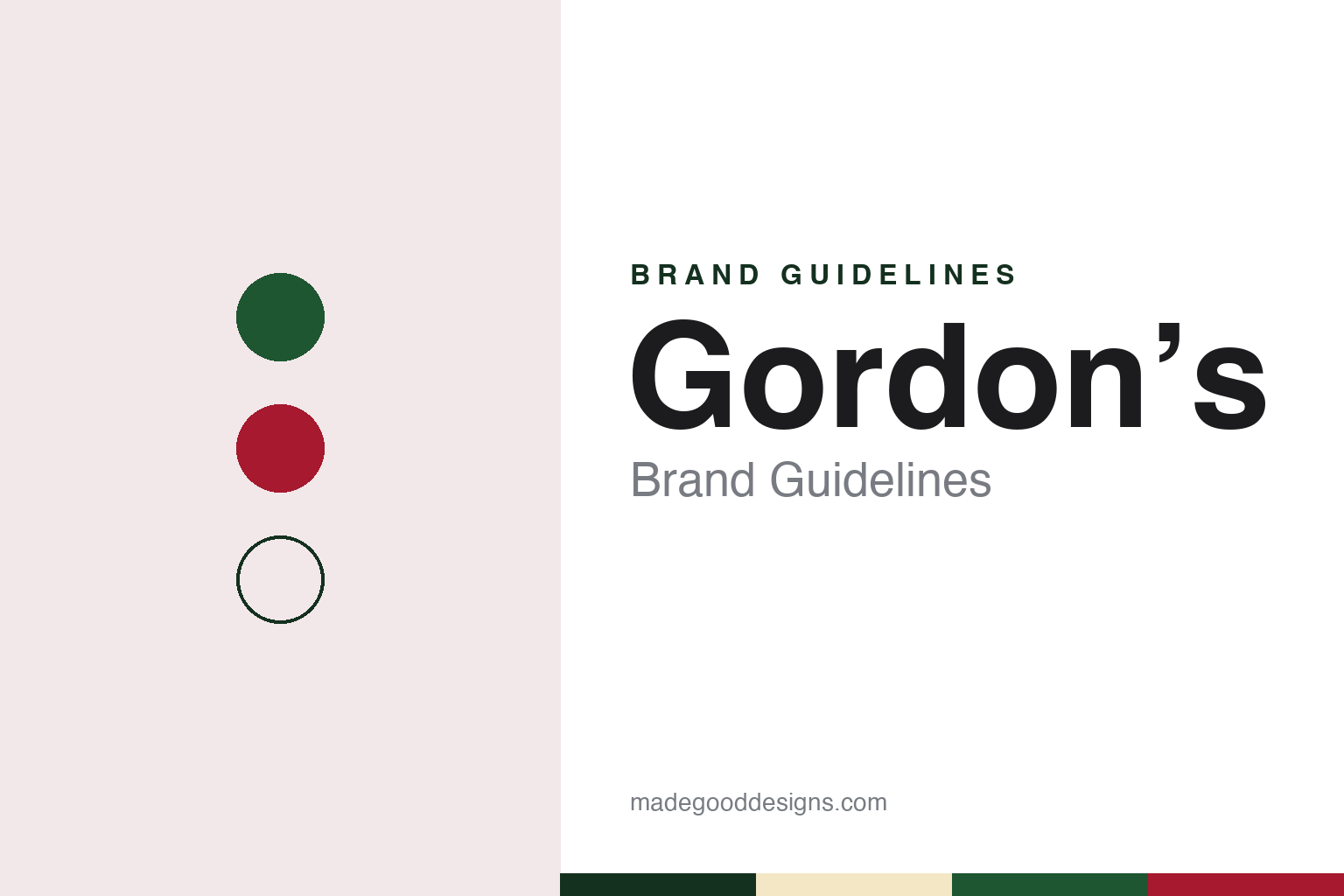
Gordon’s Brand Guidelines
The 1769 London dry gin with the boar’s head.
Aa
Two constants: a bottle green, boar red and label cream palette and an engraved capital serif register. Abstract homage — not a Gordon’s product or mark; no bottle, label or logo is reproduced.
A Southwark distiller
Southwark, Clerkenwell and a secret recipe.
Gordon’s is one of the oldest gin names still on sale, and its owner dates it to 1769. According to the brand’s own timeline, as archived in 2015, Alexander Gordon, a Londoner of Scottish descent, opened a distillery that year in Southwark and set about refining the recipe for what became Gordon’s London Dry Gin. In 1786, the timeline says, he moved operations north to Clerkenwell, a district the company describes as long favoured for the purity and abundance of its water. Diageo’s brand page today says Gordon set out to make a gin that would set the benchmark for the category, built on juniper, coriander, angelica and liquorice and refined through triple distillation; the brand’s 2011 website added orris root and orange and lemon peel to the list, and said the exact blend has remained a closely guarded secret.
The company tells an expansive early story. Its timeline says that by about 1800 sailors of the British Navy and merchant fleet were carrying the gin to all corners of the world, and that ledgers record a Melbourne customer paying for consignments in gold dust in 1853. Before glass bottles, the brand’s facts page says, Gordon’s travelled in ceramic crocks, a practice it says lasted until the start of the twentieth century.
The Gordon family’s role ended at the turn of that century. In 1898, the timeline says, Gordon & Co. amalgamated with Charles Tanqueray & Co. to form Tanqueray Gordon & Co., and all production moved to Gordon’s site on Goswell Road; the company says that after 1899 the family connection survived in name only. Ownership then followed a well-documented line. Tanqueray Gordon & Co. joined The Distillers Company in 1922; Distillers was taken over by Guinness in 1986, English Wikipedia records; and Guinness merged with Grand Metropolitan in 1997 to form Diageo, which owns Gordon’s today.
Colour
A green bottle, a boar’s head and the heart of a good cocktail.
Gordon’s best-known design elements are a colour and an animal. The company’s timeline dates its distinctive square-faced green bottle for the home market to 1904; its facts page says green and clear glass were both in use from 1903 — green for Britain, clear for export — and that the green began as a manufacturing constraint before becoming the brand’s signature in the UK. English Wikipedia, citing the brand’s site, says the split persists: Gordon’s is sold in green glass in the UK and in clear glass in export markets. On the cap is a boar’s head. Legend has it, the company says, that a member of the Gordon clan saved the King of Scotland from a wild boar while hunting, and that Alexander Gordon’s ancestors carried a boar’s head on their coat of arms ever since.
The label’s long-running line was “The Heart of a Good Cocktail”, used from the 1940s according to English Wikipedia, which cites a 1999 article in The Independent and an auction listing for a 1960s bottle. The cocktail link was literal. From 1924, the company says, Gordon’s sold a “Ready-to-Serve” range of pre-mixed cocktails, each in its own shaker bottle — among them the Martini, the Piccadilly, the Manhattan and the Bronx — and the last shaker cocktails were bottled in 1990. Alfred Hitchcock’s 1929 film Blackmail shows Gordon’s neon signs using the cocktail slogan, and Ian Fleming named Gordon’s in James Bond’s Vesper recipe in Casino Royale (1953).
Royal Warrants followed: the first from King George V in 1925, the company says, then from George VI in 1941 and Elizabeth II in 1955. The same timeline records that Goswell Road was bombed on the night of 11 May 1941, destroying the offices, warehouses and distillery; rebuilding was completed in 1957, and the company says one of the original stills, known as “Old Tom”, survived.
Production has moved many times. The company opened its first US distillery at Linden, New Jersey, in 1934 and a South African one at Isando in 1952, and says that by 1966 thirteen plants around the world were making Gordon’s. British production moved to Laindon, in Basildon, Essex, in 1984. In 1998, the timeline says, the owner concentrated its UK spirits production in Scotland, making Cameronbridge in Fife the centre of Gordon’s production — where English Wikipedia says it remains.
Typography
Design and documentation.
The seven brands in this group are all gin brands: Tanqueray, Gordon’s, Beefeater, Hendrick’s, Plymouth, Sipsmith and Monkey 47. Gin brands in general sit at many different points in the trade, from small distilleries that still carry a founder’s name to names that now belong to much larger drinks groups, and a single brand can be sold everywhere from a neighbourhood bar to a supermarket shelf.
A gin brand’s identity is usually carried less by a single product than by a bottle, a label and a name, because the company behind the name may have changed hands, moved its production or grown far beyond the place where it started. That makes the questions behind each name worth asking plainly: who started it, who owns it now, and where its gin is actually distilled and bottled.
Each guide separates what independent sources record from what the company says about itself — its founding story, its owners over time, where its gin is made and how its bottles and labels have changed — and marks plainly what rests only on the company’s own word.
Aa
An engraved capital serif for a gin with a heraldic boar on the cap. (Specimen set in Cinzel, a serif STAND-IN; NOT the Gordon’s logo.)
Gordon’s
Ten green bottles, new flavours and a zero-alcohol line.
Diageo’s brand page calls Gordon’s the world’s number-one gin, and the brand says more than 3,000 botanicals are tested every year to make it. The company has also used its green bottle as a canvas. Its timeline says that in 2012 it worked with Sir Terence Conran on the first Ten Green Bottles collection, a limited edition, and that a second edition followed in 2013 with the fashion designer Alice Temperley. In 2011, it says, the brand launched the advertising campaign “Shall We G&T Started”, featuring the actors Philip Glenister and Emilia Fox.
The range has widened around the original. The company says it launched a pre-mixed Gordon’s and tonic in a can in 1997. English Wikipedia records Gordon’s Crisp Cucumber in 2013 and an elderflower version in 2014; a pink gin flavoured with red berries in 2017, which Good Housekeeping reported that July; and a Sicilian lemon flavour in 2020. In December 2020 The Spirits Business reported that Diageo had launched an alcohol-free Gordon’s 0.0%, made by distilling the same botanicals as the London Dry, and The Grocer reported an alcohol-free version of the pink gin in April 2022.
For a design guide, Gordon’s shows how a production accident — green glass — and a piece of family heraldry can become a brand’s whole visual vocabulary, and stay there for well over a century. Compare it with its stablemate Tanqueray, merged with Gordon’s in 1898 and now distilled at the same Scottish site, and with Beefeater, another London dry gin with deep London roots. For this guide we use bottle green, boar red and label cream with an engraved capital serif, an unofficial interpretation; no product or logo is reproduced.
Explore & save
Keep Gordon’s’s identity on hand — save it to a board in the Made Good inspiration library.
Gordon’s identity set
Pin the Gordon’s bottle green, boar red and label cream palette and the engraved capital serif register to your own board.