Maker’s Mark Brand Guidelines
Margie Samuels’ red wax, name and label from Loretto.
Aa
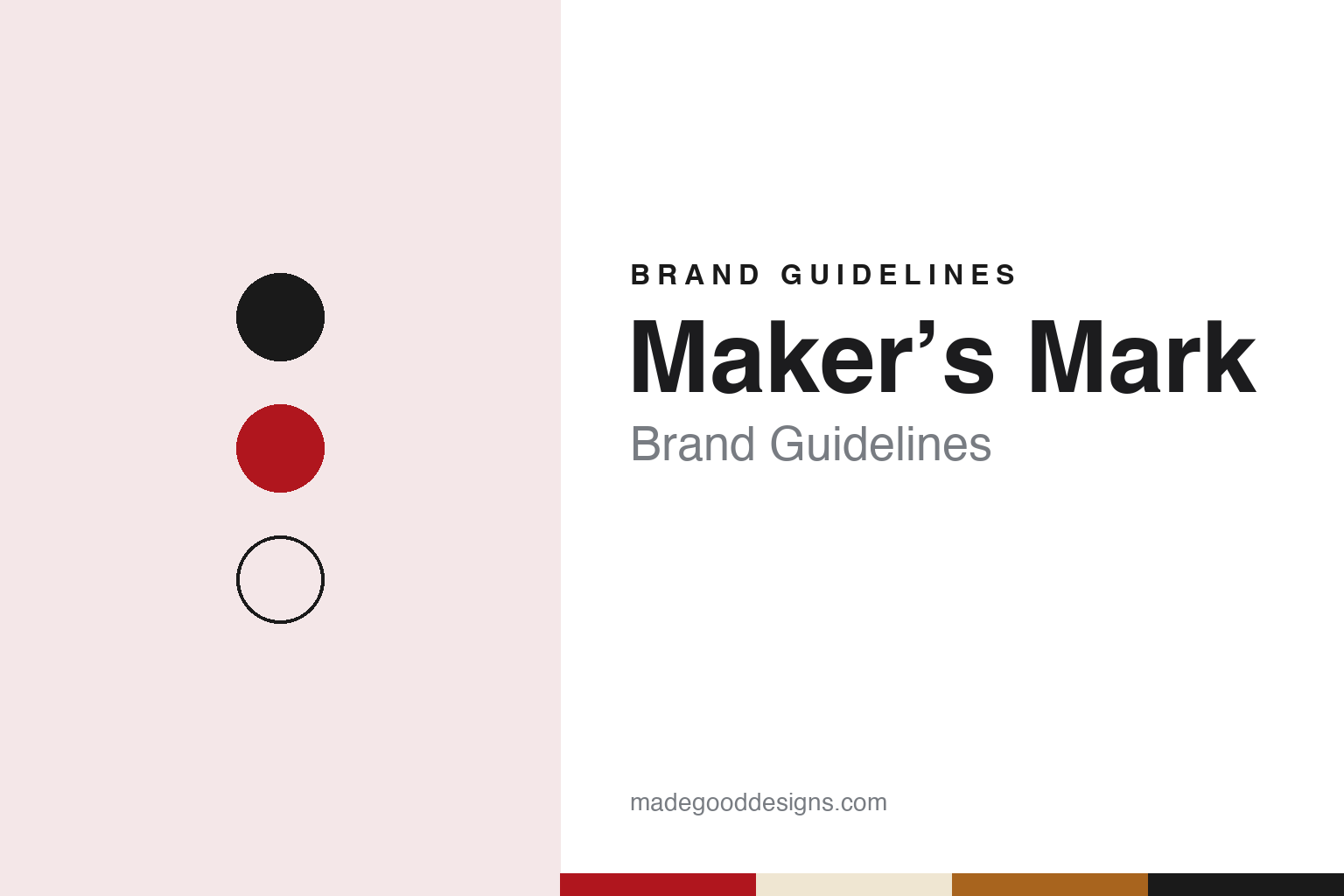
Two constants: a wax red, label cream and bourbon palette and a hand-set serif register. Abstract homage — not a Maker’s Mark product or mark; no bottle, label, seal or logo is reproduced.
Burks’ Distillery
An old distillery, a burned recipe and a loaf of bread.
Maker’s Mark is made at Loretto, Kentucky, on a site with a long distilling past. The Kentucky Historical Society says the Burks family settled the property in 1803 and ran a grist mill and distillery there for generations, and that the plant had been closed in 1951. On 1 October 1953, it says, T. William “Bill” Samuels Sr. bought the old distillery and property; distilling began in February 1954, and the first bottle of Maker’s Mark was bottled in 1958, with the brand’s dipped red wax seal.
The company tells the beginning slightly differently. Its timeline says Bill Samuels Sr. started the new distillery in 1952, and that in 1953 he burned the old family recipe; Beam Suntory’s history called it the 170-year-old family recipe, and said the Samuels family had built its first commercial distillery at Samuels Depot, Kentucky, in 1840. In place of the old recipe Samuels made a bourbon with red winter wheat instead of rye — 70% corn, 16% wheat and 14% malted barley, according to Mark H. Waymack and James F. Harris’s 1995 The Book of Classic American Whiskeys, which also says Maker’s Mark is one of the few distillers to rotate its barrels between the upper and lower floors of its warehouses while they age. The company says he tested candidate mash bills by baking bread from each rather than distilling and ageing them, and English Wikipedia, citing Charles K. Cowdery’s 2004 book Bourbon, Straight, says he received help and recipes from Pappy Van Winkle, whose Stitzel-Weller distillery made wheated bourbons.
The distillery itself became a monument. It was listed on the National Register of Historic Places in December 1974 and designated a National Historic Landmark in December 1980, under the name Burks’ Distillery, English Wikipedia says.
Colour
Margie Samuels’ packaging.
The look of Maker’s Mark is credited to Margie Samuels, Bill Sr.’s wife. “The shape of the bottle, look of the label, our signature red wax, and even the Maker’s Mark name exist because of her,” the company says, and its timeline dates the name and the bottle design to 1953. English Wikipedia says she named the whiskey, drew its label and thought up the wax dipping that gives the bottle its distinctive look. The company also credits her with inventing bourbon tourism and calls her the first woman directly involved with a distillery; those are its own claims. The Kentucky Bourbon Hall of Fame lists her among its 2014 inductees, after Bill Samuels Sr. in 2002.
The craft is still part of the presentation. The company says every bottle is hand-dipped in red wax at the Loretto distillery, and that its labels — “another Margie Samuels original” — are still cut on a hand-operated 1935 Chandler & Price printing press. The bottle is squarish and the label spells the spirit “whisky,” the Scottish form, which The New York Times noted in 2008 as one of a handful of American exceptions to the usual “whiskey.” In the 1960s and 1970s the brand was advertised with the line “It tastes expensive … and is,” a slogan registered as a trademark. The company says a 1980 article in The Wall Street Journal introduced the bourbon to a wider audience.
Special bottles have extended the design. From 1997 Maker’s Mark issued Keeneland racing bottles, including one with a white label, a dark green horse and green wax, and since 1993 it has made limited bottles for University of Kentucky sport, English Wikipedia says.
Typography
Design and documentation.
The seven brands in this group are all American whiskey and rum names: Jim Beam, Maker’s Mark, Wild Turkey, Havana Club, Captain Morgan, Sailor Jerry and The Kraken. American whiskey and rum brands in general sit at many different points in the trade, from family distilleries that still carry a founder’s name to names that now belong to much larger drinks groups, and a single brand can be sold everywhere from a neighbourhood bar to a supermarket shelf.
A spirits brand’s identity is usually carried less by a single bottling than by a bottle, a label and the story the name promises, because the company behind the name may have changed hands, moved its production or grown far beyond the place where it started. That makes the questions behind each name worth asking plainly: who started it, who owns it now, and where its spirits are actually distilled and bottled.
Each guide separates what independent sources record from what the company says about itself — its founding story, its owners over time, where its spirits are made and how its bottles and labels have changed — and marks plainly what rests only on the company’s own word.
Aa
A hand-set serif for a label cut on an old press. (Specimen set in IM Fell English, a serif STAND-IN; NOT the Maker’s Mark logo.)
Maker’s Mark
Family stewards, corporate owners.
The Samuels family has run the distillery through a series of owners. The company says Bill Samuels Jr. took over from his father in 1975. In 1981 Maker’s Mark was sold to Hiram Walker & Sons, the Associated Press reported in 2011; Hiram Walker was bought by Allied-Lyons in 1987, which became Allied Domecq, and when Pernod Ricard bought Allied Domecq in 2005, Maker’s Mark went to Fortune Brands, whose spirits arm became Beam Inc. in 2011. Rob Samuels, Bill Jr.’s son, succeeded his father in April 2011, the AP reported. In January 2014 Beam Inc. agreed to sell itself to Suntory, and the owner has been called Suntory Global Spirits since May 2024, Forbes reported. In February 2013 the company announced it would lower the bourbon’s strength and reversed the decision eight days later, The Daily Telegraph reported.
The range has grown slowly. Maker’s 46, finished with seared French oak staves, was launched in 2010, which the Courier-Journal called the brand’s first new bourbon since the 1950s; a cask-strength edition followed at the distillery in 2014, The Washington Post reported. In 2025, the company says, it released Star Hill Farm Whisky, its first American wheat whisky. The company’s website names Maker’s Mark Distillery, PBC, of Loretto, and says the bourbon is aged “to taste, not time,” usually six to seven years. For lettering, see our separate note on the Maker’s Mark font.
For a design guide, Maker’s Mark shows how one packaging gesture — a hand-dipped seal — can become the whole identity. Compare Jim Beam, its Kentucky stablemate, and Suntory, its owner since 2014. For this guide we use a wax red, a label cream and a bourbon brown with a serif, an unofficial interpretation; no product or logo is reproduced.
Explore & save
Keep Maker’s Mark’s identity on hand — save it to a board in the Made Good inspiration library.
Maker’s Mark identity set
Pin the Maker’s Mark wax red, label cream and bourbon palette and the hand-set serif register to your own board.