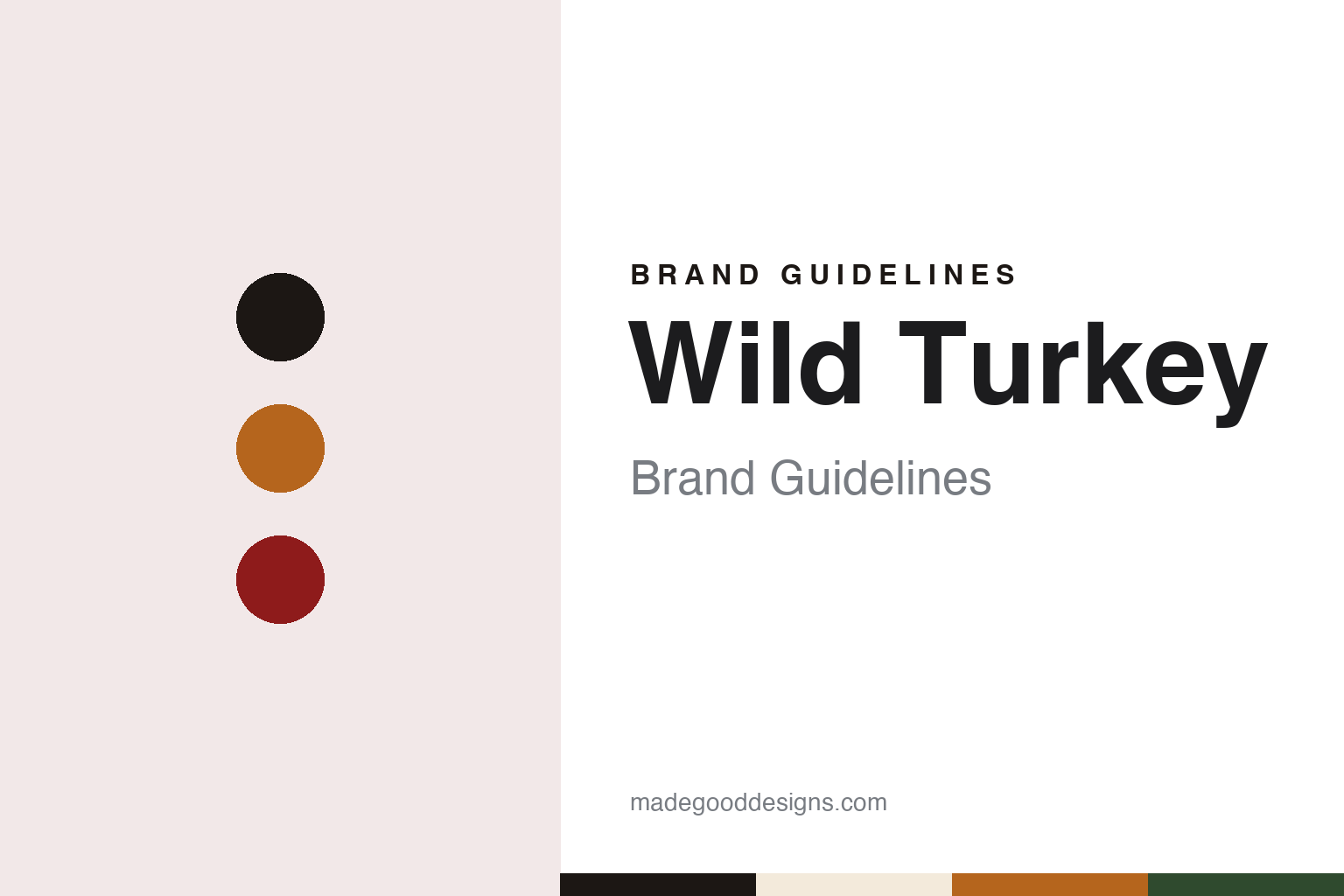
Wild Turkey Brand Guidelines
The Lawrenceburg bourbon named on a 1940 hunting trip.
Aa
Two constants: a barn red, bourbon amber and hill green palette and a condensed American sans register. Abstract homage — not a Wild Turkey product or mark; no bottle, label or logo is reproduced.
Wild Turkey Hill
A Ripy distillery, a New York grocer and a hunting trip.
Wild Turkey is a Kentucky straight bourbon made at the Wild Turkey Distillery in Lawrenceburg, Kentucky, on what the company calls Wild Turkey Hill, overlooking the Kentucky River. The whiskey and the name, however, have different origins. The distillery belonged to the Ripy family. The company’s own timeline says the Ripy brothers opened their family distillery on Wild Turkey Hill in 1869, and that their bourbon represented Kentucky at the World’s Fair in Chicago in 1893; English Wikipedia instead says that Thomas Ripy built the Old Hickory Distillery at Tyrone, near Lawrenceburg, in 1891, on the site of an earlier distillery. After Prohibition the family rebuilt the plant and sold its bourbon to wholesalers, who bottled it under their own brands.
One of those wholesalers was Austin, Nichols, a wholesale grocer that, the company says, began selling wine and spirits in 1855. The Wild Turkey name came later. According to an account repeated by The Guardian in 2009, an Austin, Nichols executive, Thomas McCarthy, took some warehouse samples on a wild turkey hunting trip in 1940, and his friends kept asking afterwards for “that wild turkey bourbon.” Austin, Nichols began bottling whiskey under the Wild Turkey name in 1942, English Wikipedia says, citing the guide Whiskey University.
For three decades the brand had no distillery of its own. In 1949 the Ripys sold their plant to Robert and Alvin Gould, and Austin, Nichols carried on as a non-distiller producer, buying bourbon on the open market, much of it from the old Ripy site, then known as the Boulevard Distillery. In 1971 Austin, Nichols bought the Boulevard plant and renamed it the Wild Turkey Distillery, bringing the brand and the place together under one name.
Colour
Low-proof distilling, the 101 and a father-and-son line.
Wild Turkey’s house style is described in production terms. In The Book of Classic American Whiskeys (1995), Mark Waymack and James Harris wrote that its mash uses a relatively low share of corn compared with most bourbons and that the spirit comes off the still at about 55% alcohol by volume, well below the legal maximum for bourbon; the company today sums this up as bourbon “distilled at a low proof.” Its rickhouses are seven storeys tall, and the company says the height at which a barrel rests shapes the whiskey inside it.
The flagship is Wild Turkey 101, named for its proof, which Whisky Magazine gave an Editor’s Choice award in 2012, English Wikipedia says. The company dates its later range in its timeline: a bourbon liqueur in 1976, which it calls the world’s first and which led to American Honey; Rare Breed, a barrel-proof bourbon, in 1991; Kentucky Spirit, a single-barrel 101-proof bourbon, in 1995; and a barrel-proof Rare Breed Rye in 2020. The Russell’s Reserve line, which carries the family name, is bottled at the same Lawrenceburg distillery.
The name most tied to the whiskey is Jimmy Russell. The company says he joined Wild Turkey in 1954, learned from Bill Hughes and Ernest W. Ripy, son of the original distiller, and became the third in their line of master distillers; it marks his 50th year in 2004 and his 70th in 2024, when it called him the longest-tenured master distiller in the world. He was inducted into the Kentucky Bourbon Hall of Fame in 2000, the company says. His son Eddie Russell joined in 1981 as a relief operator, entered the same hall of fame in 2010 and received the title of master distiller in 2015, alongside his father. A third generation, Bruce Russell, is credited by the company as associate master blender on recent releases.
Typography
Design and documentation.
The seven brands in this group are all American whiskey and rum names: Jim Beam, Maker’s Mark, Wild Turkey, Havana Club, Captain Morgan, Sailor Jerry and The Kraken. American whiskey and rum brands in general sit at many different points in the trade, from family distilleries that still carry a founder’s name to names that now belong to much larger drinks groups, and a single brand can be sold everywhere from a neighbourhood bar to a supermarket shelf.
A spirits brand’s identity is usually carried less by a single bottling than by a bottle, a label and the story the name promises, because the company behind the name may have changed hands, moved its production or grown far beyond the place where it started. That makes the questions behind each name worth asking plainly: who started it, who owns it now, and where its spirits are actually distilled and bottled.
Each guide separates what independent sources record from what the company says about itself — its founding story, its owners over time, where its spirits are made and how its bottles and labels have changed — and marks plainly what rests only on the company’s own word.
Aa
A condensed American sans for a bourbon with a bird for a name. (Specimen set in Oswald, a sans STAND-IN; NOT the Wild Turkey logo.)
Wild Turkey
Pernod Ricard, Campari and a bird on the label.
Wild Turkey has passed through two international owners. In 1980 the French group Pernod Ricard bought the distillery and the brand, and in April 2009 it sold both to Italy’s Gruppo Campari, The New York Times and The Guardian reported at the time. On 9 May 2000, under Pernod Ricard, a fire destroyed one of the distillery’s seven-storey ageing warehouses, the Baltimore Sun reported. Under Campari, distilling and bottling came back together on the site: a new distillery opened in 2011 where the old bottling hall had stood, the whiskey writer Chuck Cowdery reported, and in September 2013 Campari opened a bottling plant at the distillery, BevNET reported, after some 13 years in which Wild Turkey had been bottled out of state, in Indiana and later Arkansas. Campari’s SKYY vodka is bottled there too, Cowdery wrote.
The distillery doubles as a visitor attraction on the Kentucky Bourbon Trail. The company says its visitor centre was inspired by the silhouette of a Kentucky tobacco barn and that red and green mark its buildings on the hill.
Advertising has leaned on the bird in the name. In 2011 a video built around the line “Give ’em the Bird” and a middle-finger gesture drew a ruling from the Distilled Spirits Council of the United States, whose review board found in August 2011 that it breached the industry code; the company disagreed but withdrew the video, the council recorded, and kept the slogan for a television campaign reported by the Associated Press in May 2012. In 2016 the actor Matthew McConaughey became the brand’s creative director, with the aim of reaching more women and international drinkers, NBC News reported; the company says he co-created the Longbranch bourbon with Eddie Russell in 2018. Its 2025 global campaign, “Don’t Change a Damn Thing,” returned to the theme of an unchanged recipe and Jimmy Russell’s seven decades at the distillery.
For a design guide, Wild Turkey shows how a name from a hunting trip, a family of distillers and one hilltop distillery can carry a bourbon brand across three owners. A separate guide covers the font Wild Turkey uses. Compare Appleton Estate, the Jamaican rum also owned by Campari, and Maker’s Mark, another Kentucky bourbon. For this guide we use barn red, bourbon amber and hill green with a condensed sans, an unofficial interpretation; no product or logo is reproduced.
Explore & save
Keep Wild Turkey’s identity on hand — save it to a board in the Made Good inspiration library.
Wild Turkey identity set
Pin the Wild Turkey barn red, bourbon amber and hill green palette and the condensed American sans register to your own board.