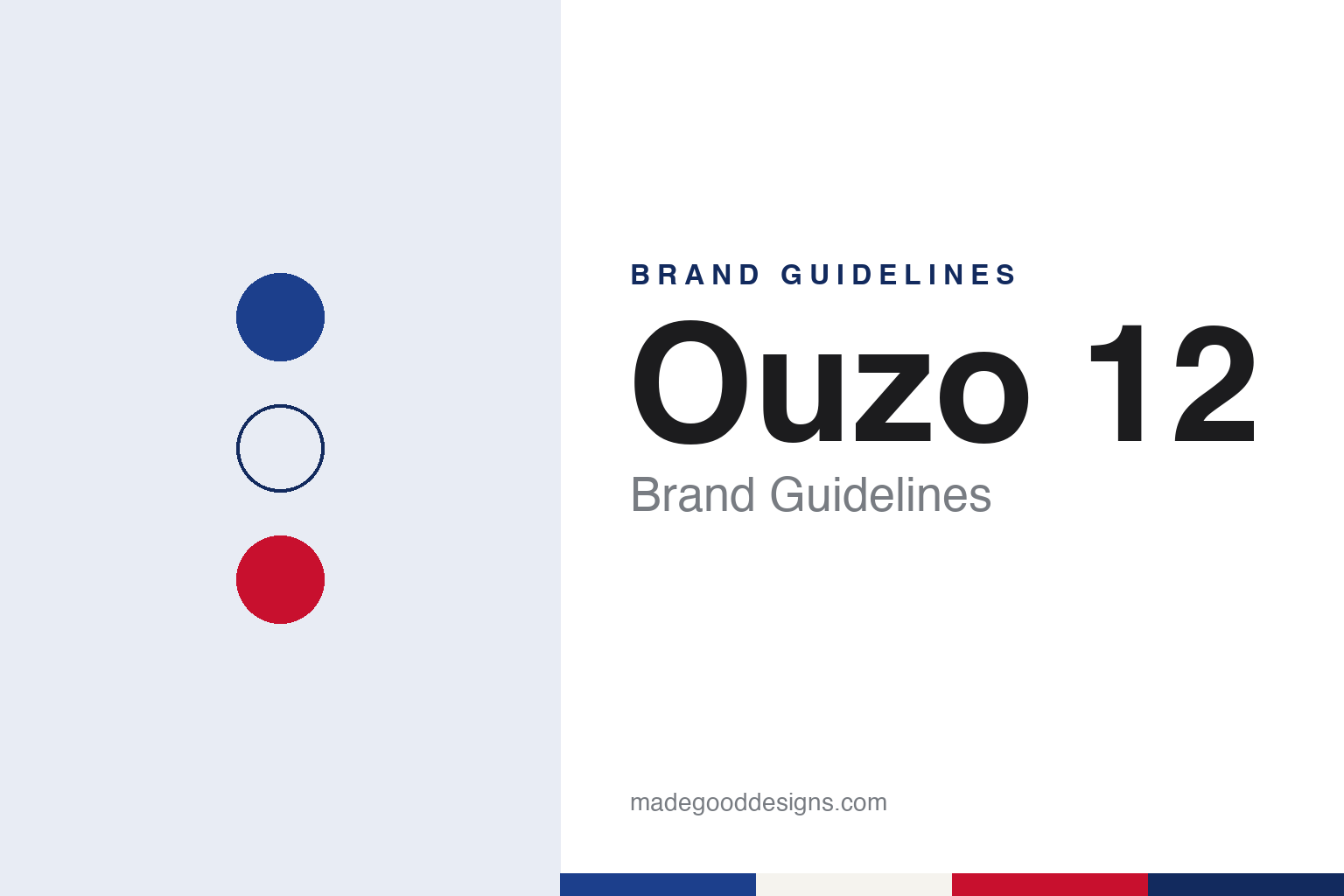
Ouzo 12 Brand Guidelines
The Constantinople ouzo named after its twelfth barrel.
Aa
Two constants: a blue, white and red palette and a condensed numeral sans register. Abstract homage — not an Ouzo 12 product or mark; no bottle, label or logo is reproduced.
Barrel No. 12
A Constantinople distillery and a favourite cask.
Ouzo 12 is an anise-flavoured Greek spirit whose name, its owners say, comes from a single barrel. The brand’s website says the story began in 1880 in Constantinople, today’s Istanbul, at the Kalogiannis distillery, where connoisseurs always asked for ouzo from one particular barrel, which it calls aromatic and rich in flavour. Campari’s website told the same story in 2012 and 2013, spelling the family name Kaloyannis: the ouzo “took its name in 1880 at the Kaloyannis Distillery from ‘Barrel No12’,” chosen, it said, for its rich taste and delicate aroma. Both versions are the brand owners’ own account of the name.
The family and its ouzo then moved. The brand says the Kalogiannis family settled in Thessaloniki in 1925, where their ouzo “enchanted the whole city,” and that in 1950 the distillate reached Piraeus, where it was bottled for the first time. Since its beginnings in Constantinople, the brand says, Ouzo 12 has kept the same flavour and stayed true to its original recipe.
The word ouzo has a contested story too. English Wikipedia gives the popular derivation as “uso Marsiglia,” “for use in Marseille,” said to have been stamped on crates of silkworm cocoons exported from Tyrnavos, while noting that major Greek dictionaries derive the word from the Turkish üzüm, grape. Campari’s website in 2008 told a different version, in which local tsipouro was praised as “uso Massalia” and the phrase replaced the older name by word of mouth.
Colour
The carafe, the number and the table.
The brand’s strongest design claim is its bottle. When the ouzo was first bottled in Piraeus in 1950, the brand says, it introduced the carafe, which it says became the most common ouzo bottle. The number itself is the other constant: the brand’s website calls its product “the world’s most popular ouzo from Barrel N°12,” and the figure 12 does the work of a name, a story and a mark at once.
Campari has described the flavour in plain terms. In 2008 its website said the aniseed is joined by cinnamon, cardamom and coriander, called the spirit “classic yet modern,” and said Ouzo 12 is served straight, with ice or with a little water. In 2012 and 2013 it named Germany and Greece as the brand’s main markets, and presented Ouzo 12 under the heading “The most popular Ouzo in the world,” describing it as the ouzo “with the extraordinary aroma of history and tradition” and saying that every bottle represents “the soul of Greece.” The same pages called it one of the most consumed varieties of the aniseed spirit worldwide, always faithful to its original recipe.
The current campaign is about the Greek table. The brand’s website runs under the line “Let’s drink to that!” and lists everyday moments — love for food in excess, anticipation of summer, a mother’s cooking, loud conversations — before saying there are many things Greeks share that bring them together around the same table with a glass of ouzo, “but not any ouzo.” The brand also says Ouzo 12 is the world’s number one ouzo, citing an IWSR report for 2023; an earlier version of the claim cited the IWSR database for 2016.
Typography
Design and documentation.
The seven brands in this group are all spirit names from Mexico, France, Greece and Spain: José Cuervo, Patrón, Ricard, Pernod, Metaxa, Ouzo 12 and Licor 43. Spirit brands in general sit at many different points in the trade, from family firms that still carry a founder’s name to names that now belong to much larger drinks groups, and a single brand can be sold everywhere from a neighbourhood bar to a duty-free shelf.
A spirit brand’s identity is usually carried less by a single bottle than by a label, a name and the drink or ritual it promises, because the company behind the name may have changed hands, moved its production or grown far beyond the place where it started. That makes the questions behind each name worth asking plainly: who started it, who owns it now, and where its spirits are actually made and bottled.
Each guide separates what independent sources record from what the company says about itself — its founding story, its owners over time, where its spirits are made and how its bottles and advertising have changed — and marks plainly what rests only on the company’s own word.
12
Oswald is a STAND-IN chosen for its tall, condensed numerals, which suit a brand built on a number; it is NOT the Ouzo 12 logo or label lettering.
Ouzo 12
From Diageo to Campari.
Ouzo 12 passed to an Italian group in 1999. Campari’s website said in 2008, 2012 and 2013 that Ouzo 12 had been “part of the Gruppo Campari since 1999.” Italian Wikipedia, citing an Adnkronos report of 29 September 1999, says that in 1999 Diageo sold the Cinzano brand to Campari together with the Greek brand Ouzo 12 and some smaller brands. English Wikipedia’s history of Campari Group also lists Ouzo 12 among its 1999 acquisitions, alongside Cinzano, and still lists it in the group’s brand table.
The neighbours in that portfolio have changed. English Wikipedia says Campari announced the sale of Cinzano to Gruppo Caffo 1915 in June 2025, and that it completed the sale of Averna and Zedda Piras to Illva Saronno Holding in June 2026, as part of a plan to streamline its brands. In 2013 Campari’s website filed Ouzo 12 among its liqueurs, next to names such as Frangelico, Cynar and Irish Mist.
What the brand presents today is compact: a founding city, a year, a barrel number and a bottle. Its website opens on the barrel line and the 1880 date, retells the moves from Constantinople to Thessaloniki and Piraeus, and closes on the toast. The owners of the story have changed over the decades, but the number and the carafe have stayed at the centre of it.
For a design guide, Ouzo 12 shows how a single number and a bottle shape can hold a whole origin story. Compare Metaxa, another Greek spirit built around a founder’s date and a bottle, and Appleton Estate, a Jamaican rum in the same Campari portfolio. For this guide we use barrel blue, anise white and a red with a condensed sans, an unofficial interpretation; no product or logo is reproduced.
Explore & save
Keep Ouzo 12’s identity on hand — save it to a board in the Made Good inspiration library.
Ouzo 12 identity set
Pin the Ouzo 12 blue, white and red palette and the condensed numeral sans register to your own board.