Q Mixers Brand Guidelines
Jordan Silbert’s Brooklyn tonic that became a mixer range.
Aa
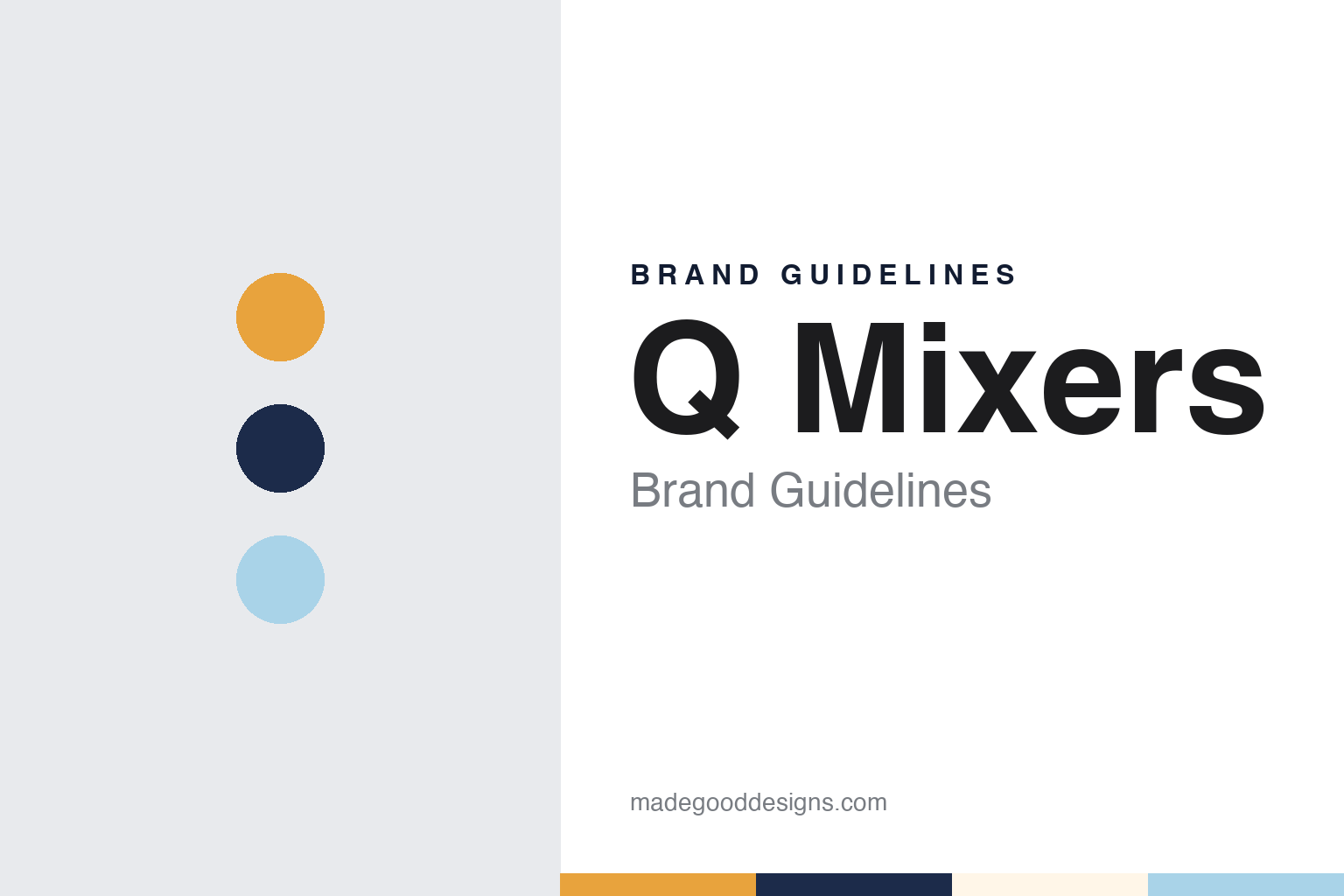
Two constants: a golden hour amber, bar navy and bubble blue palette and a bold grotesque sans register. Abstract homage — not a Q Mixers product or mark; no label, logo or bottle is reproduced.
A better tonic for a good gin
A backyard question, a kitchen full of quinine bark and two famous bars.
Q Mixers started with a question about a gin and tonic. The Bridge, a Brooklyn business news site, reported in September 2018 that the idea came to Jordan Silbert on a summer night in 2002 in his backyard in Fort Greene, Brooklyn, when he was working as an executive at the Alliance for Downtown New York. Reading the label of the tonic water he was drinking, he found it sweetened with high-fructose corn syrup and, by his account, built much like a lemon-lime soda. The question he took from that night, as The Bridge put it, was “Why can’t my tonic water be as good as my gin?”
The answer took several years of kitchen experiments. Silbert bought quinine bark online and worked on recipes at home, The Bridge reported, and then found an industrial bottling plant in Western Massachusetts to produce the drink at scale. The founding date depends on the source: a company statement carried by Beverage Industry in May 2021 says Q was founded in 2006 by Silbert “from his kitchen,” while Eurazeo’s April 2019 press release says the brand was “born in a Brooklyn kitchen in 2007.”
Its first customers were bartenders. The Bridge says Silbert introduced his tonic to readers of the food forum eGullet in 2006, and that Jim Meehan, then at Gramercy Tavern and later the founder of the bar PDT, asked him to bring samples for a tasting and placed an order. The founder of Milk & Honey also asked for deliveries, after the bar closed; Silbert told The Bridge he borrowed a car to deliver his first cases there. The timing, the site noted, matched the rise of the New York cocktail revival.
The company first traded under the name of its first product. BevNET reported in 2012 that Q Tonic had changed its company name to Q Drinks, by then making a ginger ale and a club soda as well as tonic; the brand now presents itself as Q Mixers. Eurazeo’s release names Ben Karlin as president and co-founder.
Colour
One letter for a name, and carbonation treated as an ingredient.
The name is a single letter. The Bridge explained that the Q stands for quinine, the bittering ingredient in the first product, though it noted that quality and a question also fit. The rest of the range grew from requests made at the bar: over the following decade Silbert added ginger ale, ginger beer, club soda, a kola, sparkling grapefruit and an Indian tonic water, and he told The Bridge that bartenders asked him for a ginger ale to stand beside his tonic. The company says on its site that the kola is no longer made because demand was not high enough.
Carbonation is part of the brand story. The Bridge reported that each flavour is carbonated to its own level and packed in specially designed, thicker bottles that hold more carbonation, and that the drinks were made at several plants around the United States. The site also reported that agave nectar was used instead of sugar in the recipes and that the ginger ale included cardamom, orange peel and rose oil.
The look has been reworked twice in recent years. Beverage Industry reported in May 2021 that Q had launched a new identity and packaging with the branding agency CBA, with each label naming a classic cocktail to pair with the mixer, such as gin and tonic for the tonic and a Moscow mule for the ginger beer, and with cocktail photography by Francesco Tonelli. CBA’s own case study, dated 2022, describes three ideas behind the system, “Spectacular Effervescence,” “Inspired by the Golden Hour” and “Made to Mix,” expressed through warm, dappled light and bubble patterns. BevNET then reported in November 2023 on a second rebrand under the headline “Approachable and Elevated.”
Typography
Design and documentation.
The seven brands in this group are all mixer and alcohol-free names: Canada Dry, Q Mixers, Thomas Henry, Franklin & Sons, London Essence, Double Dutch and Clausthaler. Mixer and alcohol-free brands in general sit at many different points in the trade, from small companies that still carry a founder’s name to labels that now belong to much larger drinks groups, and a single brand can be sold everywhere from a corner shop to a cocktail bar.
A mixer or alcohol-free brand’s identity is usually carried less by a single bottle than by a label, a name and the promise it makes, because the company behind the name may have changed hands, moved its production or grown far beyond the place where it started. That makes the questions behind each name worth asking plainly: who started it, who owns it now, and where its drinks are actually made and bottled.
Each guide separates what independent sources record from what the company says about itself — its founding story, its owners over time, where its drinks are made and how its labels have changed — and marks plainly what rests only on the company’s own word.
Aa
A bold grotesque sans for a one-letter mixer brand. (Specimen set in Archivo, a sans-serif STAND-IN; NOT the Q Mixers logo.)
Q Mixers
A founder-led brand that brought in investors and outside chief executives.
Q has grown with outside investors. In April 2019 the French investment firm Eurazeo announced that its Eurazeo Brands arm had completed an investment in Q Mixers, described as a premium carbonated mixer brand based in New York, in partnership with the founders, joining existing investors including First Beverage Ventures; it was Eurazeo Brands’ first food and beverage investment, and two Eurazeo representatives joined Q’s board. The Bridge had described the company in 2018 as based in Dumbo, Brooklyn, with 39 employees and a range sold to some 11,000 accounts, among them Whole Foods and Target.
The founder later handed over day-to-day leadership. BevNET reported in 2022 that Silbert had stepped down as chief executive after more than 15 years and that Bob Arnold, a former Mondelez, Bacardi and Coca-Cola executive, had taken over. In December 2024 Q announced Betsy Frost, previously chief executive of the non-alcoholic beer brand Hoplark, as its new chief executive. In September 2025 the company said, via Business Wire, that it was expanding its distribution partnership with Breakthru Beverage Group into California.
The name needs care online. The brand’s current site is qmixers.com; older coverage uses Q Tonic and Q Drinks, and the single letter is shared with many unrelated products.
For a design guide, Q Mixers shows how a single letter, a label that names its cocktail and a golden-hour palette can position a mixer as the equal of the spirit it is poured with. Compare Fever-Tree, the London premium tonic brand, and Thomas Henry, the Berlin mixer maker. For this guide we use golden hour amber, bar navy and bubble blue with a bold sans, an unofficial interpretation; no product or logo is reproduced.
Explore & save
Keep Q Mixers’s identity on hand — save it to a board in the Made Good inspiration library.
Q Mixers identity set
Pin the Q Mixers golden hour amber, bar navy and bubble blue palette and the bold grotesque sans register to your own board.