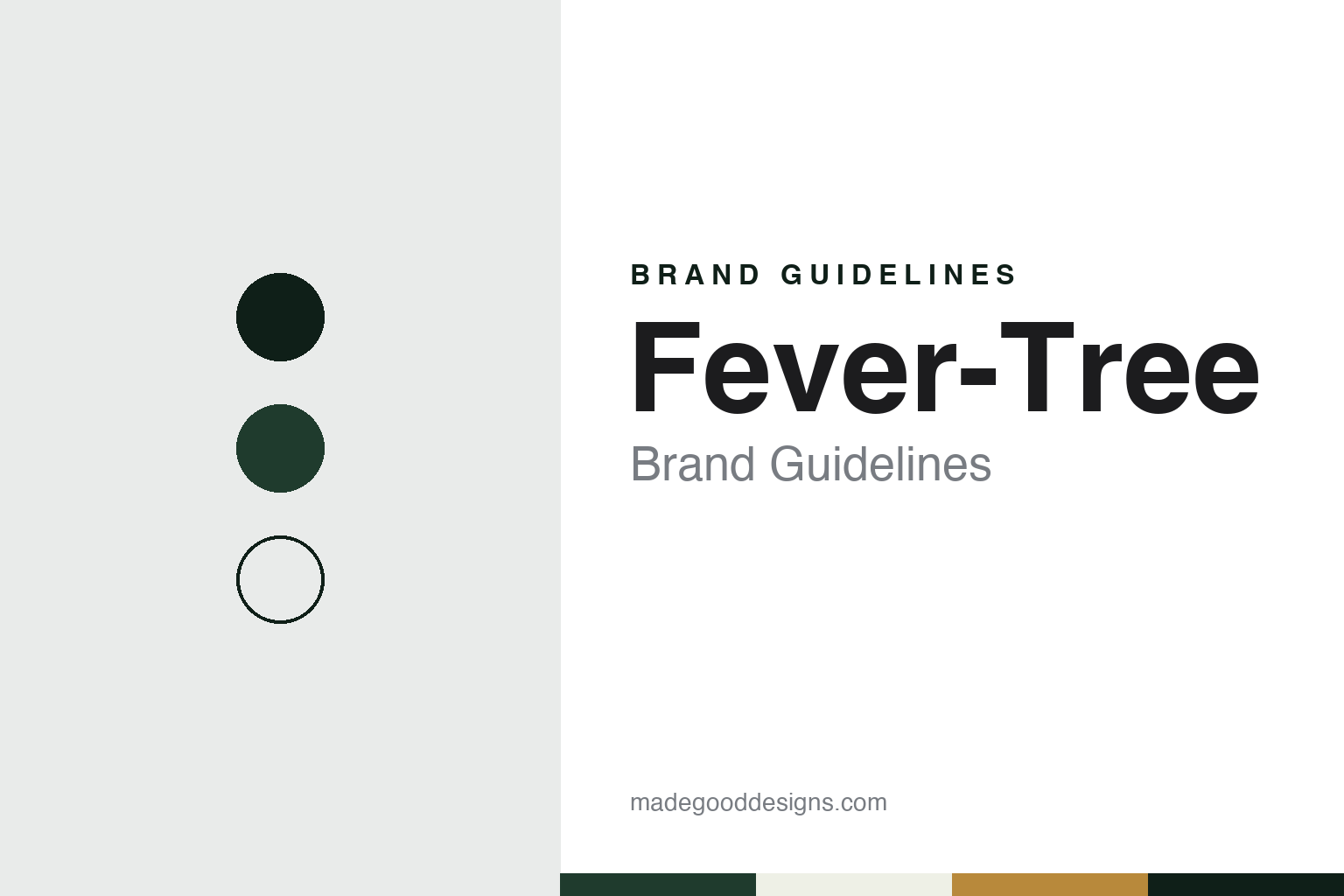
Fever-Tree Brand Guidelines
The London mixer brand that made tonic a premium category.
Aa
Two constants: a cinchona green, white and gold palette and a botanical serif register. Abstract homage — not a Fever-Tree product or mark; no bottle, label or logo is reproduced.
Two founders and a tonic
A gin man and an advertising man.
Fever-Tree is a British maker of premium drink mixers, traded on the London Stock Exchange as Fevertree Drinks plc and based in Hammersmith, west London. It was founded by Charles Rolls and Tim Warrillow. Rolls came from the spirits trade: English Wikipedia, citing the company’s directors’ biographies, says he had worked for the consultants Bain & Co and in 1997 took a stake in Plymouth Gin, becoming its managing director until the gin was sold in 2001. Warrillow came from advertising. The Telegraph reported in 2015 that the two first met in a pub near Sloane Square.
Sources give different founding dates. The company’s own story says Fever-Tree “began in 2003 with a meeting of minds”; The Drinks Business, reporting in 2013, and English Wikipedia give 2004; Who’s Who, quoted by Wikipedia, says Rolls co-founded it in 2005. All agree on the first product: Premium Indian Tonic Water, launched in 2005 after months of work on botanicals. The company says its first British retail listing was with Waitrose, and Wikipedia adds Selfridges.
The aim, English Wikipedia says, citing Forbes and Australian trade press, was a premium alternative to standard mixers, made without high levels of preservatives or artificial sweeteners. The name comes from the tonic’s defining flavour: quinine, from the bark of the South American cinchona tree, long known in India as the fever tree, as The Guardian noted in 2018. Wikipedia says a trip to the Democratic Republic of the Congo was part of the early development, and the company still names the Congo as the origin of its quinine.
Colour
From Waitrose to more than 80 countries.
Growth came quickly. English Wikipedia says the company took investment from the venture capital firm London & Lochside in 2006, launched in the United States and Spain in 2007, and was listed by Sainsbury’s and Tesco by 2008. In 2011 it appeared in the Sunday Times International Track 100 of fast-growing exporters. In March 2013 the founders sold a quarter of the business to Lloyds Development Capital, The Drinks Business reported, and in November 2014 Fever-Tree floated on the London Stock Exchange’s AIM market. Rolls served as chief executive until 2014, according to Who’s Who, and stepped down as non-executive deputy chairman in 2022; Wikipedia lists Warrillow as chief executive.
The range spread from tonic to ginger beer, ginger ale, lemonade, cola, soda water and flavoured tonics such as Mediterranean and Elderflower, and later to cocktail mixers. The company says it launched a Soda range and bought its US partner, the Global Drinks Partnership, in 2020; in 2022 it bought the American cocktail-mixer brand Powell & Mahoney, The Spirits Business reported. Fever-Tree says that by 2018 it had overtaken Schweppes by value in the British market, and that it opened a Sydney office in 2023. Wikipedia says its drinks are sold in more than 80 countries.
Its marketing rests on ingredients and bars. The company’s website lists where each one comes from — ginger from Nigeria, the Ivory Coast and Cochin in India, lemons from Sicily, raspberries from Scotland’s Strathmore valley, yuzu from Kochi in Japan and vanilla from Madagascar. Wikipedia says Drinks International’s annual bar reports named it the best-selling and top-trending mixer brand each year from 2015 to 2022, and from 2018 the brand was the title sponsor of the Queen’s Club tennis championships in London. Partnerships carried the name further: in 2018 it made a citrus tonic with Bacardi’s Patrón tequila, and in 2019 the coffee chain Caffè Nero began selling espresso-and-tonic drinks made with it, The Grocer reported.
Typography
British soft drinks and their owners.
The seven brands in this group are all soft-drink names from Australia, Britain and the United States: Kirks, Solo, Passiona, Bickford’s, Ben Shaws, Fever-Tree and Shasta. Australian, British and American soft-drink brands in general sit at many different points in the trade, from family firms that still carry a founder’s name to names that now belong to much larger drinks groups, and a single brand can be sold everywhere from a corner shop to a supermarket shelf.
A soft-drink brand’s identity is usually carried less by a single product than by a bottle or can, a name and the flavour it promises, because the company behind the name may have changed hands, moved its production or grown far beyond the place where it started. That makes the questions behind each name worth asking plainly: who started it, who owns it now, and where its drinks are actually made and bottled.
Each guide separates what independent sources record from what the company says about itself — its founding story, its owners over time, where its drinks are made and how its packaging has changed — and marks plainly what rests only on the company’s own word.
Aa
A botanical serif — the register of a premium mixer label. (Specimen set in Cormorant Garamond, a serif STAND-IN; NOT the Fever-Tree logo.)
Fevertree Drinks
A brand without a factory of its own.
Fever-Tree does not describe itself as a bottler. Its sustainability pages refer throughout to co-packers — outside manufacturers that fill its bottles and cans — and list improvements made at their sites, such as solar panels at a co-packer’s plant in 2021 and boreholes in 2024; the company does not name them there. A 2008 profile in The Grocer, cited by Wikipedia, said its products were then made in Somerset. The company also says it decided from the start not to use plastic PET bottles; its targets also cover recycled content in aluminium cans.
Ownership has broadened since the flotation. The founders remain shareholders, and in January 2025 the brewer Molson Coors took an 8.5% stake in Fevertree Drinks, The Wall Street Journal reported. It has also collected awards: it won the Specialty Food Association’s sofi award for outstanding cold beverage in 2010, 2011 and 2012, and Wikipedia lists the Queen’s Award for Enterprise in 2019 and a King’s Award for Enterprise in international trade. In 2025 the company marked twenty years since its first tonic.
Fever-Tree kept the hyphen in its brand name while the listed company is written as one word, Fevertree. For a design guide, Fever-Tree shows how a mixer can be packaged and told as a premium product with a story about its ingredients. For the lettering, see what font Fever-Tree uses. Compare Bundaberg, the Australian brewed ginger beer, and Ben Shaws, a Victorian Yorkshire pop maker. For this guide we use a cinchona green, white and gold with a serif, an unofficial interpretation; no product or logo is reproduced.
Explore & save
Keep Fever-Tree’s identity on hand — save it to a board in the Made Good inspiration library.
Fever-Tree identity set
Pin the Fever-Tree cinchona green, white and gold palette and the botanical serif register to your own board.