Shasta Brand Guidelines
The Mount Shasta spring water that became a flavour-soda line.
Aa
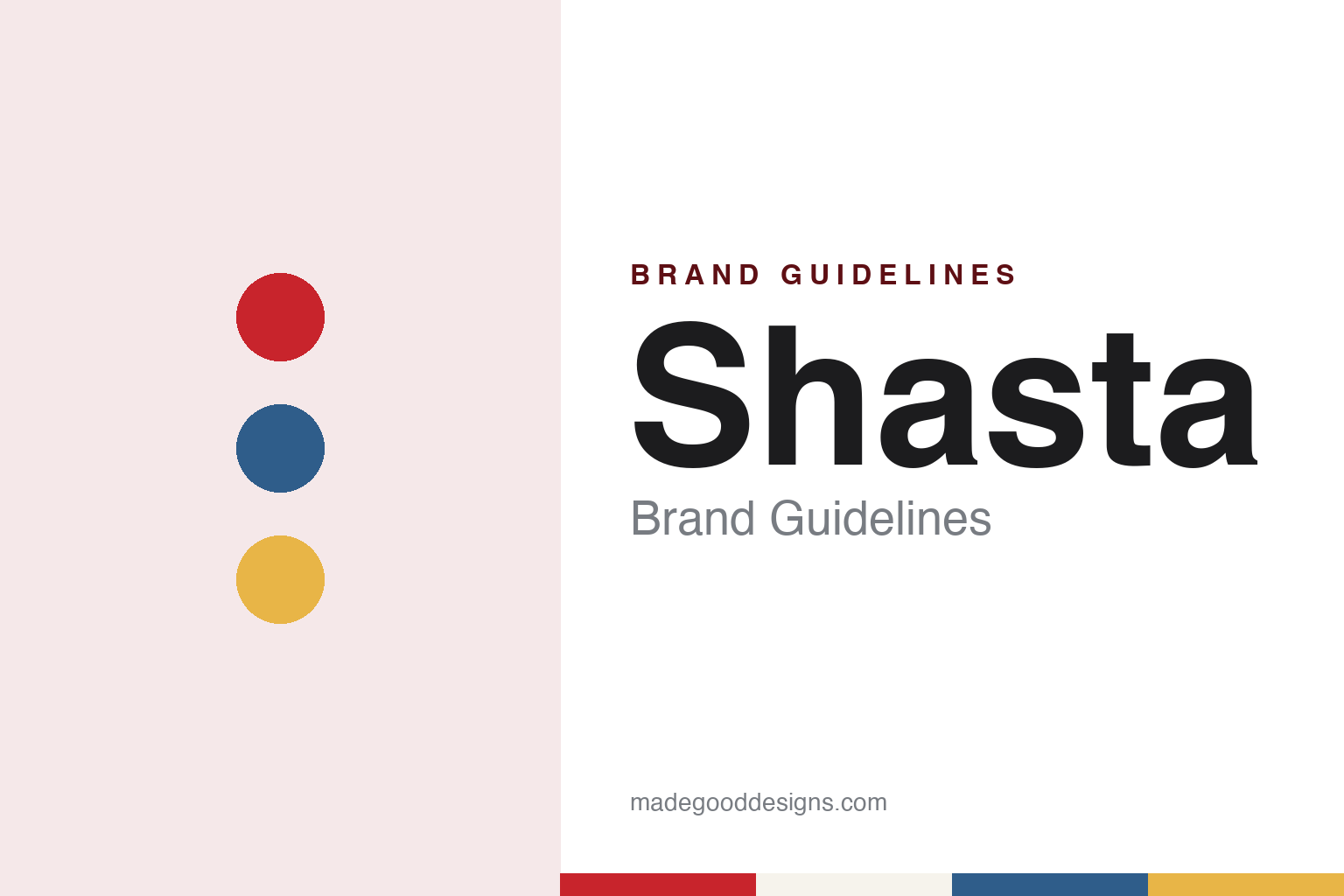
Two constants: a pop red, mountain blue and ginger ale gold palette and a rounded pop sans register. Abstract homage — not a Shasta product or mark; no can, logo or label is reproduced.
Mineral springs
A mountain, a railway and a spring-water company.
Shasta takes its name from Mount Shasta, the volcano in northern California, and from Shasta Springs, a summer resort that stood on the upper Sacramento River just north of the town of Dunsmuir. English Wikipedia, citing the Encyclopedia of Consumer Brands (1994) and Darla Greb Mazariegos’s 2007 local history Mount Shasta, says the natural springs at the resort, which sat on the Southern Pacific Railroad’s main line, were the original source of the water and drinks that became the Shasta brand.
The business began in 1889 as the Shasta Mineral Springs Company. English Wikipedia gives the founding date as 6 December 1889, in Siskiyou County, and the company itself still uses 1889 on its website and in its tagline. At first it sold mineral water. English Wikipedia says the water was poured into glass-lined railroad cars and shipped off to be bottled elsewhere; the company’s own history adds that it went into siphon bottles.
Flavours came later. The company says that in the 1920s it introduced a line of flavoured carbonated drinks in 12-ounce bottles and opened a third bottling plant, and that in 1928 it changed its name to the Shasta Water Company, a date English Wikipedia also gives. Its first soft drink, English Wikipedia says, was a ginger ale in 1931; the company calls it Shasta Pale Dry Ginger Ale and says that ginger ale has been one of its flagship flavours ever since. Until the 1950s, English Wikipedia says, Shasta’s products were mainly mixers for alcoholic drinks: ginger ale, mineral water and club soda. The resort that gave the drinks their name closed in the early 1950s, when it was sold, English Wikipedia says.
Colour
Cans, diet drinks and a corporate parent.
The 1950s changed what Shasta sold and how. English Wikipedia, citing the Encyclopedia of Consumer Brands, says Shasta introduced marketing methods in that decade that became industry standards: soft drinks packed in cans, low-calorie or “diet” soft drinks, and direct delivery of bottles and cans to grocers through wholesale channels. The company goes further, saying that in 1953 the Shasta Water Company became the first company to put soft drinks in cans, and that in the 1960s it was the first to introduce sugar-free soft drinks; those are the company’s own claims. Its history page also traces how the ginger ale has looked through the decades, from the 1930s to the 2020s.
By the 1960s, English Wikipedia says, Shasta sodas and mixers were well known across most of the western United States and parts of the Southwest. In 1966 the company was bought by Consolidated Foods, the group later known as Sara Lee, and was renamed Shasta Beverages, a name it still uses. The company says that in the 1970s it set up a food-service division supplying hospitals with soft drinks in 8-ounce cans.
Advertising made the name familiar. English Wikipedia says Shasta was heavily advertised on television in the late 1960s and early 1970s with a run of humorous commercials, and that in the early 1980s it was expanding nationally and spending more on advertising. In 1983 its advertising agency hired Al Jourgensen, later the frontman of the band Ministry, to write and perform a jingle, as Jourgensen recounts in his 2014 memoir; the company names the song as “I Wanna Pop.”
Typography
Design and documentation.
The seven brands in this group are all soft-drink names from Australia, Britain and the United States: Kirks, Solo, Passiona, Bickford’s, Ben Shaws, Fever-Tree and Shasta. Australian, British and American soft-drink brands in general sit at many different points in the trade, from family firms that still carry a founder’s name to names that now belong to much larger drinks groups, and a single brand can be sold everywhere from a corner shop to a supermarket shelf.
A soft-drink brand’s identity is usually carried less by a single product than by a bottle or can, a name and the flavour it promises, because the company behind the name may have changed hands, moved its production or grown far beyond the place where it started. That makes the questions behind each name worth asking plainly: who started it, who owns it now, and where its drinks are actually made and bottled.
Each guide separates what independent sources record from what the company says about itself — its founding story, its owners over time, where its drinks are made and how its packaging has changed — and marks plainly what rests only on the company’s own word.
Aa
A rounded pop sans for a brand that sells itself on flavour. (Specimen set in Fredoka, a sans STAND-IN; NOT the Shasta logo.)
Shasta
National Beverage, twelve plants and many flavours.
Shasta’s present owner was born out of a boardroom fight. According to the International Directory of Company Histories, National Beverage Corp. was formed in 1985 by a partnership controlled by Nick A. Caporella, then chief executive of the Fort Lauderdale cable-installation company Burnup & Sims, as part of his defence against the financier Victor Posner. To give the new company a business, Caporella had it buy Shasta Beverages from Sara Lee Corporation the same year; Shasta was its first branded soft drink. National Beverage added the Midwest soda brand Faygo in 1987, and the two brands gave it twelve bottling plants across the United States, the same reference work says. National Beverage went public in 1991 and is listed on Nasdaq.
National Beverage, now based in Fort Lauderdale, Florida, makes its drinks in its own plants rather than contracting out bottling. Its annual report for the fiscal year ended in May 2026 lists twelve production facilities in ten states — ten owned, in California, Georgia, Kansas, Michigan, Ohio, Texas, Utah and Washington, and two leased, in Maryland and Florida — and says it controls all production, distribution and marketing of its brands. Shasta Beverages itself is based in Hayward, California, where a Shasta Twist sculpture stands at the headquarters, according to English Wikipedia. In the same report National Beverage calls Shasta “a bottling industry pioneer and innovator” and lists it, with Faygo, as its carbonated soft drinks, alongside LaCroix sparkling water and its juice and energy brands.
The range has always been about flavour. English Wikipedia lists more than 30 current flavours and mixers, among them Tiki Punch, Twist, Dr. Shasta and California Dreamin’. In 1993 Shasta sold children’s flavours such as Mario Punch in 8-ounce cans, the Sarasota Herald-Tribune reported, and from 2003 to 2006 it sold a children’s line called Shasta Shortz, BusinessWeek reported. In the 2020s, the company says, it launched its first Zero Sugar line and renamed Diet Shasta as Zero Sugar Shasta.
For a design guide, Shasta shows how a 19th-century spring-water name from a California mountain can carry a long line of flavoured sodas through more than a century of owners. Compare Big Cola, another value-led soda brand, and Kas, the Spanish flavoured soda. For this guide we use a pop red, a mountain blue and a ginger ale gold with a rounded sans, an unofficial interpretation; no product or logo is reproduced.
Explore & save
Keep Shasta’s identity on hand — save it to a board in the Made Good inspiration library.
Shasta identity set
Pin the Shasta pop red, mountain blue and ginger ale gold palette and the rounded pop sans register to your own board.