Charles Heidsieck Brand Guidelines
The 1851 Reims house of “Champagne Charlie” and the crayères.
Aa
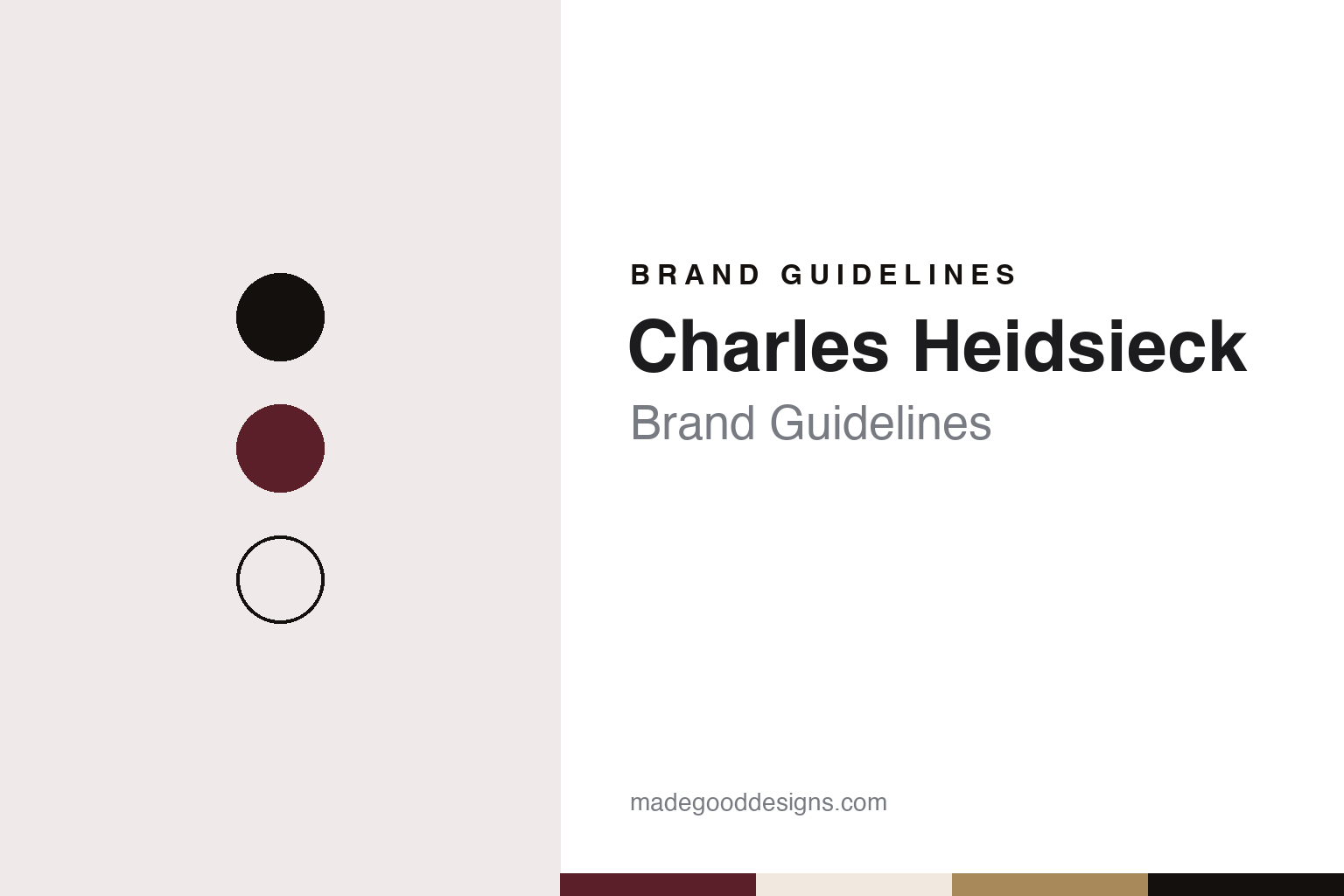
Two constants: a Charles Heidsieck claret, chalk and gold palette and a Didone serif register. Abstract homage — not a Charles Heidsieck product or mark; no bottle, label or logo is reproduced.
Champagne Charlie
A founder who became a nickname.
Charles Heidsieck is a Reims house, founded in 1851 by Charles-Camille Heidsieck. He came from a Champagne family: the company says he was born 37 years after his grand-uncle founded the Heidsieck house of 1785 — the house that today trades as Piper-Heidsieck — and that he was 29 when he set up a house of his own. His mother, Emilie, and his wife, Amélie, were both Henriots, English Wikipedia says, a family name that returns later in the story.
His fame was made in America. In 1852 he made his first trip to the United States, touring New England and New York State and appointing an import agent, English Wikipedia says; on a later visit he was celebrated in New York with banquets, and the press persona of “Champagne Charlie” followed. The company calls the America of 1852 a country “still untouched by any champagne trade” and quotes an 1860 letter to his wife: “There is a rumour about me, an excitement as they say, that we will greatly benefit from.”
The Civil War ended that run. In 1862, after travelling to New Orleans to recover debts, he was seized by the Union general Benjamin F. Butler, held at Fort Jackson in Louisiana on suspicion of spying, and released on 16 November 1862, English Wikipedia says, citing Don and Petie Kladstrup’s history Champagne. He returned to France bankrupt; land in Colorado, received in settlement of a debt, later let him repay his creditors and relaunch the house, the same source says. The story was retold in a 1989 French-Canadian television film, Champagne Charlie, with Hugh Grant in the title role.
Colour
Chalk, time and reserve wines.
The house’s second founding asset lies underground. In 1867, the company says, Charles Heidsieck bought the crayères — chalk pits beneath Reims that it describes as dating from the 3rd century and calls “veritable subterranean cathedrals.” It says they hold more than eight kilometres of galleries, some thirty metres below ground, and several million bottles. The chalk cellars of Reims and Épernay were inscribed on the UNESCO World Heritage List in 2015 as part of the “Champagne Hillsides, Houses and Cellars,” and in 2025 the house marked the tenth anniversary of its crayères’ inscription.
The house builds its style on stored wine. It says its Brut Réserve contains about half reserve wines, with an average of ten years of ageing, and calls time “a 4th varietal.” It also says a single bottle can draw on almost 60 different crus, a habit of blending it traces to the founder. Its range runs from the Brut Réserve and Rosé Réserve through vintage wines to Blanc des Millénaires, a Chardonnay-only vintage cuvée, a revived Champagne Charlie cuvée named after the founder’s nickname, and the Collection Crayères, older bottles released from the cellars.
Its cellar masters are part of the brand. Decanter’s producer profile credits Daniel Thibault, installed in 1976, with the first vintage of Blanc des Millénaires. The company says its cellar masters have been named Sparkling Winemaker of the Year at the International Wine Challenge twelve times in twenty years. Élise Losfelt was appointed cellar master in March 2023, the company says; when she left in 2025 to run her family estate in the Languedoc, she handed over to Émilien Érard, who had joined the house in 2018 and took up the role in July 2025, the trade press reported. The house also says it is a certified B Corporation.
Typography
Design and documentation.
The seven brands in this group are all Champagne houses: Pol Roger, Billecart-Salmon, Perrier-Jouët, Pommery, Nicolas Feuillatte, Charles Heidsieck and Gosset. Champagne houses in general sit at many different points in the trade, from family houses that still carry a founder’s name to labels that now belong to much larger drinks groups, and a single name can be sold everywhere from a corner shop to a restaurant list.
A Champagne house’s identity is usually carried less by a single bottle than by a label, a name and the place it promises, because the company behind the name may have changed hands, moved its cellars or grown far beyond the town where it started. That makes the questions behind each name worth asking plainly: who started it, who owns it now, and where its wine is actually made and aged.
Each guide separates what independent sources record from what the company says about itself — its founding story, its owners over time, where its wine is made and how its labels have changed — and marks plainly what rests only on the company’s own word.
Aa
A Didone serif — “Typiquement Charles.” (Specimen set in Playfair Display, a serif STAND-IN; NOT the Charles Heidsieck logo.)
Charles Heidsieck
Henriot, Rémy Cointreau, Descours.
The house has changed hands several times. In 1976 the struggling business was bought by Joseph Henriot of Champagne Henriot, Decanter’s producer profile says, bringing it back to the family of its founder’s mother and wife. In 1985 it passed to Rémy Cointreau, the cognac and spirits group, whose Champagne company, Piper-Heidsieck Compagnie Champenoise, came to hold both Heidsieck brands. In May 2011 Rémy Cointreau and EPI — the family holding company run by Christopher Descours — announced that they had finalised the sale of that company, Piper-Heidsieck Compagnie Champenoise, with both Heidsieck brands, according to a Business Wire release of 31 May 2011; Decanter and The Drinks Business reported the sale completed that summer, with Rémy keeping a distribution agreement. The company says the Descours family took over the house in 2011 “with the aim of ensuring its international renown.”
Today Charles Heidsieck and Piper-Heidsieck are run as separate brands from the same Reims company, Compagnie Champenoise PH-CH, and Decanter says the two are made side by side in a modern winery on the outskirts of the city, while Charles Heidsieck keeps its own crayères for ageing.
The founder’s character is the brand’s tone of voice. The company sums it up as “Typiquement Charles” — “flouting convention, bowing to no influence,” in its words — and opens its founder page with a line of its own: “Do you know Charles Heidsieck? The man or the champagne? What difference does it make, the two are inseparable!”
For a design guide, Charles Heidsieck shows how a founder’s biography — a nickname, a voyage, a prison cell and a set of chalk cellars — can carry a whole brand. Compare Piper-Heidsieck, its sister house under the same owner, and Nicolas Feuillatte, whose owner bought Champagne Henriot in 2023. For this guide we use a claret, a chalk white and an old gold with a serif, an unofficial interpretation; no product or logo is reproduced.
Explore & save
Keep Charles Heidsieck’s identity on hand — save it to a board in the Made Good inspiration library.
Charles Heidsieck identity set
Pin the Charles Heidsieck claret, chalk and gold palette and the Didone serif register to your own board.