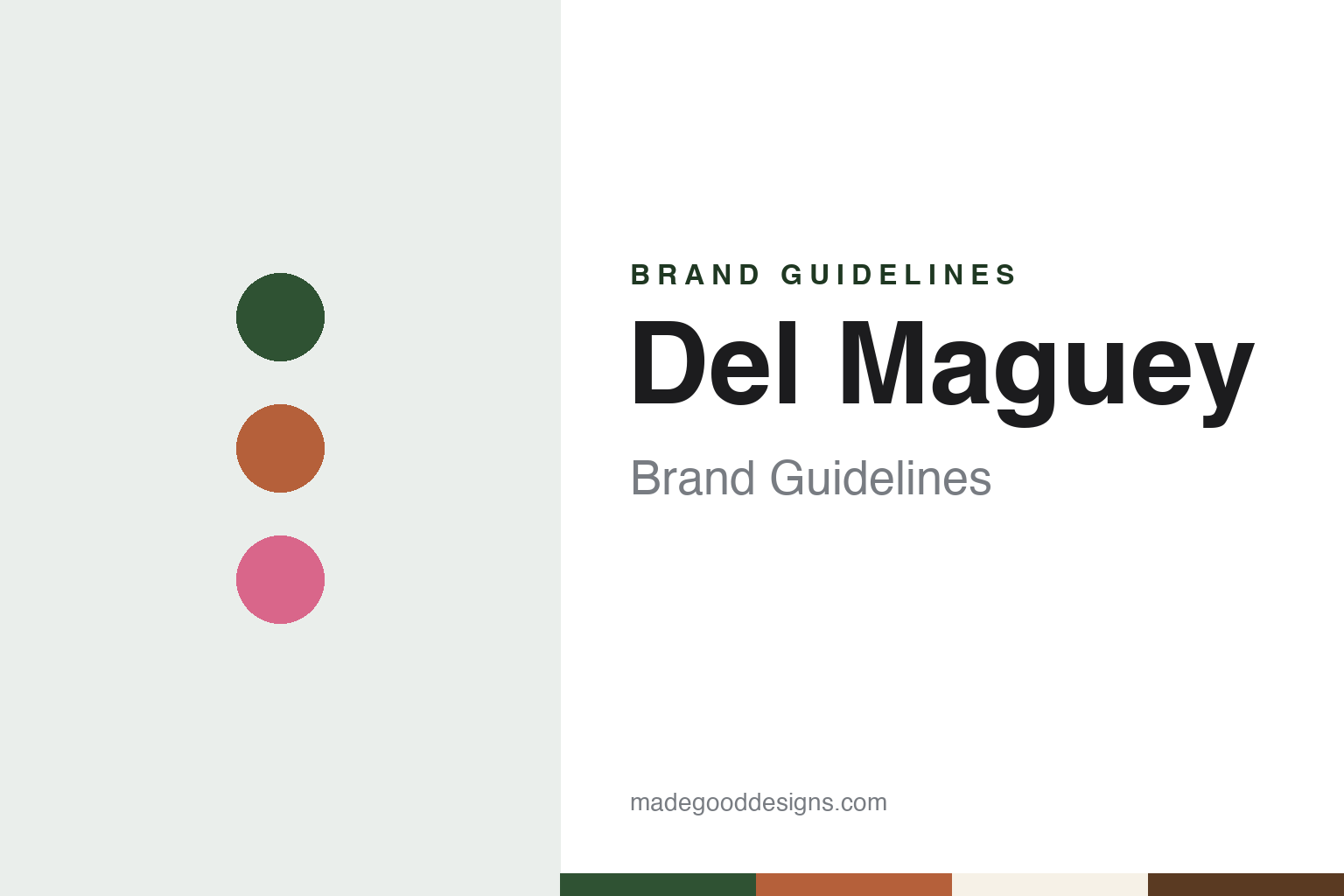
Del Maguey Brand Guidelines
Ron Cooper’s single-village mezcal, founded 1995.
Aa
Two constants: a marigold, agave teal and clay red palette and a warm humanist serif register. Abstract homage — not a Del Maguey product or mark; no label, artwork or bottle is reproduced.
An artist in Oaxaca
From a studio in California to the palenques of the villages.
Del Maguey began with an artist rather than a distiller. Ron Cooper, English Wikipedia says, is an American artist who started his career in Los Angeles in the mid-1960s and is counted among the California-based Light and Space artists, with work in the collections of the Solomon R. Guggenheim Museum and the Los Angeles County Museum of Art. The same article says he first drove to Oaxaca in 1972, in a Volkswagen van along the early Pan-American Highway, and that by 1990 he was living and working there alongside Zapotec, Mixtec and Mixe producers.
The publisher’s description of Cooper’s book Finding Mezcal (Ten Speed Press, 2018, written with Chantal Martineau) says he came across mezcal in 1990 while collaborating with craftspeople in Oaxaca, at a time when the spirit was barely known in the United States. He founded Del Maguey Single Village Mezcal in 1995 to bring it north; the founding year is given in Pernod Ricard’s 2017 announcement and in VinePair’s profile of the brand published in October 2017. The book’s publisher credits Cooper with largely popularising mezcal in the United States.
The idea is in the name. Each bottle, VinePair explained in 2017, is named after the village where it is made, and the mezcal comes from family producers rather than a central distillery; the magazine counted twelve families in Oaxaca and Puebla, four of whom had worked with the company since its founding. Among the village names on the shelf are Chichicapa, after San Baltazar Chichicapa, and San Luis del Rio. Westword has described a visit to a palenque in Santa Catarina Minas run by the maker of Del Maguey Minero and Pechuga, a village known for distilling in clay pots. The entry-level Vida was already on the market by May 2010, when the blog Thirsty in LA reported on a tasting with Cooper and called it the brand’s latest release.
The bartender Bobby Heugel told VinePair in 2017 that Cooper had introduced him to mezcal in 2007 with a taste of Chichicapa, one small example of how the brand travelled through bars before it reached a wider public. English Wikipedia, citing the James Beard Foundation, says Cooper received a James Beard Award in 2016 as Outstanding Wine, Beer or Spirits Professional.
Colour
A sculptor’s labels and a village on every bottle.
The look of Del Maguey comes from a friendship. VinePair reported in 2017 that Cooper and the sculptor Ken Price lived next door to each other in Ventura, California, in the 1960s and became lifelong friends, and that Price drew the brand’s label art. The publisher of Finding Mezcal calls those labels “now-iconic,” and the book reproduces artwork by both men.
Price was best known for fired-clay sculptures painted in layers of bright colour, and Difford’s Guide describes his label artworks as distinctive and vibrantly coloured. The Albuquerque Museum holds a group of Price prints dated to around 1995 and titled after the brand’s bottlings, among them “Minero,” “San Luis del Rio,” “Santo Domingo Albarradas” and “Tobalá.” The museum’s catalogue describes the “Minero” print as showing a truck on a red road, with a village, mountains and a flock of birds behind it: a landscape of the place the mezcal comes from rather than a picture of the bottle.
That gives the brand an unusual structure for a spirits label. Instead of one fixed emblem repeated across a range, each village gets its own picture and its own name, and the brand name and the phrase Single Village Mezcal hold the set together. The village is the product name; the picture is the place.
The labels also connect the brand to the art world it came from. Cooper’s own artwork and Price’s appear side by side in Finding Mezcal, and Price’s label prints sit in a public museum collection rather than only on a shelf.
Typography
Design and documentation.
The seven brands in this group are all mezcal, baijiu and grappa names: Del Maguey, Montelobos, 400 Conejos, Luzhou Laojiao, Fenjiu, Yanghe and Nardini. Spirits brands in general sit at many different points in the trade, from family houses that still carry a founder’s name to labels that now belong to much larger drinks groups, and a single brand can be sold everywhere from a corner shop to a bar list.
A spirits brand’s identity is usually carried less by a single bottle than by a label, a name and the place it promises, because the company behind the name may have changed hands, moved its production or grown far beyond the place where it started. That makes the questions behind each name worth asking plainly: who started it, who owns it now, and where its spirit is actually made and bottled.
Each guide separates what independent sources record from what the company says about itself — its founding story, its owners over time, where its spirit is made and how its labels have changed — and marks plainly what rests only on the company’s own word.
Aa
A warm humanist serif for a range named village by village. (Specimen set in Alegreya, a serif STAND-IN; NOT the Del Maguey logo.)
Del Maguey
From an artist’s import business to part of a global drinks group.
Del Maguey became the first mezcal in the portfolio of Pernod Ricard. The French group announced on 7 June 2017, through its American incubator New Brand Ventures, that it had agreed to take a majority stake in Del Maguey Single Village Mezcal, BevNET and BeverageDaily reported; the terms were not disclosed. Drinks International reported in August 2017 that the acquisition had been completed. Pernod Ricard said at the time that Cooper, Michael Gardner, Steve Olson and the rest of the team would remain, and Cooper said the partnership rested on preserving Zapotec culture and the traditional way of making mezcal. VinePair noted that the group already owned the Altos and Avión tequilas.
Under the new owner the range has kept growing while staying tied to named places. The International Wine & Spirits Competition announced in November 2024 that Del Maguey had won its Outstanding Spirit Producer trophy, and in 2025 the brand marked its 30th anniversary, which Maxim covered in April 2025.
Two practical notes for anyone researching the brand. “Maguey” is a common Mexican word for the agave plant, so the name turns up across many unrelated mezcal labels, bars and shops; the full brand name is Del Maguey Single Village Mezcal. And the label artist is the California sculptor Ken Price, Cooper’s neighbour from Ventura.
For a design guide, Del Maguey shows how a range can be built on places instead of a single emblem: a village name and a painted landscape for every bottle, held together by one artist’s hand. Compare Montelobos, the Oaxacan mezcal that Campari Group took control of in 2019, and Pernod, the anise that gave Pernod Ricard half its name. See also What font does Del Maguey use? For this guide we use marigold, agave teal and clay red with a serif, an unofficial interpretation; no product or logo is reproduced.
Explore & save
Keep Del Maguey’s identity on hand — save it to a board in the Made Good inspiration library.
Del Maguey identity set
Pin the Del Maguey marigold, agave teal and clay red palette and the warm humanist serif register to your own board.