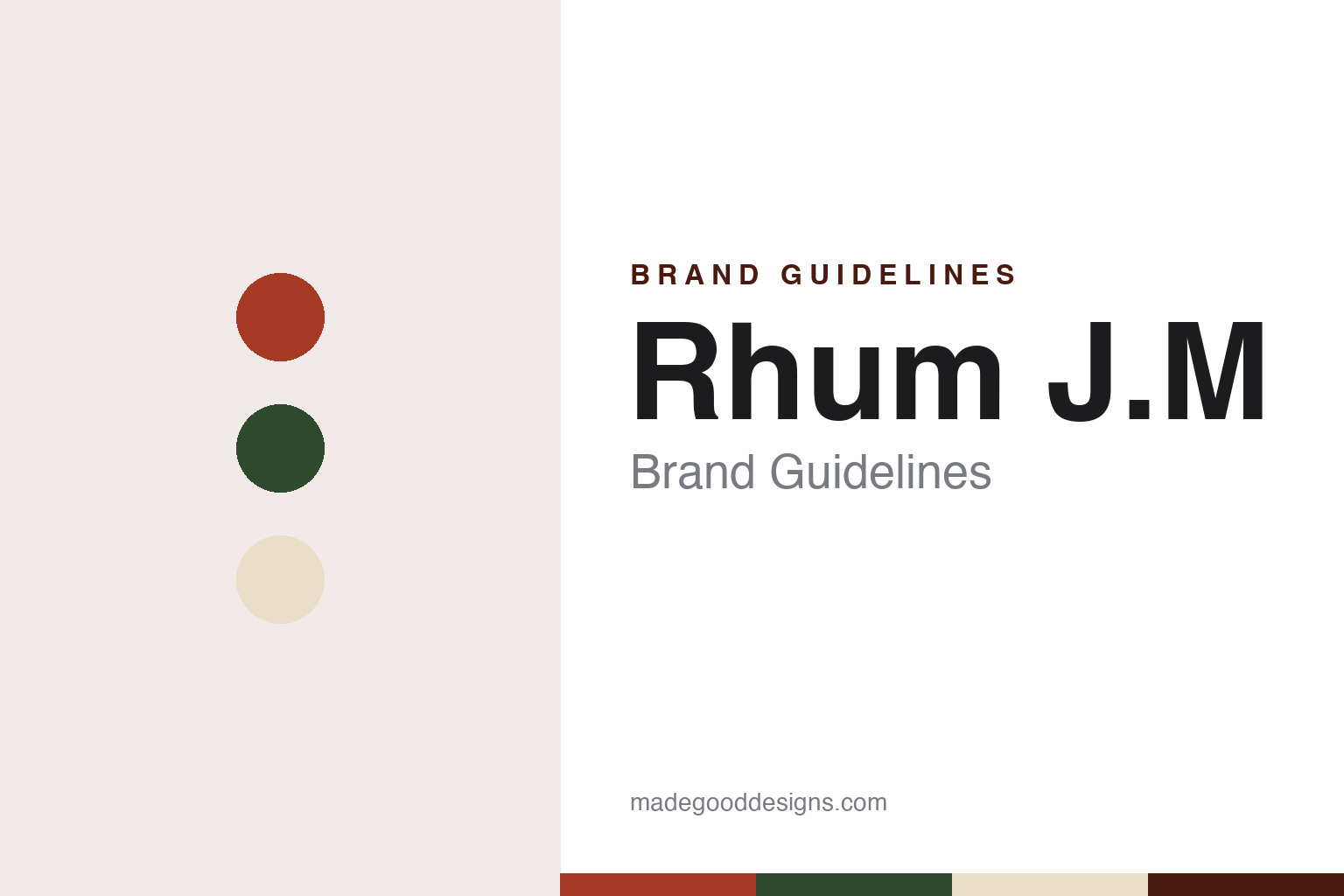
Rhum J.M Brand Guidelines
The 1845 Macouba distillery named for its founder’s initials.
Aa
Two constants: a red roof, Pelée green and cane cream palette and a classical serif register. Abstract homage — not a Rhum J.M product or mark; no label, logo or bottle is reproduced.
Two initials
A Saint-Pierre merchant names a distillery after himself.
Rhum J.M takes its name from a man. French Wikipedia’s article on the brand says that in 1845 Jean-Marie Martin, a merchant from Saint-Pierre, bought an estate at Macouba and founded a distillery named after his initials, J.M. The rum reviewer The Lone Caner wrote in December 2021 that Martin aged his rum in oak casks marked with those initials.
The land had a long history before the rum. French Wikipedia says the Habitation Bellevue is first recorded in 1671 and is one of the oldest estates in Macouba, at the northern tip of the island. It lies at the foot of Montagne Pelée, between the Roches and Macouba rivers. In 1790 Antoine Leroux-Préville bought the neighbouring estate, which The Lone Caner says he renamed Habitation Fonds-Préville; it was from his daughters that Jean-Marie Martin bought it in 1845.
The 20th century belonged to another family. French Wikipedia says Gustave Crassous de Médeuil, who already owned Bellevue, bought Fonds-Préville in 1913 and joined the two into a single estate; The Lone Caner dates the purchase to 1914. The family grew coffee on the land until the Second World War and tried tobacco in the 1960s before giving it up, French Wikipedia says, and in 1971 the estate turned fully to rum. It was, The Lone Caner wrote, among the last independent single-estate rum makers on Martinique.
That ended in 2002, when the Crassous de Médeuil heirs sold the distillery and the estates to the Groupe Bernard Hayot, the Martinique group that already owned Rhum Clément, according to French Wikipedia.
Colour
Estate cane, creole columns and a sense of place.
The brand’s story is built on its single estate. French Wikipedia says Rhum J.M is made only from cane grown on the Bellevue estate, and names four cane varieties planted there, three bred in Barbados and one in Réunion. The cane juice is distilled in two traditional copper creole columns, the same article says, at about 72 per cent alcohol, a level it links to keeping the rum’s aromas.
The rum carries the AOC Martinique appellation. French Wikipedia’s article on rhum agricole says that appellation was created by a decree of 5 November 1996, the first in France’s overseas territories and the first for a white spirit, and that it requires continuous column distillation of fresh cane juice. J.M’s range runs across white, amber and aged (vieux) rums, French Wikipedia says, with rums bottled at 50 and 55 per cent.
Place has also shaped the packaging. The design sites World Brand Design and Packaging of the World have shown a limited edition called J.M Joyau Macouba, packaged with the design agency LINEA of the Spirits Valley in a patchwork-style sleeve meant to evoke travel. Its printed images draw on the estate: the view over the distillery’s red roofs, the bridge carrying spring water from Montagne Pelée, a cane-cutting machine and the workshop where the house develops its flavours. The Lone Caner wrote in 2021 that the white rum was first released in 2017 as “Jungle” and sold as Joyau Macouba from 2018.
The estate’s visual history has also been questioned. French Wikipedia says an old entrance sign at the distillery showed the four-serpent flag, which it describes as considered a symbol of slavery, and that the flag was removed from the distillery’s visuals after a controversy reported by RCI in February 2021.
Typography
Design and documentation.
The seven brands in this group are all rum names: Planteray, Don Q, Pampero, Santa Teresa, Rhum Clément, Rhum J.M and Damoiseau. Rum brands in general sit at many different points in the trade, from family houses that still carry a founder’s name to labels that now belong to much larger drinks groups, and a single brand can be sold everywhere from a corner shop to a cocktail bar.
A rum brand’s identity is usually carried less by a single bottle than by a label, a name and the place it promises, because the company behind the name may have changed hands, moved its production or grown far beyond the place where it started. That makes the questions behind each name worth asking plainly: who started it, who owns it now, and where its rum is actually distilled, aged and bottled.
Each guide separates what independent sources record from what the company says about itself — its founding story, its owners over time, where its rum is made and how its labels have changed — and marks plainly what rests only on the company’s own word.
Aa
A classical serif for two initials and a founding date. (Specimen set in Cormorant Garamond, a serif STAND-IN; NOT the Rhum J.M logo.)
Rhum J.M
A northern estate inside a Martinique group.
Since 2002 Rhum J.M has been part of the same group as Rhum Clément. The Groupe Bernard Hayot, which French Wikipedia says Bernard Hayot founded in 1960 and which is based in Le Lamentin, Martinique, holds its rums through a subsidiary, Spiribam. The Lone Caner wrote in 2021 that Spiribam markets J.M alongside Clément and the rums of Saint Lucia Distillers.
Spiribam has grown beyond Martinique. Drinks International reported in March 2025 that the division had eleven spirits brands from distilleries in Martinique, Saint Lucia, Mauritius, French Guiana and France, naming Rhum JM among its agricole rums. French Wikipedia says the group bought the Burgundy liqueur maker Joseph Cartron in July 2021.
The two Martinique rums sit in different places. Clément is distilled at the Simon distillery in Le François, on the Atlantic coast, while J.M is distilled on its own estate at Macouba in the far north, under Montagne Pelée. French Wikipedia lists the operating company as the heirs’ firm SCA Héritiers Crassous de Médeuil, with distribution handled by Rhum J.M Distribution.
The name needs care online: “JM” and “J.M” are common initials used by many unrelated businesses, so searches for the rum are best made with the word “rhum” in front.
For a design guide, Rhum J.M shows how a founder’s initials, a single estate and a volcano can carry an agricole rum’s identity for nearly two centuries, from a Saint-Pierre merchant’s casks to limited editions that picture the distillery’s red roofs. Compare Rhum Clément, its stablemate from Le François, and Appleton Estate, the Jamaican estate rum. For this guide we use red roof, Pelée green and cane cream with a serif, an unofficial interpretation; no product or logo is reproduced.
Explore & save
Keep Rhum J.M’s identity on hand — save it to a board in the Made Good inspiration library.
Rhum J.M identity set
Pin the Rhum J.M red roof, Pelée green and cane cream palette and the classical serif register to your own board.