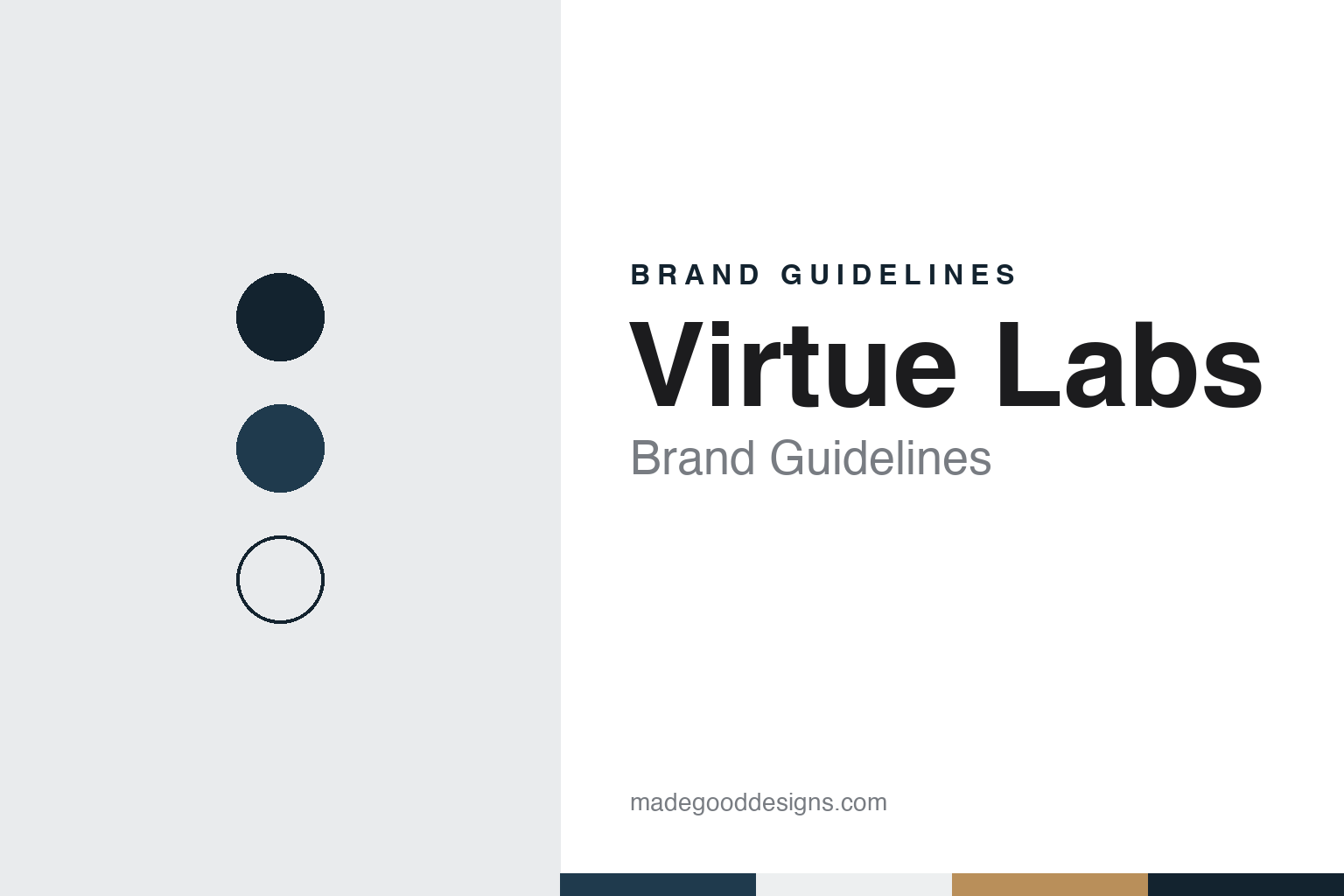
Virtue Labs Brand Guidelines
The Raleigh haircare brand built on a keratin protein from military research.
Aa
Two constants: a lab navy, clinic white and amber palette and a clinical sans register. Abstract homage — not a Virtue Labs product or mark; no bottle, logo or label is reproduced.
From KeraNetics
A protein developed for wounded soldiers, adapted for hair.
Virtue Labs is a haircare company based in Raleigh, North Carolina, and it launched its first products in 2017, according to a December 2020 press release from its majority owner. Its founder is Melisse Shaban, whom the Raleigh magazine WALTER described in November 2017 as the former chief executive of Frédéric Fekkai and of the skincare brand StriVectin, which links Virtue to Fekkai.
The brand’s starting point was not a salon but a laboratory. WALTER reported that Shaban heard of technology developed by a retired Army officer, Lt. Col. Dr. Luke Burnett, who worked at KeraNetics, a biotechnology company in Winston-Salem, North Carolina. The work was aimed at using regenerative medicine to treat catastrophic injuries from battlefield explosions, and the scientists behind it had links to Wake Forest University, the magazine said.
The material at the centre of that work was a keratin protein that Virtue calls Alpha Keratin 60ku. According to WALTER, it took Shaban five years to turn it into a range of hair products: her team had to adapt the protein for topical cosmetic use, a purpose for which Virtue holds the exclusive rights; build its own machines to extract it; and work out how to put it into shampoos, conditioners and styling products. The company describes the protein as patented and says it appears in each of its Virtue haircare products.
Colour
A lab in a former tobacco building.
In 2017 WALTER visited Virtue’s laboratory, which it located inside a former R.J. Reynolds tobacco facility in Winston-Salem. The magazine described rooms set aside for protein extraction, purification, batch-testing, quality control, experimentation and bottling, and reported that the raw material was untreated human hair bought from individuals in China and shipped through a specialist importer. The company’s chief science officer at the time, Erin Falco, held a doctorate in regenerative tissue, the magazine said. Early backing came from a group of North Carolina investors, with a grant from the Golden LEAF Foundation routed through the Whitaker Park Development Authority, and Shaban said she hoped to create as many as 60 jobs at the lab within a few years.
Virtue’s own website still makes the North Carolina connection part of its pitch. It says Alpha Keratin 60ku is “thoroughly tested and produced right here in our lab in North Carolina,” and signs that line with the lab’s Winston-Salem location. That is the company’s claim about the protein; its website does not say where every finished product is filled.
The range grew from a small core. The 2020 release listed Recovery shampoo and conditioner, a restorative treatment mask, a healing oil and ColorKick among its products, and named Sephora and Bluemercury, along with salons and retailers in the United States, Britain, Canada, Europe and Australia, as places it was sold. Today the website organises its products into ranges including Recovery, Full, Smooth, Curl and Flourish, alongside a hair quiz and a salon finder.
The brand presents itself in the language of a laboratory rather than a salon: the word “Labs” in the name, an emphasis on a single molecule, and copy that talks about science and testing. Its website lists its values as integrity, innovation and transparency.
Typography
Haircare and its owners.
The seven brands in this group are all hair-care names: KEVIN.MURPHY, Sachajuan, Maria Nila, IGK, Virtue, Fekkai and Pureology. Hair-care brands in general sit at many different points in the trade, from small houses that still carry a founder’s name to labels that now belong to much larger beauty groups, and a single brand can be sold everywhere from a hairdresser’s back bar to a department store or an online shop.
A hair-care brand’s identity is usually carried less by any one formula than by a bottle, a name and a colour code on the shelf, because the company behind the name may have changed hands, moved its offices or grown far beyond the salon or city where it started. That makes the questions behind each name worth asking plainly: who started it, who owns it now, and how its packaging and name have changed over time.
Each guide separates what independent sources record from what the company says about itself — its founding story, its owners over time, its packaging and how its look has changed — and marks plainly what rests only on the company’s own word. None of these guides assesses what a product does for hair; claims about ingredients or results are the companies’ own.
Aa
A clinical sans for a brand that leads with its lab. (Specimen set in Inter Tight, a sans STAND-IN; NOT the Virtue Labs logo.)
Virtue Labs
Majority-owned by Combe since 2020.
Virtue did not stay founder-controlled for long. On 1 December 2020, Combe Inc. announced a Series C investment in the company and said that, as a result, it would now hold majority ownership. Combe, founded in 1949 and based in New York, describes itself as a privately held, third-generation family-owned personal care company; its own brands include Just For Men, Clearasil and Vagisil, and it says it also invests in outside brands built on what it calls differentiated technologies. In the same release Keech Combe Shetty, Combe’s executive chair, said the company had invested in Virtue’s growth “since its launch in 2017,” and Shaban, then chief executive, called Combe “a valuable partner since our early days of commercialization.”
The leadership changed in 2023. On 22 May that year WRAL TechWire reported new funding led by Combe, again described as Virtue’s majority owner, and the appointment of Jose Luis Palacios, who had worked at Procter & Gamble, Coty and Google, as chief executive. Shaban stayed on as an adviser to the board and to the new chief executive, the report said, and John Rice was named as Virtue’s chairman.
That makes Virtue a different kind of haircare story from the salon-founded brands around it. Its founder came from the business side of beauty rather than from a chair behind a client, its signature ingredient came from medical research in North Carolina, and its majority owner is a family company whose own brands include Just For Men and Clearasil. The brand’s Raleigh base and Winston-Salem laboratory have stayed part of how it describes itself through each of those changes.
For a design guide, Virtue Labs shows how a haircare brand can build its whole identity around one ingredient and the laboratory that makes it. Compare Olaplex, another brand built on a single patented treatment, and K18, which also leads with a lab-made molecule. For this guide we use navy, white and a warm amber with a sans, an unofficial interpretation; no product or logo is reproduced.
Explore & save
Keep Virtue Labs’s identity on hand — save it to a board in the Made Good inspiration library.
Virtue Labs identity set
Pin the Virtue Labs navy, white and amber palette and the clinical sans register to your own board.


