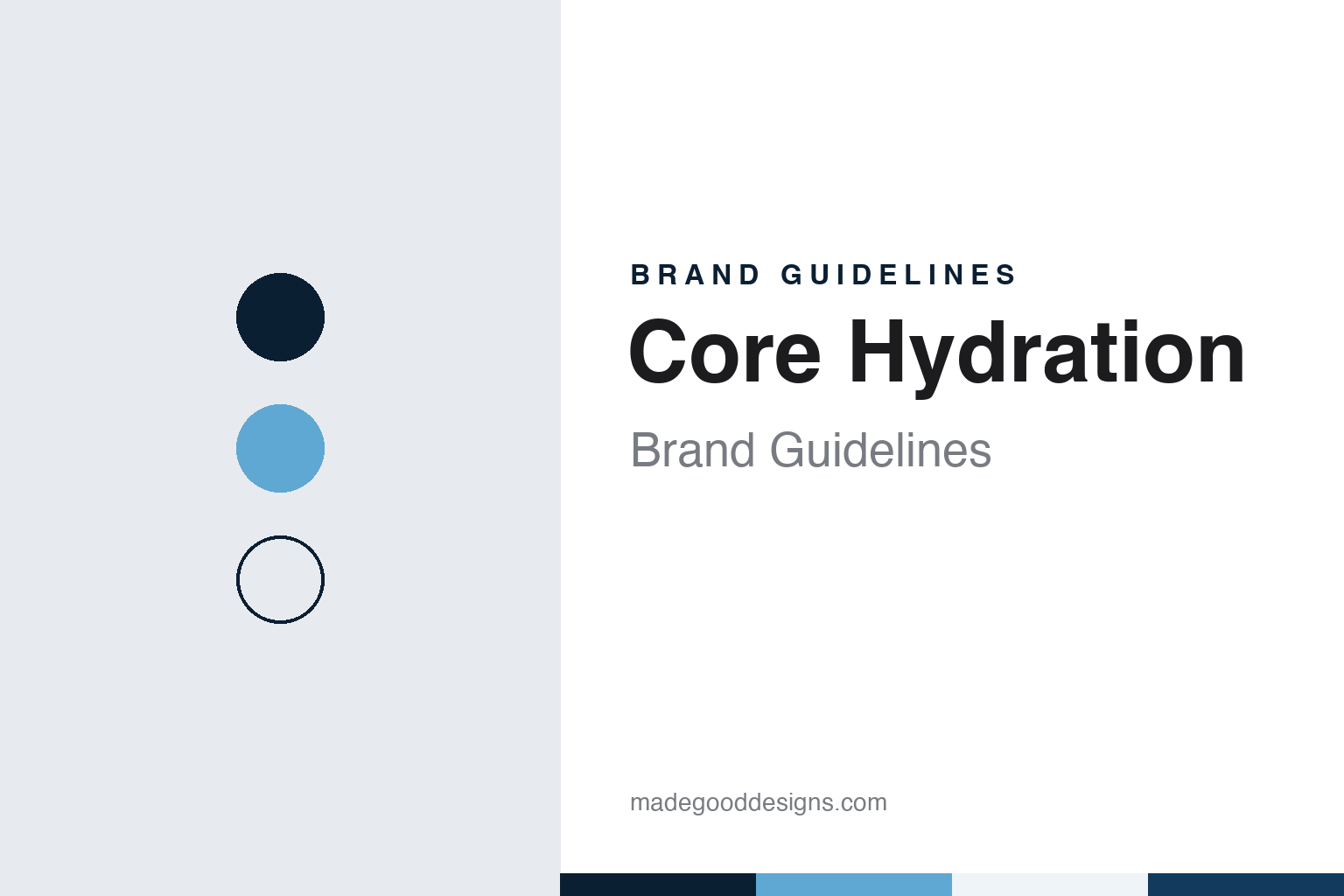
Core Hydration Brand Guidelines
Lance Collins’s tall-bottle water, from Southern California to Keurig Dr Pepper.
Aa
Two constants: a navy, blue and clear palette and a geometric sans register. Abstract homage — not a Core Hydration product or mark; no bottle, label or logo is reproduced.
CORE Natural
A beverage entrepreneur, a music producer and a new bottle.
Core Hydration began life under another name. In April 2015 the trade title Packaging Strategies published the launch announcement for CORE Natural Water, a premium bottled water from the beverage entrepreneur Lance Collins and the songwriter and record producer Lukasz Gottwald, known in the music business as Dr. Luke. The announcement described Collins as the founder of Fuze and NOS Energy and a co-founder of BodyArmor.
The company behind the water, CORE Nutrition, gives its founding year as 2015, and that is the date repeated in Keurig Dr Pepper’s 2018 announcement and in BevNET’s coverage. The water itself reached shelves a little earlier. The April 2015 announcement said that CORE Natural had been on the market for “just over six months,” and FoodNavigator-USA reported in February 2016 that the brand first appeared in late 2014.
The first market was Southern California. According to the 2015 announcement, CORE Natural debuted through Haralambos Beverage Company, a Los Angeles distributor, and launched in San Diego County with John Lenore & Company. The same release listed grocery and convenience chains that had agreed to stock it, including Whole Foods, Sprouts, Kroger, Safeway and 7-Eleven, and new distribution in the Northeast through Big Geyser in New York and Polar Beverages. The company described the product as purified water treated in a seven-stage process that includes ultraviolet light, carbon filtration, reverse osmosis and ozonation.
Music was part of the pitch from the start. The 2015 release named Katy Perry, Diplo, Becky G and the producer Max Martin among the brand’s music ambassadors and investors, and BevNET later added Juicy J to the list of famous backers. By 2016 the water was trading as CORE Hydration, the name used in trade coverage that year and in Keurig Dr Pepper’s later announcement.
Colour
A contoured bottle with a wide mouth.
For a design guide, the most useful fact about Core is that its package was a deliberate, credited piece of work. The April 2015 launch announcement said that Collins and Gottwald chose the branding agency Flood Creative to design the brand’s packaging, and that the bottle was proprietary and trademarked. It described three features: a contoured shape, a wide-mouth closure and a translucent over-cap, in 30-ounce and 20-ounce sizes of PET plastic.
The release presented the package as a selling point in its own right, saying that Collins wanted to deliver innovation through package design as well as through the drink, and that the bottle was built for convenience on the go.
The name is short. The company’s own releases set it in capitals, as CORE, and used the same word across the business, from CORE Natural and CORE Nutrition to the later CORE Hydration and CORE Organic. Launch publicity paired the bottle with recording artists and producers: the April 2015 release quoted Gottwald as saying he wanted to connect leading artists with the brand, and it presented the water alongside his work as a songwriter for Kelly Clarkson, Britney Spears, Avril Lavigne and Katy Perry, and as the owner of the record label Kemosabe Records.
The brand also grew into a small family. BevNET reported in March 2017 that CORE Nutrition showed new products in its Organic and Hydration lineups at Natural Products Expo West, and Keurig Dr Pepper’s 2018 announcement described the portfolio as two lines, CORE Hydration and CORE Organic, a USDA-certified organic fruit drink. The palette in this guide is our own reading of a clear bottle and blue labelling, not an official specification.
Typography
Design and documentation.
The seven brands in this group are all water names: vitaminwater, Liquid I.V., Core, Crystal Geyser, Deer Park, Arrowhead and Harrogate. Water brands in general sit at many different points in the trade, from family companies that still carry a founder’s name to labels that now belong to much larger food and drinks groups, and a single brand can be sold everywhere from a corner shop to a restaurant table.
A water brand’s identity is usually carried less by what is in the bottle than by a label, a name and the place or idea it promises, because the company behind the name may have changed hands, moved its production or grown far beyond the place where it started. That makes the questions behind each name worth asking plainly: who started it, who owns it now, and where its products are actually made and bottled.
Each guide separates what independent sources record from what the company says about itself — its founding story, its owners over time, where its products are made and how its labels have changed — and marks plainly what rests only on the company’s own word.
Aa
A geometric sans with wide, round capitals for a short all-caps wordmark. (Specimen set in Montserrat, a sans-serif STAND-IN; NOT the Core Hydration logo.)
Keurig Dr Pepper
From allied brand to owned brand.
Core’s route to a large owner ran through distribution. BevNET and the company’s announcement of 27 September 2018 said that Core had been an “allied brand” of Dr Pepper Snapple Group, and then of Keurig Dr Pepper, since 2016, with the larger company already handling about two-thirds of its distribution in the United States. Keurig Dr Pepper itself had been formed only that July, by the merger of Keurig Green Mountain and Dr Pepper Snapple Group.
On that day Keurig Dr Pepper announced a definitive agreement to acquire CORE Nutrition LLC, the owner of CORE Hydration and CORE Organic, paying in its own shares. Collins said in the release that he looked forward to being a shareholder in the company. BevNET noted two details of the cap table: Coca-Cola had held an indirect stake through L.A. Libations, an early investor in and distributor of Core in which Coca-Cola is a part-owner, and the convenience chain 7-Eleven was also an investor. The publication set the deal against a reshuffle of the independent brands that the Dr Pepper business distributed, after the premium water Fiji moved its distribution elsewhere and Coca-Cola took a minority stake in BodyArmor.
The same year brought Keurig Dr Pepper another regional purchase, the Texas soda Big Red, English Wikipedia notes, citing CNBC. Its article on the company lists CORE Hydration among the key brands of Keurig Dr Pepper’s US refreshment beverages business, alongside names such as Dr Pepper, Canada Dry and Snapple, and the Mexican mineral water Peñafiel.
The name needs care online. “Core” is a common word used by many unrelated businesses, and in October 2026 the address corewater.com led to a domain-sale page rather than to the brand.
For a design guide, Core Hydration shows how a credited bottle shape, a one-word name in capitals and a set of famous backers can carry a new water from Los Angeles distributors to a national drinks company in about four years. Compare Peñafiel, the Tehuacán mineral water in the same owner’s portfolio, and Big Red, the Waco soda it bought in the same year. For this guide we use deep navy, label blue and a clear pale blue with a geometric sans, an unofficial interpretation; no product or logo is reproduced.
Explore & save
Keep Core Hydration’s identity on hand — save it to a board in the Made Good inspiration library.
Core Hydration identity set
Pin the Core Hydration navy, label blue and clear palette and the geometric sans register to your own board.