Big Red Brand Guidelines
The Waco red cream soda named on a golf course.
Aa
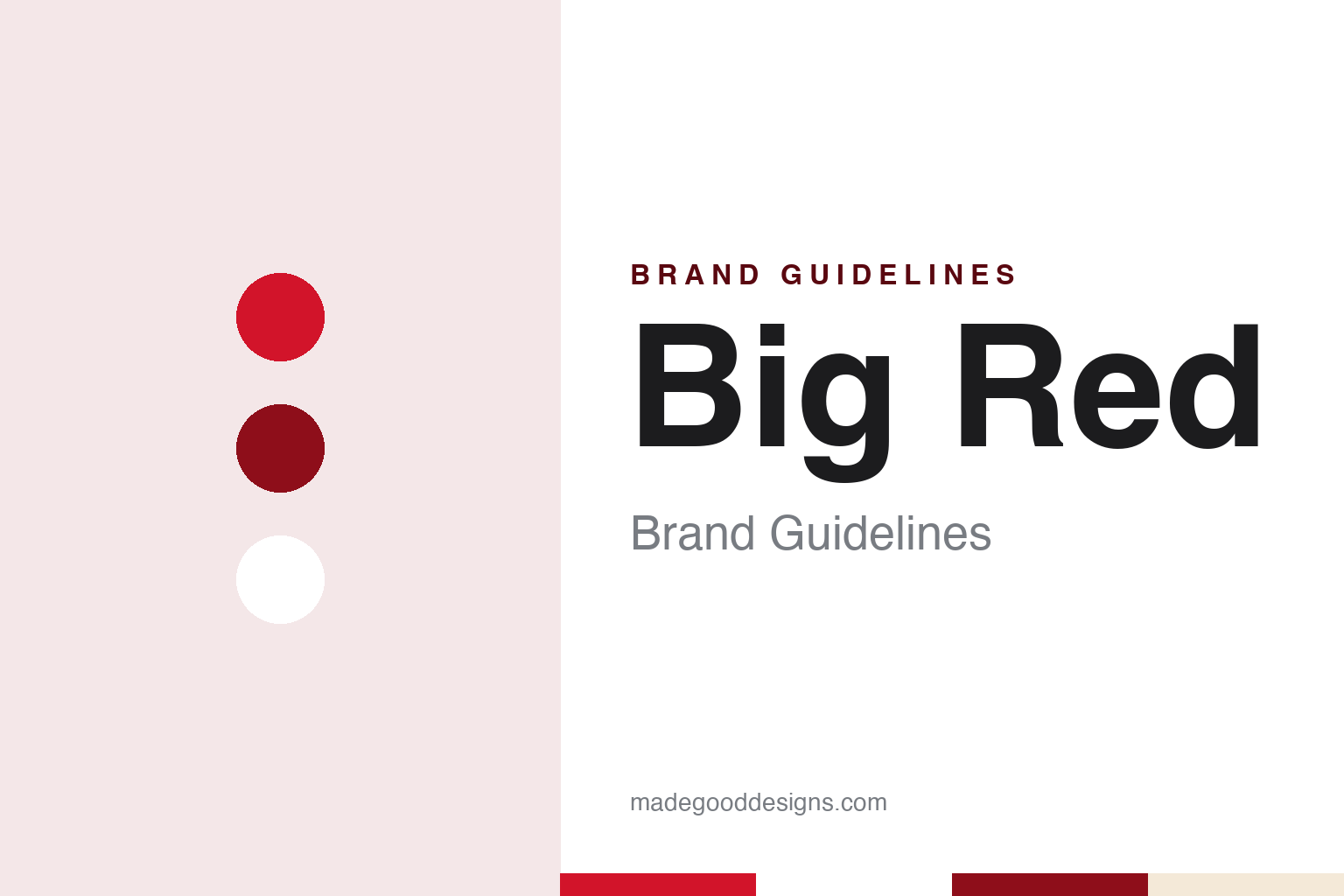
Two constants: a soda red, deep red and vanilla cream palette and a heavy grotesque sans register. Abstract homage — not a Big Red product or mark; no bottle, can or logo is reproduced.
Sun Tang Red Cream Soda
A Waco laboratory, two bottlers and a red drink.
Big Red began in Waco, Texas, the same city that gave the world Dr Pepper half a century earlier. Texas Monthly, in a 1986 profile by Joe Nick Patoski, said the drink was invented in a Waco laboratory in 1937 by Grover C. Thomsen and R.H. Roark, 52 years after Dr Pepper’s birth in the same town. The company’s own history page, as archived in 2009, gives the same two names and the same year. The drink was not yet called Big Red: it went on sale as Sun Tang Red Cream Soda, and the company says the trademark for that name was registered in 1939.
It was a regional drink from the start. Texas Monthly said Sun Tang was marketed only in Central and South Texas and around Louisville, Kentucky. English Wikipedia, citing Kentucky Living magazine in 2018, explains the Kentucky link through Roark, who owned a bottling company in Louisville, and says Kentucky was the first state where the soda reached consumers. In May 2018 the mayor of Louisville, Greg Fischer, proclaimed a Big Red Day to mark 80 years of the drink in the city, the same magazine reported.
The flavour has long puzzled drinkers. Patoski wrote that many people take it for liquid bubble gum, but that it is in fact a combination of lemon and orange oils with a dose of vanilla for a creamy finish, and that its colour comes from a standard food dye, Red 40.
Colour
A caddy’s nickname, a splash and a bigger map.
The name came from a golf course. Texas Monthly reported that in the late 1950s Harold Jansing, then president of the San Antonio bottling plant, overheard caddies calling a Sun Tang a “big red.” When he later asked a caddy to fetch him four big reds and was handed another brand, he decided to change the name, he told the magazine. The company dates the change in two steps: the drink became Sun Tang Big Red Cream Soda in 1959, and plain Big Red in 1969, when the Sun Tang was dropped.
Growth followed. Texas Monthly said that in the late 1970s the company began an aggressive expansion into most Texas cities and beyond, reaching 105 franchises in 28 states, Panama and British Columbia by 1986. The company’s timeline lists a Sugar Free Big Red in 1971 and a Diet Big Red in 1982, long-neck bottles in 1988, Big Peach in 1994, Big Pineapple in 2001, a Big Red Float that it says made its debut at the Kentucky Derby in 2004, and Big Blue in 2008; by 2009 it said Big Red was sold in 43 states.
For a design reader, the most useful line in that timeline is the entry for 1997, when the company says it unveiled the “Big Red splash identity.” Its 2008 entries add a “bubbles” packaging design for Diet Big Red and a 20-ounce vintage-style bottle aimed at nostalgia. The colour has also travelled well beyond the pack. Patoski called the drink a must at Juneteenth celebrations, a point The New York Times (2004) and NPR (2007) also made about red sodas in Texas, and he noted that the San Antonio musician Doug Sahm posed with a Big Red on the cover of his 1971 album The Return of Doug Saldaña.
Typography
Design and documentation.
The seven brands in this group are all soft drinks from different regions of the United States: Cheerwine, Moxie, Faygo, Vernors, Big Red, Ale-8-One and Sun Drop. American regional soft-drink brands in general sit at many different points in the trade, from family firms that still carry a founder’s name to names that now belong to much larger drinks groups, and a single brand can be sold everywhere from a corner shop to a supermarket shelf.
A soft-drink brand’s identity is usually carried less by a single product than by a bottle or can, a name and the flavour it promises, because the company behind the name may have changed hands, moved its production or grown far beyond the place where it started. That makes the questions behind each name worth asking plainly: who started it, who owns it now, and where its drinks are actually made and bottled.
Each guide separates what independent sources record from what the company says about itself — its founding story, its owners over time, where its drinks are made and how its packaging has changed — and marks plainly what rests only on the company’s own word.
Aa
A heavy grotesque sans for a soda sold on its colour. (Specimen set in Archivo Black, a sans STAND-IN; NOT the Big Red logo.)
Big Red
Independent bottlers, private equity and a soft-drink giant.
For most of its life Big Red was a brand licensed to bottlers rather than a single factory. English Wikipedia says the drink has been produced and distributed by independent bottlers under licence from Big Red, Inc.; Beverage World, as cited there, ranked the company as the sixth-largest soft-drink company in the United States in the early 2000s, and the company’s own timeline repeated that ranking for 2008. In 2007, English Wikipedia says, the business was bought by Gary Smith with backing from Citigroup Venture Capital and Goldman Sachs, and the corporate headquarters moved from Waco to Austin in 2009.
The link with Dr Pepper ran deep. CNBC reported in July 2018 that Dr Pepper Snapple had held a minority stake in Big Red for a decade and had distributed it for more than 30 years. That month, a week after Dr Pepper Snapple completed its merger with Keurig Green Mountain, a Keurig Dr Pepper spokeswoman told CNBC that Big Red had signed an agreement to sell to the new company. CNBC described Big Red at the time as an Austin-based business, founded in 1937, which also owned the Hydrive energy water and Xyience energy drink brands. English Wikipedia’s Keurig Dr Pepper article records the acquisition as completed in 2018, and Big Red now sits in the same portfolio as Dr Pepper itself, the Waco drink that came first.
For a design guide, Big Red shows how a single colour and a nickname picked up on a golf course can become a regional identity strong enough to outlast the bottlers who built it. Compare Vernors, another regional soda in the Keurig Dr Pepper stable, and Sun Drop, a citrus soda with Southern roots. For this guide we use a soda red, a deep red and a vanilla cream with a heavy sans, an unofficial interpretation; no product or logo is reproduced.
Explore & save
Keep Big Red’s identity on hand — save it to a board in the Made Good inspiration library.
Big Red identity set
Pin the Big Red soda red, deep red and vanilla cream palette and the heavy grotesque sans register to your own board.