Marukome Brand Guidelines
The Nagano miso house of 1854 and its shaven-headed boy.
Aa
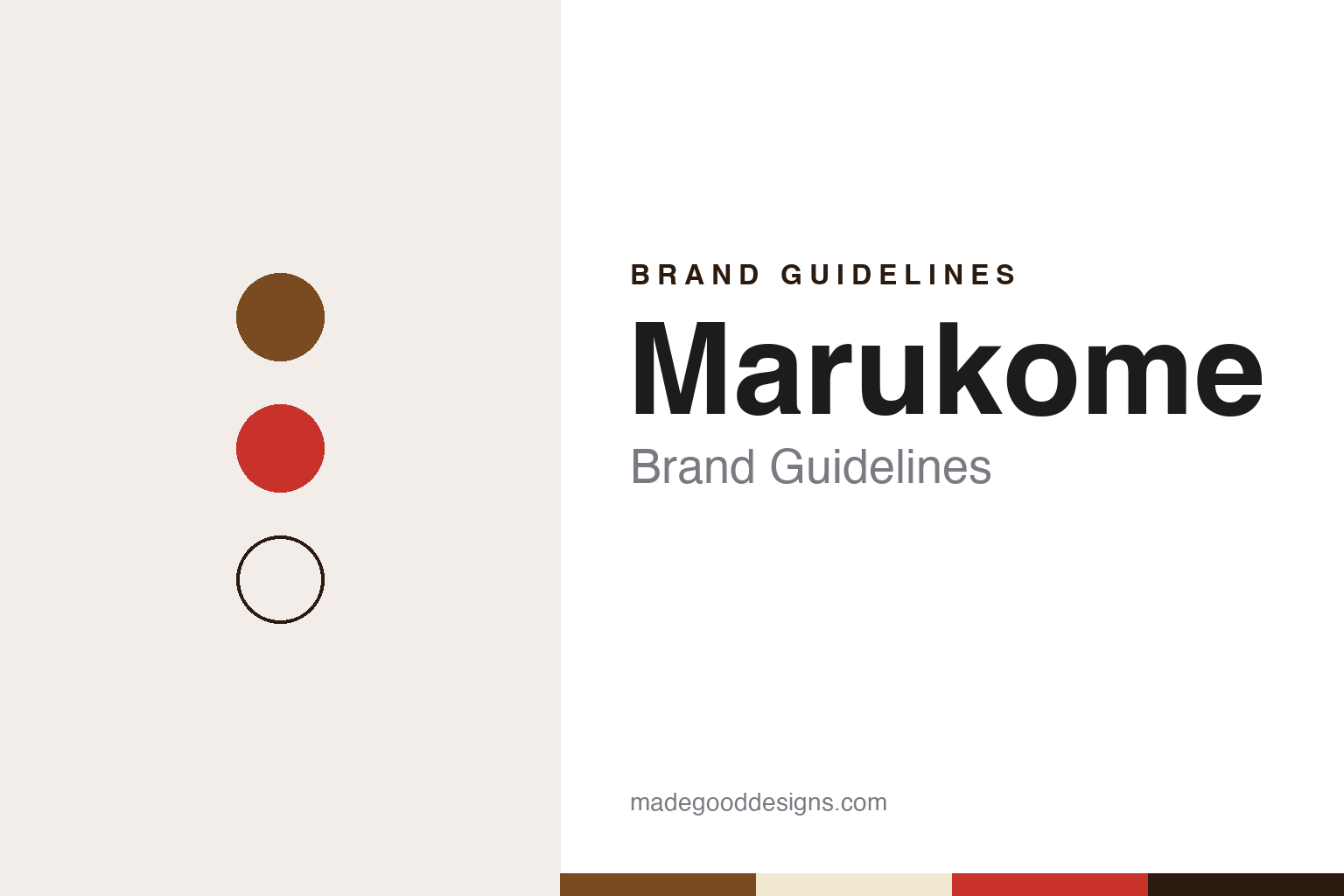
Two constants: a Marukome miso brown, cream and vermilion palette and a Mincho serif register. Abstract homage — not a Marukome product or mark; no pack, mascot or logo is reproduced.
Aoki of Nagano
A miso house that dates its start to 1854.
Marukome dates its start to 1854, the first year of the Ansei era, in Nagano, in the mountains of central Japan. The company says that a miso master named Aoki began brewing miso and soy sauce that year and that his family has carried the work on ever since; it does not give his first name. The business is still privately held, and the company’s own overview names Aoki Tokio as president.
The firm was incorporated in 1948 as Aoki Miso and Soy Sauce Co., Ltd. It took the name Marukome Miso in 1967, when it also set up sales companies for Tokyo and the Kansai region, and became Marukome Co., Ltd. in 1990, the year it introduced a corporate identity programme, according to the company’s timeline. The company explains the name as two words: “maru,” meaning round, for the plump soybean, and “kome,” meaning rice, for the rice koji used to ferment it.
Its head office and main factories remain in the Amori district of Nagano city. The company’s timeline adds a central research laboratory in 1989, a third factory at the head office in 1995, a fermentation warehouse in the Miasa highlands in 2004 and a factory at Takayama in 2011. Japanese Wikipedia, citing the Nihon Keizai Shimbun and the trade paper Shokuhin Shimbun, says a new plant at Uonuma in Niigata prefecture, run by the subsidiary Uonuma Jozo, began making rice-koji amazake in 2018. Abroad, the Orange County Register reported in December 2007 that Marukome USA had opened a headquarters and factory in Irvine, California; the company’s timeline lists it as its Los Angeles factory.
Colour
A shaven-headed boy and a jingle.
Marukome’s best-known image is Marukome-kun, the shaven-headed boy of its mark and its advertising. The company says the character was born around 1955 and draws on the old practice of young monks making miso as part of their training in Japanese temples. English Wikipedia describes the logo as a small boy with a bald head and says children have competed to play him in advertisements; Japanese Wikipedia says boys chosen by open audition have appeared in its television commercials since 1977, and that a girl with a bob haircut, Marukome-chan, joined them in 2015, which the Yomiuri Shimbun also reported in 2016.
Sound is part of the identity too. A jingle that repeats the company name, written by the composer Nakatani Katsuaki and heard in television and radio commercials from the 1970s, was registered as a sound trademark in March 2019, Japanese Wikipedia says. The company announced in 2012 that the tune had become the departure melody on the platforms of Takadanobaba station on the Seibu Shinjuku Line, the station nearest its Tokyo headquarters.
Packaging runs through the company’s own account of itself. Its timeline says it was the first in the industry to replace barrels with cardboard containers in 1960, patented a machine for “pillow” packs of miso in 1963 and another for stand-up pouches in 1972, as household refrigerators spread, and developed a machine for one-kilogram plastic cups in 1979. In 1982 it launched Ryotei no Aji, a miso with dashi stock already mixed in, which Japanese Wikipedia calls a long seller. The company says it became the leader of the miso industry in 1978; English Wikipedia, citing William Shurtleff and Akiko Aoyagi’s 2014 history of soyfoods in Japan, puts its share of Japanese miso production at about 13 percent.
Its advertising has used both animation and celebrity. Television commercials for Ryotei no Aji from around 2015 were fully animated by the production companies ROBOT and Studio Colorido, Japanese Wikipedia says. From 2016 the Australian model Miranda Kerr appeared in the company’s commercials, the Yomiuri Shimbun reported, and in 2017 she worked with Marukome on two organic miso powders, SoraNews24 reported.
Typography
Japan’s food and drink makers.
The seven brands in this group are all food and coffee names from Japan: Marukome, Hagoromo, Nagatanien, Sapporo Ichiban, UCC, Boss and Georgia. Japanese food and coffee brands in general sit at many different points in the trade, from family firms that still carry a founder’s name to names that now belong to much larger food and drink groups, and a single brand can be sold everywhere from a corner shop to a supermarket shelf.
A food or drink brand’s identity is usually carried less by a single product than by a pack, a name and the meal, snack or drink it promises, because the company behind the name may have changed hands, moved its production or grown far beyond the place where it started. That makes the questions behind each name worth asking plainly: who started it, who owns it now, and where its products are actually made and packed.
Each guide separates what independent sources record from what the company says about itself — its founding story, its owners over time, where its products are made and how its packaging has changed — and marks plainly what rests only on the company’s own word.
Aa
A Mincho serif — the brushed calm of a Japanese food label. (Specimen set in Shippori Mincho, a serif STAND-IN; NOT the Marukome logo.)
Marukome
From miso to koji, soy and sake.
The company has grown beyond miso paste. Its timeline lists instant miso production facilities from 1969, freeze-dried block miso soup in 1988, liquid miso in 2009, the Plus Koji range of rice-koji products in 2012 and the Daizu Lab soy-based range in 2015. In 2013 it introduced a new corporate message, “Bringing the warmth of Japan to the future.” It has also bought other producers: the company announced in July 2020 that Kanesa had become a subsidiary, and in October 2024 that it had acquired the sake brewer Chiyonokame Shuzo of Uchiko, in Ehime prefecture.
Overseas, the Asian business news service NNA reported in January 2019 that Marukome would open a fermentation-themed shop, Hakko Lab, in the Donki Mall Thonglor in Bangkok; Japanese Wikipedia dates the opening to February 2019 and calls it the company’s first permanent shop abroad. The question of the lettering on its packs is covered in our separate article on the Marukome font.
For a design guide, Marukome shows how a mascot, a jingle and a run of packaging changes have served a family business founded in 1854. Compare Kikkoman, another Japanese fermentation house known for its container, and Yamasa, the soy sauce brewer of Choshi. For this guide we use miso brown, a koji cream and a vermilion with a serif, an unofficial interpretation; no product or logo is reproduced.
Explore & save
Keep Marukome’s identity on hand — save it to a board in the Made Good inspiration library.
Marukome identity set
Pin the Marukome miso brown, cream and vermilion palette and the Mincho serif register to your own board.