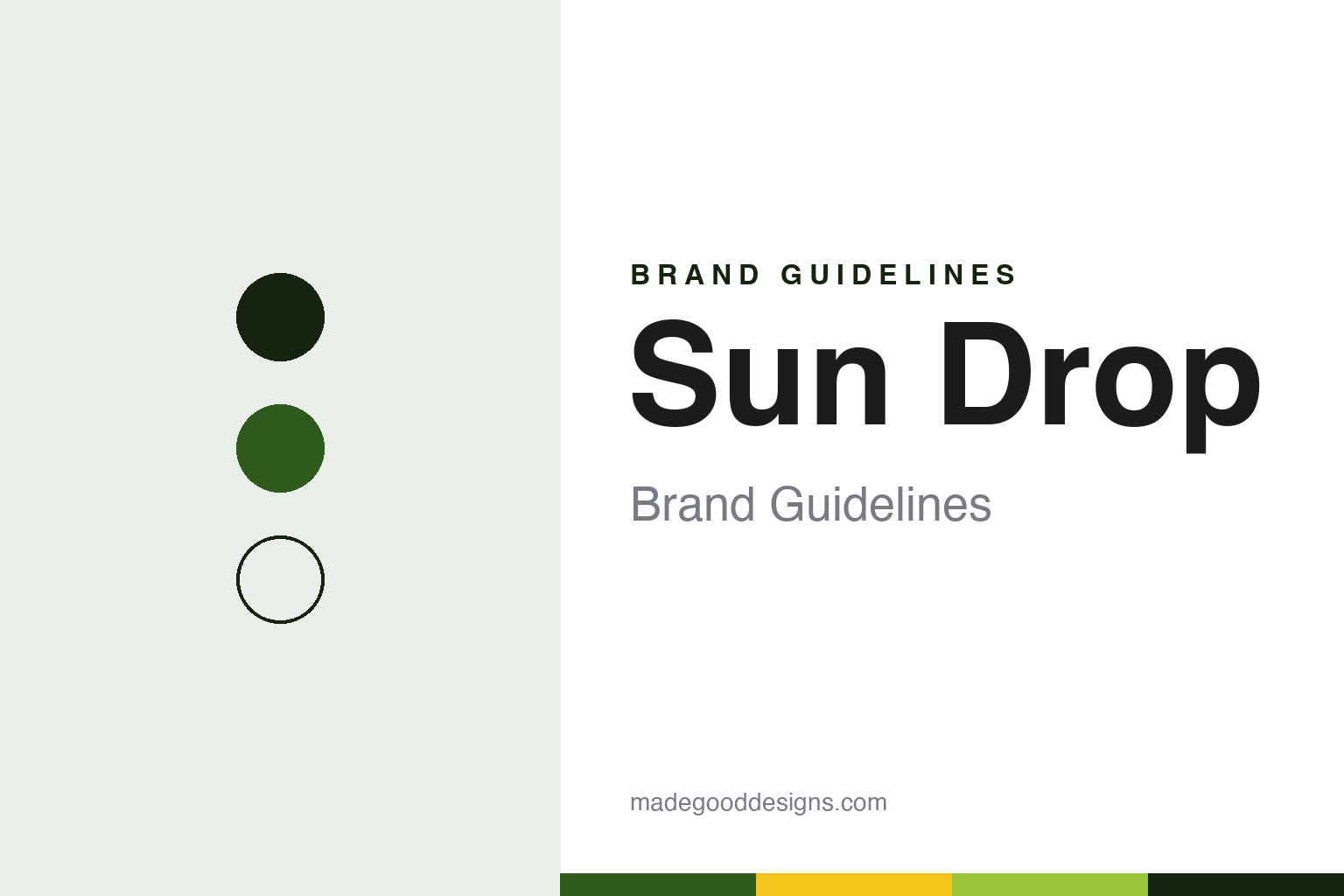
Sun Drop Brand Guidelines
The St. Louis citrus soda that grew up in the American South.
Aa
Two constants: a Sun Drop green, yellow and lime palette and a rounded bold sans register. Abstract homage — not a Sun Drop product or mark; no can, bottle, logo or label is reproduced.
A recipe in the family car
A concentrate salesman, his son and a name from the 1920s.
The story of Sun Drop is told mainly by its owner. According to the brand pages of Dr Pepper Snapple Group, the drink was developed in St. Louis, Missouri, in 1949 by Charles Lazier, whom the company describes as a salesman of beverage concentrates. The company’s account is a small domestic scene: while riding around town in the family car, Lazier scribbled a recipe for a new soft drink on a scrap of paper and handed it to his son, Charles Lazier Jr., who worked as a lab technician at his father’s plant and began work on the formula.
Two years later, in 1951, the company says, the drink made its debut at the American Bottlers of Carbonated Beverages conference in Washington, D.C. English Wikipedia follows the same account, citing the owner’s own page, and gives 1949 as the year of introduction.
The name is older than the drink. In a note headed “What’s in a name?”, the company says that Charles Lazier’s father, John Fredrick “Soda Jack” Lazier, first coined the name for an orange drink in the 1920s. The 2009 version of that page spells the brand as one word, Sundrop; later pages, and the brand’s own website, write it as two, Sun Drop, which is the form the owner now registers as a trademark.
In its first decades Sun Drop was not one uniform product. The company says that in many southeastern states it was sold as Sun-drop Golden Cola, Golden Girl Cola and Golden Sun-drop Cola, and that it travelled under various names across the Southeast until 1970.
Colour
Crush, Procter & Gamble, Cadbury Schweppes, Keurig Dr Pepper.
Sun Drop’s ownership history is a chain of ever-larger drinks companies, and again the dates come from the owner’s own account, repeated by English Wikipedia. In 1970 Crush acquired the brand and, the company says, standardised its name, packaging and advertising. In 1980 Procter & Gamble acquired Crush and with it the Sun Drop trademark.
Procter & Gamble widened the range. In 1985, the company says, it introduced several new flavours, including a reformulated Diet Sun Drop and a Cherry-Lemon Sun Drop. In 1989 Crush was acquired by Cadbury Schweppes, and Sun Drop went with it. In February 2002 the brand added a caffeine-free version, which the company says followed requests from its drinkers.
In 2008 Cadbury Schweppes separated its American drinks business, which became Dr Pepper Snapple Group, based in Plano, Texas. On 9 July 2018 that company merged with Keurig Green Mountain to form Keurig Dr Pepper, English Wikipedia records, citing The New York Times and the company’s own announcement. The Sun Drop website now describes Sun Drop as a registered trademark of Dr Pepper/Seven Up, Inc., and lists four drinks: Sun Drop, Diet Sun Drop and the regular and diet versions of Sun Drop Cherry Lemon.
The drink itself reaches shops through local bottlers holding Sun Drop franchises, and one of them is documented in detail. The Salisbury Post reported on 1 December 2016 that Piedmont Cheerwine Bottling Co., the Salisbury, North Carolina, company behind Cheerwine, had bought Sun Drop Bottling Co. of Concord and its franchise rights for Rowan, Iredell, Cabarrus and Stanly counties. The paper noted that “Dr Pepper actually owns the Sun Drop formula,” that the Concord business dated back to 1954 and had stayed in the family of its original owners, Bill and Margaret King, and that the Concord plant had reportedly closed. It also reported that the Concord company was no longer bottling and received finished product from elsewhere, and that Piedmont Cheerwine Bottling had already been bottling and distributing Sun Drop in other areas, from Lexington to Danville, Virginia, for about twenty years.
Typography
Regional soft drinks in America.
The seven brands in this group are all soft drinks from different regions of the United States: Cheerwine, Moxie, Faygo, Vernors, Big Red, Ale-8-One and Sun Drop. American regional soft-drink brands in general sit at many different points in the trade, from family firms that still carry a founder’s name to names that now belong to much larger drinks groups, and a single brand can be sold everywhere from a corner shop to a supermarket shelf.
A soft-drink brand’s identity is usually carried less by a single product than by a bottle or can, a name and the flavour it promises, because the company behind the name may have changed hands, moved its production or grown far beyond the place where it started. That makes the questions behind each name worth asking plainly: who started it, who owns it now, and where its drinks are actually made and bottled.
Each guide separates what independent sources record from what the company says about itself — its founding story, its owners over time, where its drinks are made and how its packaging has changed — and marks plainly what rests only on the company’s own word.
Aa
A rounded bold sans for a bright citrus brand. (Specimen set in Rubik, a sans STAND-IN; NOT the Sun Drop logo.)
Sun Drop
From regional favourite to national launch.
For most of its life Sun Drop was a regional drink. Dr Pepper Snapple Group’s own brand page described it as a popular regional brand in the Southeast and a “community drink,” and English Wikipedia names Kentucky, Tennessee and North Carolina among its strongholds, along with parts of the Midwest such as Wisconsin.
That changed in January 2011, when, the company says, Sun Drop expanded beyond its southeastern roots and became a national brand available across the United States. The brand’s website of that year announced that “2011 marks the year that Sun Drop will be available nationwide,” with the slogan “Get Dropped.” The Wall Street Journal covered the plan on 9 December 2010 under the headline “Bigger Splash Planned for a Niche Citrus Soda,” opening with a student who had hauled eight cases of the drink from the Carolinas to Oklahoma State University to last a semester. According to English Wikipedia’s summary of that report, the campaign included a new website, a Facebook page and an agreement with Scratch, the marketing agency of MTV, to develop new Sun Drop advertising and branding, including a new can design; the same summary says the drink had been promoted in the South by the NASCAR driver Dale Earnhardt from the 1970s to the early 1990s.
For a design guide, Sun Drop shows how a regional drink’s identity can be fixed by an owner long after its launch: the 1970 standardisation of its name, packaging and advertising turned several local “golden cola” names into one brand, and the 2011 national campaign, by English Wikipedia’s account of the Journal report, brought a new can design. Compare Cheerwine, whose bottler took over a Sun Drop franchise in North Carolina, and Vernors, another regional soft drink in the same owner’s portfolio. For this guide we use a deep green, a sun yellow and a citrus lime with a rounded sans, an unofficial interpretation; no product or logo is reproduced.
Explore & save
Keep Sun Drop’s identity on hand — save it to a board in the Made Good inspiration library.
Sun Drop identity set
Pin the Sun Drop green, yellow and lime palette and the rounded bold sans register to your own board.