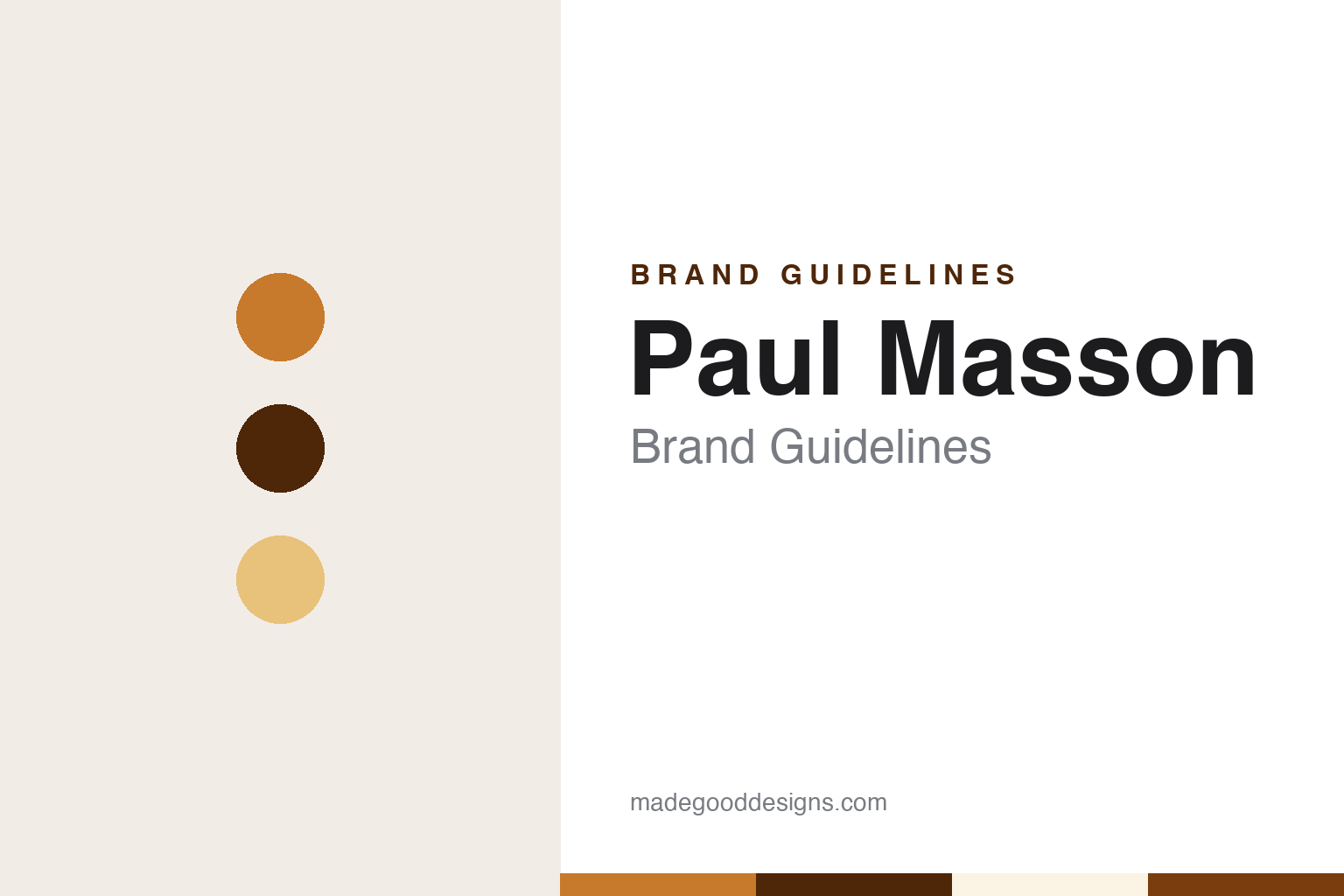
Paul Masson Brand Guidelines
A Burgundian’s Californian name, from Saratoga to Sazerac.
Aa
Two constants: a grande amber, cask brown and deep oak palette and a classical serif register. Abstract homage — not a Paul Masson product or mark; no label, logo or bottle is reproduced.
A Burgundian in the Santa Clara Valley
From a wine village near Beaune to the hills above Saratoga.
The name on the bottle belonged to a real winemaker. English Wikipedia says Paul Masson was born in Merceuil, a wine village outside Beaune in Burgundy, into families who grew wine in the region, and that in 1877 he was sent to the United States to live at his uncle’s grape plantation in San Jose, California.
There he went to work for Charles Lefranc, owner of the Almaden vineyard in the Santa Clara Valley and one of a number of French immigrants who expanded winegrowing there. According to English Wikipedia, Masson studied at the Sorbonne in Paris, came back to San Jose as Almaden’s winemaker, and married Lefranc’s daughter Louise in 1888. After Lefranc’s death he planted his own vineyard on land in the Santa Cruz Mountains above Saratoga that he called La Cresta, mainly with Pinot Noir and Chardonnay from Burgundy cuttings.
Sparkling wine made his name. English Wikipedia, citing the company’s own website, says his first sparkling wine was introduced at Almaden in 1892, and that he became known as the “Champagne King of California” after an award at the Paris Exposition of 1900. In 1905 he built a house he called the chateau on a knoll above the Saratoga winery. The California Blue Book of 1915 records his appointment to the state’s Board of Viticultural Commissioners in 1913. During Prohibition, according to Thomas Pinney’s A History of Wine in America (University of California Press, 2005), the company was allowed to make a small amount of wine for sacramental use. The San Francisco Examiner reported Masson’s death in San Jose in October 1940.
Colour
A slogan voiced by Orson Welles, and the owners behind it.
Masson had already handed the business on. English Wikipedia says that in the 1930s he sold the winery and the brand to his neighbour, the winemaker Martin Ray, and that Ray sold them in the early 1940s to Seagram, the Canadian drinks company, which owned the brand for about 45 years. Wine stopped being made at the Saratoga winery in 1952, English Wikipedia says, although the brand carried on.
It was under Seagram that the name became a television catchphrase. From 1978 to 1981 the actor and director Orson Welles fronted a series of advertisements for Paul Masson in which he promised, “We will sell no wine before its time.” English Wikipedia says the campaign was commissioned through the agency DDB Needham, and that one of the spots, a tasting party, was filmed at Masson’s chateau in Saratoga. The partnership ended in 1981: the film historian Joseph McBride wrote in Whatever Happened to Orson Welles? (University Press of Kentucky, 2006) that Welles was dropped after telling a television chat show that he was on a diet and no longer drank wine. The British actor John Gielgud took over as spokesman from 1982 to 1985, English Wikipedia says, and Ian Carmichael fronted the advertising in Britain.
The slogan outlived the campaign. The New York Times wrote in May 1990 that consumers knew Masson’s wines — “who can forget Orson Welles’s breathy incantation of ‘We will sell no wine before its time’” — but that they lacked cachet. The table wines were also known for their packaging: English Wikipedia describes them as sold in distinctive carafe bottles with wide, jam-jar-style tops.
Typography
Design and documentation.
The seven brands in this group are all gin, vodka and brandy names: Four Pillars, Ki No Bi, Deep Eddy, New Amsterdam, Chopin, Christian Brothers and Paul Masson. Spirits brands in general sit at many different points in the trade, from independent distilleries that still carry a founder’s name to labels that now belong to much larger drinks groups, and a single brand can be sold everywhere from a corner shop to a cocktail bar.
A gin, vodka or brandy brand’s identity is usually carried less by a single bottle than by a label, a name and the place it promises, because the company behind the name may have changed hands, moved its production or grown far beyond the place where it started. That makes the questions behind each name worth asking plainly: who started it, who owns it now, and where its spirit is actually distilled and bottled.
Each guide separates what independent sources record from what the company says about itself — its founding story, its owners over time, where its spirit is made and how its labels have changed — and marks plainly what rests only on the company’s own word.
Aa
A classical serif for a founder’s name on a bottle. (Specimen set in Libre Caslon Text, a serif STAND-IN; NOT the Paul Masson logo.)
Paul Masson
One name, now split between a brandy and a wine portfolio.
The brand passed through several hands after Seagram. The New York Times reported in 1990 that Paul Masson then belonged to Vintners International, which had bought it in 1987, and in September 1993 the paper reported that Canandaigua of New York would acquire Vintners. Canandaigua renamed itself Constellation Brands in 2000, English Wikipedia says, and in 2008 Constellation sold the Paul Masson winery in Madera, California, together with the Almaden and Inglenook brands, to The Wine Group.
The brandy and the wine then went separate ways. In 2019 Constellation planned to sell a group of lower-priced brands to E. & J. Gallo. The US Federal Trade Commission’s complaint of December 2019 described Gallo and Constellation as the two largest suppliers by volume of low-priced brandy in the United States, and said combining Gallo’s E&J Brandy with Paul Masson would cut the number of major providers from three to two. The deal was revised to leave out Paul Masson brandy, and in June 2020 The Spirits Business reported that Constellation had agreed to sell Paul Masson Grande Amber Brandy to Sazerac, the owner of Buffalo Trace, subject to review by the FTC; the magazine described it as one of the world’s largest brandy brands, at about two million cases a year.
Today the brandy’s own website says it is bottled by Sazerac Company in Louisville, Kentucky. It lists a VS, which it says is aged in oak barrels, a VSOP, which it says is aged four years in oak, and a line of fruit-flavoured versions. The table wines are separate: Gallo’s website lists Paul Masson Table Wines in its portfolio and links Masson’s story to California’s Central Coast.
The Saratoga estate is a different thing again. Renamed The Mountain Winery, it is an events and concert venue; California’s Office of Historic Preservation lists the Paul Masson Mountain Winery as California Historical Landmark No. 733, registered in 1960, noting its original sandstone walls and a Romanesque portal. The Olympic cyclist Paul Masson is an unrelated namesake.
For a design guide, Paul Masson shows how a founder’s name, a Burgundian origin story and one remembered slogan can keep a brand recognisable long after the founder, the estate and the owners have all changed. Compare Christian Brothers, the other American brandy in this group, and Metaxa, the Greek spirit built on muscat wine. For this guide we use grande amber, cask brown and deep oak with a classical serif, an unofficial interpretation; no product or logo is reproduced.
Explore & save
Keep Paul Masson’s identity on hand — save it to a board in the Made Good inspiration library.
Paul Masson identity set
Pin the Paul Masson grande amber, cask brown and deep oak palette and the classical serif register to your own board.