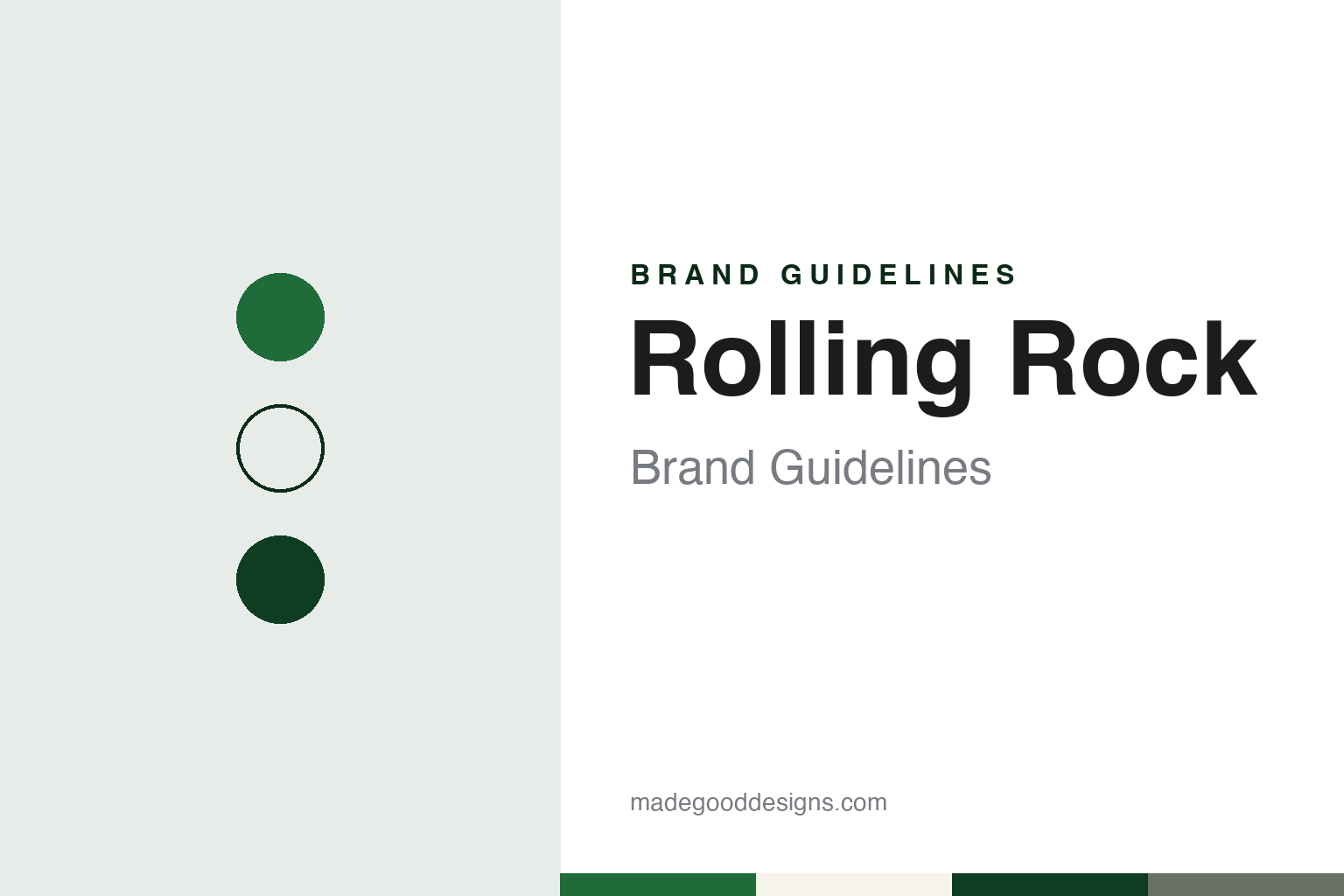
Rolling Rock Brand Guidelines
Latrobe’s 1939 lager in the painted green bottle.
Aa
Two constants: a bottle green, forest and painted white palette and a display serif register. Abstract homage — not a Rolling Rock product or mark; no bottle, label or horse is reproduced.
The Tito brothers’ brewery
A western Pennsylvania lager from the glass-lined tanks of Latrobe.
Rolling Rock comes from Latrobe, a small city in Westmoreland County, Pennsylvania, about 34 miles southeast of Pittsburgh. The brewery there was founded in 1893, according to a history of the company by Nick Stumpo published by Penn State’s Pennsylvania Center for the Book in spring 2009. Prohibition closed it in 1920; while it stood idle, Stumpo writes, the Tito brothers — Frank, Robert, Ralph and Anthony — bought it, betting on repeal. The brewery reopened in 1933 and for six years sold Latrobe Old German and Latrobe Pilsner.
Rolling Rock followed in 1939. It was a local western Pennsylvania lager, brewed, as the bottle said, with soft local water in large glass-lined tanks, a technology English Wikipedia describes as state of the art at the time. The family did little formal advertising, Stumpo writes; its representatives bought rounds in local taverns and profits went back into the plant. The small bottle was a strength: The Pittsburgh Press reported in October 1952 that Rolling Rock’s seven-ounce pony bottle was the best-selling premium pony in Pennsylvania. Production peaked, Stumpo writes, at 720,000 barrels in 1974, the brand’s 35th anniversary.
Then came a run of owners. The Tito family sold the business in 1985 to the Sundor Group, Stumpo writes, and in 1987 it passed to Labatt of Canada. Labatt’s brand manager John Chappell treated the green bottle and its painted slogan as the brand’s central assets, and under Labatt the beer grew from a regional lager into a national one. Labatt was bought in 1995 by the Belgian brewer Interbrew, which became InBev in 2004, English Wikipedia says.
In May 2006 InBev sold the Rolling Rock brands — but not the brewery — to Anheuser-Busch of St. Louis, the Pittsburgh Post-Gazette reported. Anheuser-Busch moved brewing to its plant in Newark, New Jersey; English Wikipedia says the last Rolling Rock was shipped from Latrobe on 31 July 2006. In 2008 InBev in turn acquired Anheuser-Busch, creating Anheuser-Busch InBev, which The Wall Street Journal reported in 2009 was exploring a sale of the brand.
Colour
A green bottle, a white horse and a number nobody will explain.
The bottle is the identity. Stumpo describes Rolling Rock’s green glass bottles with white painted lettering, in twelve-ounce and seven-ounce pony sizes, with a white horse on the front. Labatt’s marketing in the late 1980s put the green bottle and its painted slogan at the centre, according to Stumpo.
On the back is a short pledge of quality that mentions “the glass lined tanks of Old Latrobe” and the mountain springs the water came from, and that ends with the number “33.” The meaning has never been settled. Stumpo collected the theories: the conventional explanation is a printer’s note giving the word count of the pledge, which found its way onto the bottle; others point to 33 steps between floors at the brewery, 33 letters in the list of ingredients, the repeal of Prohibition in 1933, 33 springs feeding the reservoir, or Groundhog Day as the 33rd day of the year. “Even the brewery doesn’t know,” he wrote, “or at least they won’t admit that they do.”
When Anheuser-Busch took over, English Wikipedia says, it kept the pledge on the label but prefaced it with the words “To honor the tradition of this great brand, we quote from the original pledge of quality.” The move had a cost in goodwill at home: in May 2006 union leaders in Westmoreland County called for a boycott of Anheuser-Busch and InBev brands over it, the Pittsburgh Post-Gazette reported.
The glass-lined tanks themselves did not last. lehighvalleylive.com reported in January 2015 that Anheuser-Busch’s Newark brewery had gone all aluminium, ending bottles of Rolling Rock from glass-lined tanks; only cans continued the traditional process, English Wikipedia says.
The brand also put its name on music. From 2000 to 2005 it sponsored the Rolling Rock Town Fair, an alternative-rock festival whose first edition, on 5 August 2000 at the Westmoreland Fairgrounds in Mount Pleasant, Pennsylvania, featured the Red Hot Chili Peppers and Moby, according to English Wikipedia.
Typography
Design and documentation.
The seven brands in this group are all American beer names: Busch, Natural Light, Keystone Light, Rolling Rock, Bell’s, Deschutes and Allagash. American beer brands in general sit at many different points in the trade, from independent breweries that still carry a founder’s name to labels that now belong to much larger brewing groups, and a single brand can be sold everywhere from a corner shop to a stadium bar.
A beer brand’s identity is usually carried less by a single bottle or can than by a label, a name and the place it promises, because the company behind the name may have changed hands, moved its brewing or grown far beyond the town where it started. That makes the questions behind each name worth asking plainly: who started it, who owns it now, and where its beer is actually brewed and packaged.
Each guide separates what independent sources record from what the company says about itself — its founding story, its owners over time, where its beer is brewed and how its labels have changed — and marks plainly what rests only on the company’s own word.
Aa
A high-contrast display serif for a painted bottle pledge. (Specimen set in Libre Caslon Display, a serif STAND-IN; NOT the Rolling Rock logo.)
Rolling Rock
A Latrobe name, brewed elsewhere.
The brewery and the brand went separate ways in 2006. City Brewing Company of La Crosse, Wisconsin, signed a letter of intent for the Latrobe plant in June 2006 and agreed to buy it that September, according to the Pittsburgh Post-Gazette and the Pittsburgh Business Times; the plant reopened in 2007 brewing Samuel Adams under contract, and from 2009 brewed Iron City beer, English Wikipedia says.
Rolling Rock itself now lives inside the Anheuser-Busch portfolio alongside Michelob and Busch. Its website, rollingrock.com, carries the headline “Independent Spirits since 1939” and a footer copyright in the name of Latrobe Brewing Co., followed by a list of Anheuser-Busch brewery cities that begins with Baldwinsville, New York, and includes Newark, St. Louis and Merrimack, New Hampshire; its company links lead to anheuser-busch.com. The Latrobe name, in other words, survives on the label after the beer left Latrobe.
The name has a neighbour in search. The Rolling Rock Club is a private sporting club near Ligonier, Pennsylvania, with no connection to the beer.
For a design guide, Rolling Rock shows how much a single container can carry: a green bottle with a painted label, a white horse and an unexplained number have kept a western Pennsylvania lager recognisable through several changes of owner and a move of brewing to New Jersey. Compare Yuengling, the Pottsville brewery founded in 1829, and Pabst, another American lager defined by a single packaging detail. For this guide we use bottle green, forest and painted white with a display serif, an unofficial interpretation; no product or logo is reproduced.
Explore & save
Keep Rolling Rock’s identity on hand — save it to a board in the Made Good inspiration library.
Rolling Rock identity set
Pin the Rolling Rock bottle green, forest and painted white palette and the display serif register to your own board.