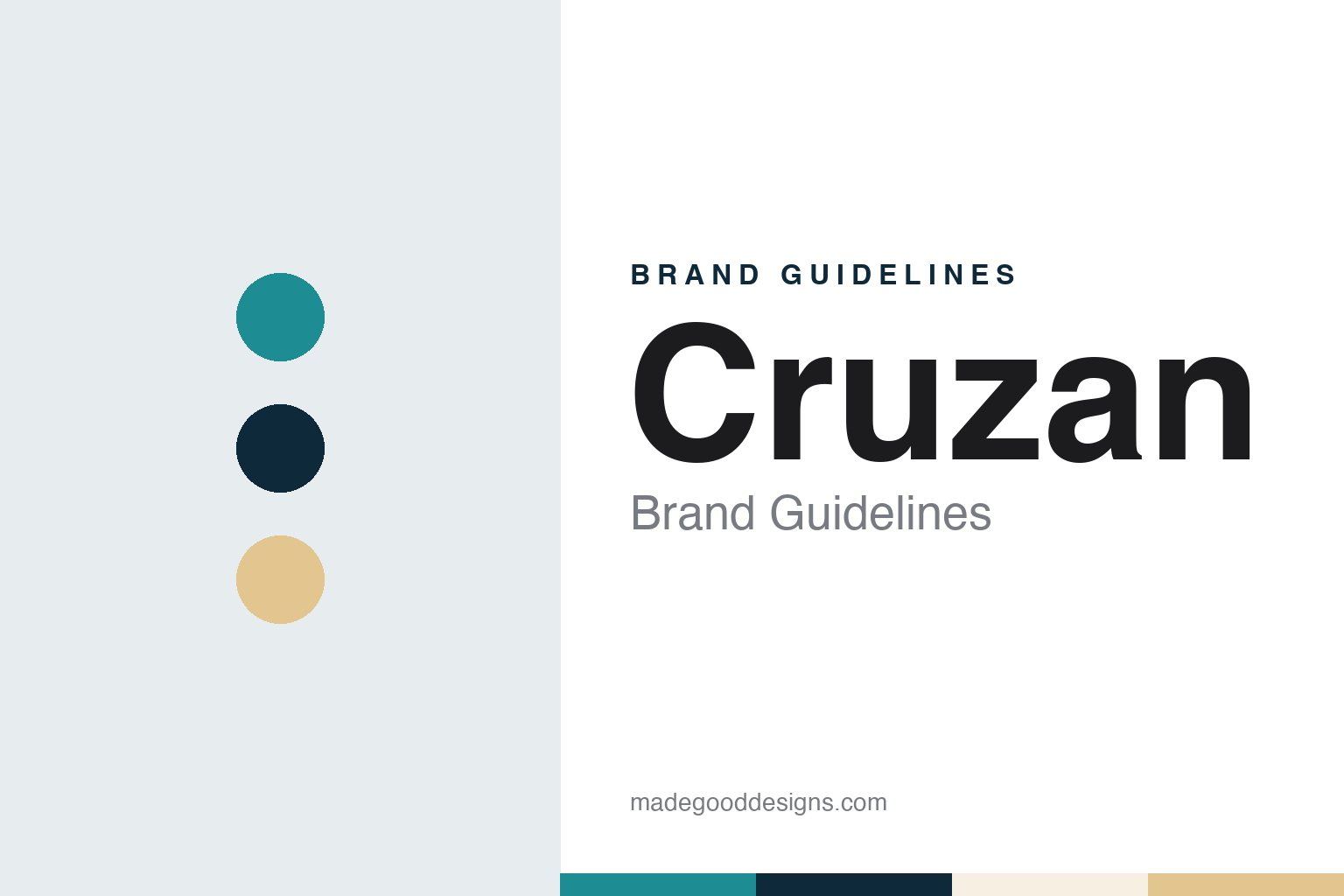
Cruzan Brand Guidelines
The St. Croix rum from Estate Diamond, bottled since 1934.
Aa
Two constants: a lagoon teal, harbour navy and sand palette and a condensed sans register. Abstract homage — not a Cruzan product or mark; no label, logo or bottle is reproduced.
A sugar estate on St. Croix
From a colonial sugar mill to a rum named for its island.
Cruzan is a rum made on St. Croix, the largest of the US Virgin Islands, at a distillery near Frederiksted that was formerly known as Estate Diamond. English Wikipedia gives the brand’s founding as 1760, the date the company itself uses: its heritage timeline says Estate Diamond, a site with a sugar mill that would eventually become the Cruzan distillery, was established that year. English Wikipedia says tours of the distillery take in its historic grounds, including the original sugar mill.
The rum brand itself is a twentieth-century story. According to the Cruzan timeline published by its owner, Malcolm Skeoch bought the historic Diamond Estate in Prince’s Quarter in 1910. The same timeline says a hurricane partly destroyed the Diamond distillery in 1928, a setback compounded by the Great Depression, and that Malcolm and his son Gordon repaired it in the years that followed. When Prohibition ended, the distillery produced its first bottle of rum under the Cruzan name; both the brand and its owner date that first bottling to 1934.
A second change shaped the liquid. Between 1940 and 1950, the company says, pot-still distillation was replaced with continuous column stills, which it credits for the pure, clean character the rum became known for. English Wikipedia describes Cruzan as made in a traditional Cuban style that produces a clean, lighter-bodied rum.
Colour
Eight generations of one family at the stills.
The family most closely tied to the brand is the Nelthropps. The company says Cedric “Ceddie” Nelthropp joined Cruzan in 1950, that his younger brother Donald “Hardy” Nelthropp became president in 1982, and that Gary Nelthropp took the top job and became master distiller in 2007. English Wikipedia says that, through several changes in corporate ownership, the Nelthropp family has managed the distillery for eight generations.
Corporate ownership has changed more than once in recent decades. The owner’s timeline says the company passed to Beam in 2008. Beam was split from Fortune Brands as the independent Beam Inc. in 2011; Suntory of Japan announced its purchase of Beam in January 2014 and completed it in April that year, and in May 2024 Beam Suntory was renamed Suntory Global Spirits, with a new visual identity, English Wikipedia reports. The same company owns Jim Beam and Maker’s Mark.
On the shelf, Cruzan works on two levels. One is a broad range of light rums and flavoured rums; English Wikipedia lists tropical flavours from coconut and mango to pineapple and vanilla, and the trade outlet BevNet reported a watermelon flavour in July 2019. The other is a set of aged and estate rums, including the Estate Diamond and the Single Barrel, which English Wikipedia says is a blend of rums aged five to twelve years and then rebarrelled in new oak, and which it says won “World’s Best Rum” at the San Francisco World Spirits Competition in 2000 and 2010.
Several product names carry the island’s story directly. English Wikipedia says Cruzan 9, a spiced rum, is named for its nine herbs and for the nine districts of St. Croix. It also notes, citing VinePair in 2019, that Gary Nelthropp said the Black Strap rum contains no blackstrap molasses and that the name was chosen for marketing.
Typography
Design and documentation.
The seven brands in this group are all mezcal, rum and whisky names: Del Maguey, Montelobos, Ilegal, Don Q, Ron Abuelo, Cruzan and Forty Creek. Spirits brands in general sit at many different points in the trade, from family houses that still carry a founder’s name to labels that now belong to much larger drinks groups, and a single brand can be sold everywhere from a corner shop to a cocktail bar.
A spirits brand’s identity is usually carried less by a single bottle than by a label, a name and the place it promises, because the company behind the name may have changed hands, moved its production or grown far beyond the place where it started. That makes the questions behind each name worth asking plainly: who started it, who owns it now, and where its spirit is actually distilled, aged and bottled.
Each guide separates what independent sources record from what the company says about itself — its founding story, its owners over time, where its spirit is made and how its labels have changed — and marks plainly what rests only on the company’s own word.
Aa
A condensed sans for an island name on a tall label. (Specimen set in Barlow Condensed, a sans-serif STAND-IN; NOT the Cruzan logo.)
Cruzan
A private-label giant, an island trail and a hurricane fund.
Much of what the distillery makes never carries the Cruzan name. English Wikipedia describes Cruzan as the largest supplier of American private and distributor label rum, and says the company also makes a high-proof pure cane distillate sold in Virgin Islands grocery stores.
The distillery is part of a wider visitor route. English Wikipedia’s article on the American Whiskey Trail, names two rum distilleries in its network: Bacardi in Cataño, Puerto Rico, and Cruzan in St. Croix. The company runs tours of the distillery and its historic grounds six days a week, English Wikipedia says.
The island’s weather has shaped the company twice in its own telling: once with the hurricane of 1928 and again in 2018, when, the company and its owner say, the Island Spirit Fund was set up to help victims of Hurricane Maria, which struck the Caribbean in September 2017.
The aged side of the range is built on simple age statements. English Wikipedia says the Estate Light and Estate Dark rums are aged for two years and the Estate Diamond for five, now offered in both dark and light versions, and that the overproof 151° is aged for at least a year in American oak. It records a gold medal for the 151° from the Beverage Testing Institute in 2002 and a silver at the San Francisco World Spirits Competition in 2011, and a score of 96 out of 100 for the Single Barrel from the Beverage Testing Institute in 2009. Among the liqueur-style products, it lists Velvet Cinn, a horchata-style blend with cinnamon.
The brand’s home on the web is cruzanrum.com, which gives the distillery’s address as Estate Diamond, Frederiksted.
For a design guide, Cruzan shows how a brand can borrow its name from its island and its date from an eighteenth-century sugar estate, then carry both across a wide range of light, flavoured and aged rums. Compare Appleton Estate, the Jamaican rum estate, and Flor de Caña, the Nicaraguan rum. For this guide we use lagoon teal, harbour navy and sand with a condensed sans, an unofficial interpretation; no product or logo is reproduced.
Explore & save
Keep Cruzan’s identity on hand — save it to a board in the Made Good inspiration library.
Cruzan identity set
Pin the Cruzan lagoon teal, harbour navy and sand palette and the condensed sans register to your own board.