Pabst Brand Guidelines
The Milwaukee lager named for a ribbon tied around the bottle.
Aa
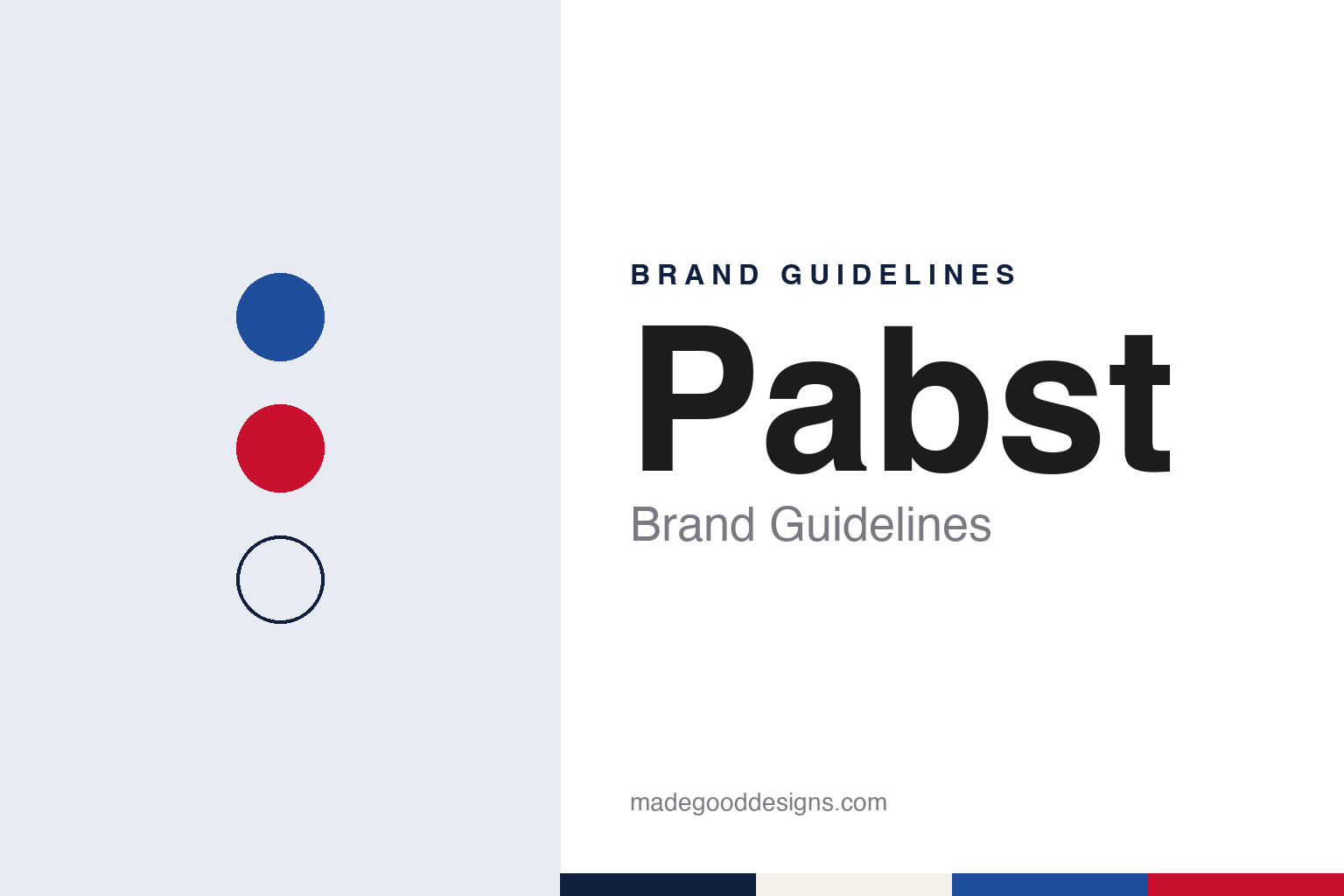
Two constants: a ribbon blue, captain navy and label red palette and a brewhouse slab serif register. Abstract homage — not a Pabst product or mark; no can, label, ribbon or logo is reproduced.
Best Select
A Milwaukee brewery, a steamship captain and a strip of silk.
Pabst began as someone else’s brewery. In 1844 the brewer Jacob Best opened what English Wikipedia calls the Empire Brewery, later Best and Company, on Chestnut Street Hill in Milwaukee, Wisconsin, with a capacity of 18 barrels; the company’s own timeline says the brewery produced 300 barrels in its first year. His son Phillip Best took control around 1860.
The name on the can came through marriage. Frederick Pabst, who had arrived in America as a boy and worked his way up to captain on the steamships of Lake Michigan, married Phillip Best’s daughter Maria. In 1863, English Wikipedia says, he bought half of Phillip Best’s business and became vice president; in 1866 Best sold the other half to Emil Schandein, who had married another of his daughters, and Pabst became president. When Phillip Best retired to Germany in 1867, Pabst and Schandein ran the firm together. English Wikipedia says that by 1874 the Phillip Best Brewing Co. was the largest brewer in the United States, and that by 1893 it was the first American brewer to sell more than a million barrels of beer in a year. After Schandein’s death in 1889, his widow Lisette took his place as vice president, and in 1889, the company says, the business was renamed the Pabst Brewing Company.
The brewery’s best-seller was a lager, Best Select, sold to the public from 1875. In 1882, the company says, Pabst began tying pieces of blue silk ribbon around the necks of Best Select bottles, a sign of the prizes the beer had won at fairs. English Wikipedia says the practice ran until 1916, when a silk shortage during the First World War ended it, and returned from 1933 to 1950. Best Select became Pabst Select and then Pabst Blue Ribbon. The company has long linked the name to a win as “America’s Best” at the 1893 World’s Columbian Exposition in Chicago, a claim printed on its label; English Wikipedia, citing Smithsonian magazine and a contemporary book of the fair, says whether the beer actually won an award there is unclear. The company’s timeline says the brand name was made official in 1899, when a red stripe was added to the label.
Colour
Cheese, cans, a long slide and a brewery with no brewery.
Prohibition forced the company into other trades. English Wikipedia says Pabst switched to cheese, selling more than 8 million pounds of Pabst-ett before the line was sold to Kraft after repeal. The company’s timeline says Pabst opened a new brewery in Peoria, Illinois, in 1934 and brought out beer in cans the following year. Under Harris Perlstein, who led the company from 1932 and was chairman until 1972, Pabst invested heavily in advertising, the Chicago Tribune reported in his 1986 obituary. In the 1950s Blue Ribbon was sold as “The Premium Beer at a Popular Price,” the company says, and its timeline puts sales at 18 million barrels in 1977.
Then came a long decline. The New York Times described a boardroom fight for control in 1982, and in the mid-1980s the company passed to the brewer and investor Paul Kalmanovitz, whose charitable trust, the company says, owned it for more than 25 years. In 1996 Pabst closed its Milwaukee brewery, ending more than 150 years of brewing in the city, the New York Times reported, and contracted its production to Stroh in La Crosse, Wisconsin. From then on Pabst was a brand owner that did not brew its own beer. In 1999 it bought the Stroh labels, bringing Schlitz, Old Milwaukee, Colt 45, National Bohemian and Old Style under one roof, and from 2001 its beer was brewed under contract by Miller, later MillerCoors.
Ownership has changed three times since. The food executive C. Dean Metropoulos bought Pabst in 2010, the New York Times reported. In November 2014 it was sold to Blue Ribbon Intermediate Holdings, a partnership between the American beer entrepreneur Eugene Kashper and the private equity firm TSG Consumer Partners, Just-Drinks reported. English Wikipedia says that since 2021 Pabst has been owned by Blue Ribbon Partners, an investment platform led by Kashper. The head office, which had moved to Los Angeles in 2011, moved to San Antonio, Texas, in 2020, the San Antonio Report reported.
Where the beer is made has shifted too. In 2019 Pabst signed a long-term production agreement with City Brewing Company, inside.beer reported, and the move of production away from Molson Coors was under way in 2022, according to the La Crosse Tribune. In January 2025 Yahoo Finance reported that Anheuser-Busch would make Pabst beer after the Molson Coors partnership ended. Pabst briefly returned to Milwaukee in 2017 with a small brewery and taproom in a former church on the old brewery site, which closed in 2020, Urban Milwaukee reported.
Typography
Design and documentation.
The seven brands in this group are all beer names from the United States, Italy and Spain: Michelob, Shiner, Blue Moon, Miller Lite, Pabst, Ichnusa and Estrella Galicia. American, Italian and Spanish beer brands in general sit at many different points in the trade, from family firms that still carry a founder’s name to names that now belong to much larger brewing groups, and a single brand can be sold everywhere from a corner bar to a supermarket shelf.
A beer brand’s identity is usually carried less by a single product than by a label, a name and the place it promises to come from, because the company behind the name may have changed hands, moved its brewing or grown far beyond the town where it started. That makes the questions behind each name worth asking plainly: who started it, who owns it now, and where its beer is actually brewed and packed.
Each guide separates what independent sources record from what the company says about itself — its founding story, its owners over time, where its beer is brewed and how its packaging has changed — and marks plainly what rests only on the company’s own word.
Aa
A sturdy slab serif for a brand built on a ribbon and a label. (Specimen set in Roboto Slab, a serif STAND-IN; NOT the Pabst logo.)
Pabst Blue Ribbon
Radio comedy, dive bars and a portfolio of old labels.
Pabst has spent most of its life selling one beer through one symbol. In the mid-1940s Blue Ribbon was the title sponsor of the radio comedy Blue Ribbon Town, starring Groucho Marx, and from 1946 to 1949 it sponsored The Eddie Cantor Pabst Blue Ribbon Show, English Wikipedia says.
The revival that followed came largely from young urban drinkers. English Wikipedia, citing press coverage from the 2000s, says the company chose not to court that following openly in its advertising, for fear of losing the “authenticity” that had made the beer popular, and instead sponsored indie music, local businesses, amateur sports teams and dive bars, and invited fans to submit their own artwork. The company’s timeline describes partnerships with O’Neill, Santa Cruz Skateboards and Vans, an inaugural Project Pabst music festival in Portland, Oregon, and later an annual Mural Day with the artist Cey Adams, who painted murals on buildings in communities across the country.
Today Pabst Brewing Company says it has more than 50 brands in its portfolio, many of them old American labels gathered over the decades, from Schlitz and Old Milwaukee to Lone Star and Rainier. Blue Ribbon remains the flagship, a lager the company sells as Original alongside stronger, lighter and non-alcoholic versions. The name Milwaukee still appears on the label, although the company no longer brews or is based there. A separate guide looks at the font Pabst uses.
For a design guide, Pabst shows how a strip of blue silk tied on a bottle in 1882 can outlast the brewery that tied it, and carry a brand through owners, contract brewers and a move to Texas. Compare Miller Lite, from the Milwaukee rival that brewed Pabst for two decades, and Michelob, from the Anheuser-Busch stable that makes it today. For this guide we use a ribbon blue, a captain navy and a label red with a slab serif, an unofficial interpretation; no product or logo is reproduced.
Explore & save
Keep Pabst’s identity on hand — save it to a board in the Made Good inspiration library.
Pabst identity set
Pin the Pabst ribbon blue, captain navy and label red palette and the brewhouse slab serif register to your own board.