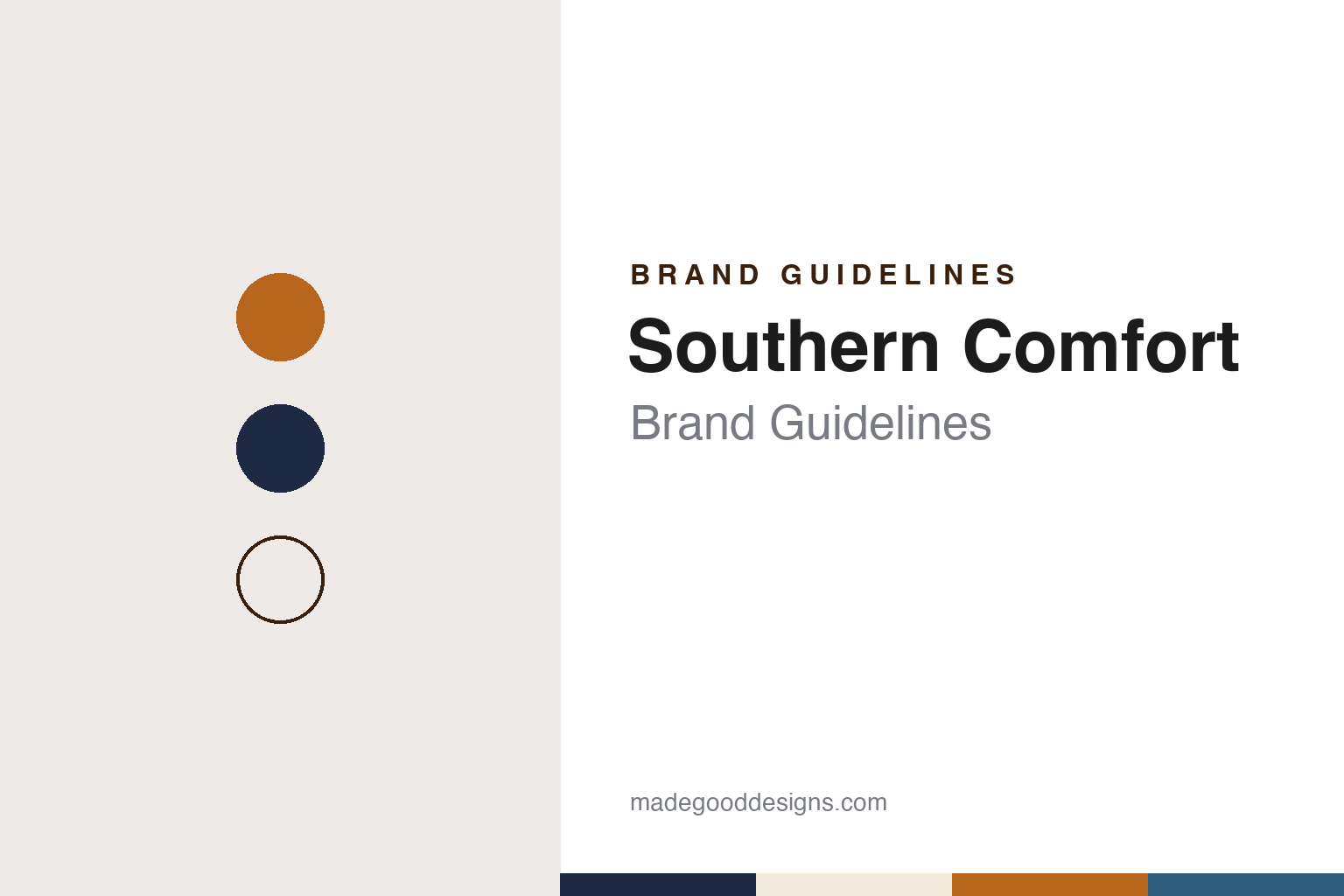
Southern Comfort Brand Guidelines
None genuine but his: a New Orleans liqueur from 1874.
Aa
Two constants: an amber, riverboat navy and parchment palette and a nineteenth-century serif register. Abstract homage — not a Southern Comfort product or mark; no bottle, logo or label is reproduced.
M. W. Heron
A bartender, a saloon and a recipe in sealed bottles.
Southern Comfort, often shortened to SoCo, is an American whiskey liqueur flavoured with fruit and spice. Its story starts with one man. Martin Wilkes Heron was an Irish-born bartender and liquor rectifier who, by the early 1870s, was working in New Orleans, English Wikipedia says, citing The New York Times and Heron’s death certificate. According to the company’s own account, in 1874 he created the recipe while working at Arthur McCauley’s saloon in the Lower Garden District, a couple of miles south of the French Quarter.
The drink did not start out as Southern Comfort. The New Orleans tourism bureau says its first name was “Cuffs and Buttons”; English Wikipedia notes that a 1911 US Department of Agriculture report gives the alternative as “Collars and Cuffs.” The spirits historian Chris Morris, interviewed on the television series The Thirsty Traveler, described Heron’s method as starting with good bourbon and steeping it for days with vanilla, lemon, cinnamon, cloves, cherries and orange, then sweetening it with honey.
Heron took the recipe up the Mississippi. City directories cited by English Wikipedia place him in St. Louis by 1883 and in Memphis as a liquor dealer by 1890. In 1889, English Wikipedia says, he began selling the drink in sealed bottles under the lines “M. W. Heron’s Famous Southern Comfort” and “None Genuine But Mine,” and from 1890 his assistant Grant M. Peoples kept the books. By 1910 Heron was back in St. Louis, running a riverfront bar with a sign that read “Two per customer. No gentleman would ask for more.” The liqueur won gold medals at the 1900 Paris Exposition Universelle and at the 1904 St. Louis World’s Fair, English Wikipedia says.
Colour
A plantation label, a redesign and a return to New Orleans.
Prohibition shut the business down, and the brand was revived afterwards by the Fowler family of St. Louis. English Wikipedia credits Francis Fowler with reopening it; the German trade site about-drinks says Peoples sold the recipe to the Fowler family in 1933. One of the earliest drinks marketed around it was the Scarlett O’Hara, of Southern Comfort, cranberry and lime, created for the release of the film Gone with the Wind in 1939, Cocktail Times says.
For about eighty years the label carried a picture. From the 1930s until 2010, English Wikipedia says, it reproduced “A Home on the Mississippi” (1871), an Alfred Waud drawing of Woodland Plantation in West Pointe à la Hache, Louisiana. The plantation artwork was dropped in a 2010 redesign by the Minneapolis firm Cue, which The Dieline reported in May 2010; The Dieline described a brand with authentic roots and strong name recognition that had lost its relevance.
The next redesign looked back to New Orleans. After the 2016 sale to the New Orleans-based Sazerac Company, the brand was repositioned as “The Spirit of New Orleans,” The Spirits Business reported in May 2017. The new bottles were taller and slightly narrower but kept the fluted shoulders and the signature of M. W. Heron; the 70 and 100 proof bottlings were joined by a new 80 proof Black Label, launched in the United States that summer and elsewhere in 2018. Kevin Richards, Sazerac’s senior marketing director, told the magazine that New Orleans had been integral to the brand’s positioning for decades.
Typography
Design and documentation.
The seven brands in this group are all liqueurs and spirits: Drambuie, Frangelico, Malibu, Southern Comfort, Tia Maria, Pimm’s and Sheridan’s. Liqueur and spirit brands in general sit at many different points in the trade, from family firms that still carry a founder’s name to names that now belong to much larger drinks groups, and a single brand can be sold everywhere from a corner shop to an airport duty-free shelf.
A liqueur or spirit brand’s identity is usually carried less by a single recipe than by a bottle, a name and the drink or serve it promises, because the company behind the name may have changed hands, moved its production or grown far beyond the place where it started. That makes the questions behind each name worth asking plainly: who started it, who owns it now, and where its drinks are actually made and bottled.
Each guide separates what independent sources record from what the company says about itself — its founding story, its owners over time, where its drinks are made and how its packaging has changed — and marks plainly what rests only on the company’s own word.
Aa
A nineteenth-century serif for a liqueur sold on a signature and a slogan. (Specimen set in Playfair Display, a serif STAND-IN; NOT the Southern Comfort logo.)
Southern Comfort
Brown-Forman, Sazerac and the question of the base spirit.
The Louisville distiller Brown-Forman bought Southern Comfort in 1979, English Wikipedia says, and owned it for more than three decades. Under Brown-Forman the range widened: from 2011 it added flavoured versions such as cherry, lime, gingerbread and a Tabasco edition, VinePair reported. In January 2016 Brown-Forman agreed to sell Southern Comfort, together with the Italian-style liqueur Tuaca, to the Sazerac Company, The Daily Telegraph and The Wall Street Journal reported. The sale completed on 1 March 2016, according to BevNET, and brought the brand back under the ownership of a New Orleans company, The Advocate noted.
The brand’s recipe has a documented history of change. The New York Times reported in May 2017 that, at some point before Brown-Forman bought it, Southern Comfort had been reformulated around a neutral grain spirit, with only a negligible amount of whiskey for flavour, and that Sazerac planned to make whiskey the base spirit again. The Spirits Business confirmed that the 2017 relaunch brought whiskey back into the blend. The flavoured lines added in the Brown-Forman years, such as lime and caramel, were dropped by Sazerac, The New York Times said.
In the United States Southern Comfort is sold at several strengths, from 21% to 50%, English Wikipedia lists, with a 30% version in Australia.
For a design guide, Southern Comfort shows how a creator’s signature and a nineteenth-century slogan have stayed on the bottle through a plantation label, a redesign and two changes of owner. Compare Tabasco, the Louisiana hot sauce, and Crystal Hot Sauce, made in New Orleans. For this guide we use amber, a riverboat navy and parchment with a serif, an unofficial interpretation; no product or logo is reproduced.
Explore & save
Keep Southern Comfort’s identity on hand — save it to a board in the Made Good inspiration library.
Southern Comfort identity set
Pin the Southern Comfort amber, riverboat navy and parchment palette and the nineteenth-century serif register to your own board.