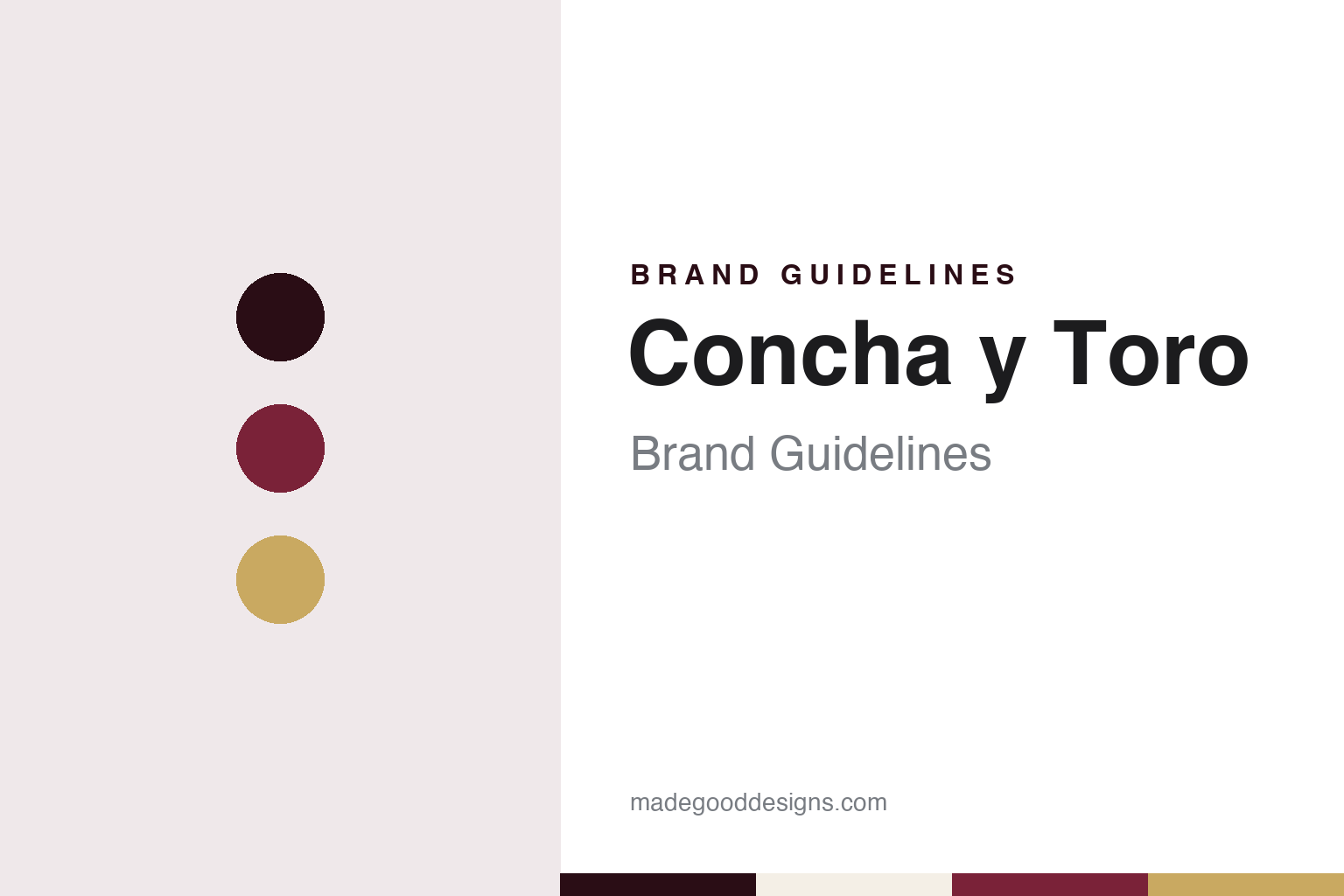
Concha y Toro Brand Guidelines
The Pirque wine house founded by a finance minister in 1883.
Aa
Two constants: a Maipo red, cellar ink and label gold palette and a classical estate serif register. Abstract homage — not a Concha y Toro product or mark; no bottle, label or logo is reproduced.
A minister’s vineyard
Bordeaux vines in the upper Maipo Valley.
Concha y Toro began in 1883 in Pirque, in the upper Maipo Valley south of Santiago. English and Spanish Wikipedia both name its founders as Melchor de Santiago Concha y Toro, a former Chilean minister of finance, and his wife, Emiliana Subercaseaux. They planted vines brought from Bordeaux, including Cabernet Sauvignon, Sauvignon Blanc, Semillon, Merlot and Carmenère. Spanish Wikipedia illustrates the family’s manor house in Pirque and notes that roads through the vineyards carry the names of the family’s noble titles, among them Marqués de Casa Concha.
The family business became a stock company in 1923, according to English Wikipedia, and its shares trade on the Santiago Stock Exchange. It began exporting in 1933, with a first shipment to Rotterdam in the Netherlands. Its American depositary shares were listed on the New York Stock Exchange from 1994; in 2018 the company announced a voluntary delisting from New York, leaving Santiago as its home market. English Wikipedia records that Eduardo Guilisasti Tagle became chairman in 1971; he was still chairman in 1997, when he signed the Almaviva agreement.
Spanish Wikipedia describes the company today as the leading producer and exporter of wine in Latin America. English Wikipedia, citing a 2011 University of Pennsylvania business-school article, also places it among the ten largest wine companies in the world. B Lab, the non-profit that certifies B Corporations, says it farms more than 11,000 hectares of vineyards in Chile, Argentina and the United States.
Colour
A portfolio of houses, not a single label.
For most drinkers, “Concha y Toro” is less a single wine than a company name printed small on the back of many bottles. English Wikipedia’s timeline shows how the portfolio was built. The Casillero del Diablo range arrived in 1966 and became the company’s best-known export label; English Wikipedia, citing the research firm Wine Intelligence, lists it as the world’s second most powerful wine brand in 2018, 2019 and 2020. In 1968 Concha y Toro bought Viña Maipo. In 1987 it launched Don Melchor, the company’s first ultra-premium wine. In 1993 it created Cono Sur, and in 1996 it crossed the Andes to found Trivento in Mendoza, Argentina.
The best-known collaboration is Almaviva. In 1997 Eduardo Guilisasti Tagle and Baroness Philippine de Rothschild, of Baron Philippe de Rothschild S.A., the Bordeaux company behind Château Mouton Rothschild, signed an agreement to make a Franco-Chilean wine on the model of a Bordeaux château, according to the company’s account of Almaviva’s 25th anniversary in 2022. Almaviva comes from a vineyard in Puente Alto, in the upper Maipo Valley, and is mainly Cabernet Sauvignon; its first vintage reached the market in 1998, wine merchants’ histories say.
The company went north in 2011, when it bought Fetzer Vineyards of California. Spanish Wikipedia describes Fetzer as one of the largest wine producers in the United States and says the deal also brought Bonterra, Bel Arbor, Jekel and Little Black Dress under Chilean ownership.
Marketing followed the exports. In 2010 Concha y Toro signed a sponsorship agreement with Manchester United; in 2020 the club’s sponsorship director described the relationship with Casillero del Diablo as a natural alliance, Spanish Wikipedia says. Drinks International named it the “World’s Most Admired Wine Brand” in 2011, 2012 and 2013, and Intangible Business ranked it the world’s most powerful wine brand in 2014 and 2015.
Typography
Design and documentation.
The seven brands in this group are all wine and sake names: Yellow Tail, Jacob’s Creek, Penfolds, Casillero del Diablo, Concha y Toro, Barefoot and Gekkeikan. Wine and sake brands in general sit at many different points in the trade, from family houses that still carry a founder’s name to labels that now belong to much larger drinks groups, and a single brand can be sold everywhere from a corner shop to a restaurant list.
A wine or sake brand’s identity is usually carried less by a single bottle than by a label, a name and the place it promises, because the company behind the name may have changed hands, moved its production or grown far beyond the place where it started. That makes the questions behind each name worth asking plainly: who started it, who owns it now, and where its wine or sake is actually made and bottled.
Each guide separates what independent sources record from what the company says about itself — its founding story, its owners over time, where its wine or sake is made and how its labels have changed — and marks plainly what rests only on the company’s own word.
Aa
A classical estate serif for an 1883 house. (Specimen set in Cormorant Garamond, a serif STAND-IN; NOT the Concha y Toro logo.)
Concha y Toro
A listed company with family roots and a B Corp badge.
Concha y Toro presents itself less as a brand than as a house that holds brands. When the group announced its B Corp certification in 2021, the company says, the certificate covered the parent and its wineries Concha y Toro, Cono Sur, Trivento and Don Melchor, each of which trades under its own name.
That certification is the most recent chapter in the corporate identity. The B Lab directory lists Viña Concha y Toro as a certified B Corporation since January 2021; the company dates its certification to 22 April 2021 and says it was the first Chilean company listed on the stock exchange to earn it. In 2024 the group was recertified with a score of 93.9, Drinks International reported, up from its first assessment. The family link also continues: Spanish Wikipedia notes that the board includes a great-grandson of the founder.
Its reach has grown well beyond Pirque. English Wikipedia says that after it opened a trade and logistics office in the United Kingdom in 2001, the company added offices in eleven more countries, and that it distributes in about 135 countries. Spanish Wikipedia adds that the Argentine subsidiary Trivento became an official sponsor of Major League Soccer in 2020.
For a design guide, Concha y Toro shows how a 19th-century estate name can sit quietly above a portfolio of louder labels, letting each brand speak while the house provides the pedigree. Compare the devil’s-cellar story of Casillero del Diablo, its best-known label, and the Australian estate house Penfolds. For this guide we use Maipo red, cellar ink and label gold with a classical serif, an unofficial interpretation; no product or logo is reproduced.
Explore & save
Keep Concha y Toro’s identity on hand — save it to a board in the Made Good inspiration library.
Concha y Toro identity set
Pin the Concha y Toro Maipo red, cellar ink and label gold palette and the classical estate serif register to your own board.