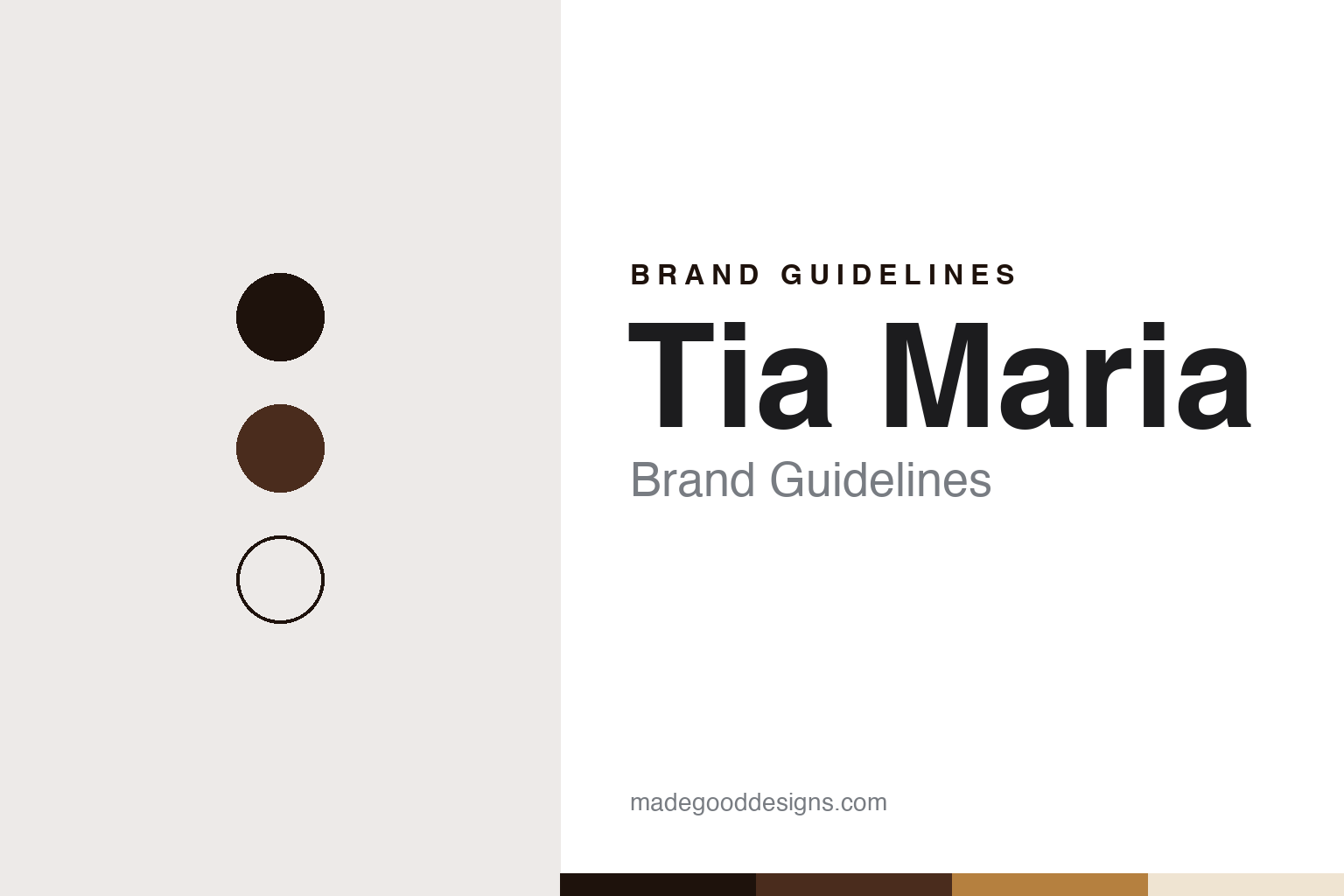
Tia Maria Brand Guidelines
The Jamaican coffee liqueur now made by Disaronno’s owner.
Aa
Two constants: a Tia Maria espresso, rum amber and vanilla cream palette and a high-contrast serif register. Abstract homage — not a Tia Maria product or mark; no bottle, label or logo is reproduced.
Aunt Mary
A Kingston idea, a doctor’s recipe and a London name.
Tia Maria is a dark coffee liqueur that began in Jamaica in the years after the Second World War. Its best-documented origin story comes from one of the men who started it. In his 1978 book Jamaica Farewell, the Jamaican writer and businessman Morris Cargill recalled wanting to make a coffee liqueur like one his aunt used to make. In 1946, English Wikipedia says, citing the book, he tried without success to get her recipe, and then teamed up with Dr Ken Evans, who developed the recipe that became the product.
The partners came from well-known Jamaican drinks families. Cargill’s account, as summarised by English Wikipedia, names Herbert Hart, Eustace Myers of the Myers rum house and Paul Geddes of the brewer Desnoes & Geddes, and says the first five thousand cases were made with Blue Mountain coffee supplied by the grower Keble Munn. The name came from London. Cargill hired the advertising agency J.P. MacNulty to brand the liqueur and design its labels, and after days without a name, he told the story of his aunt’s recipe; Joseph MacNulty is quoted as replying that they would call it “Aunt Mary” — Tia Maria.
The brand tells a more romantic story. In it, a young Spanish aristocrat fled Jamaica during a colonial war in the seventeenth century, and her maid saved a jewellery box holding the family’s liqueur recipe; the drink is named after the maid. In that version, retold by Drinks Industry Ireland in 2020, Dr Kenneth Leigh Evans rediscovered the recipe in the 1940s and began producing and marketing it. The brand’s own website has also described Evans discovering the drink after the war. The two accounts agree on Evans and on Jamaica; the legend is the brand’s telling, the agency story is Cargill’s.
Colour
Hiram Walker, Allied, Pernod and then Saronno.
Tia Maria spent most of its life inside large drinks groups. By the 1980s it belonged to the Canadian distiller Hiram Walker; a 1985 American court case over a spilled shipment of the liqueur names Hiram Walker as the brand’s owner. Control moved to Europe in 1987, when the British group Allied-Lyons bought Hiram Walker’s liquor business, the Associated Press reported. Allied-Lyons became Allied Domecq, and when Pernod Ricard bought Allied Domecq in 2005, Tia Maria came with it.
Pernod already owned the market leader in coffee liqueur, Kahlúa, and Tia Maria was described in the trade press at the time as the second-largest brand in the category. On 27 July 2009 Pernod Ricard announced that it had sold Tia Maria to Illva Saronno. The company said the sale was part of its debt-reduction programme after its July 2008 purchase of Vin & Sprit, the Swedish owner of Absolut vodka; the Moodie Davitt Report and the drinks business covered the deal the same week.
The buyer is the Italian group best known for Disaronno, the amaretto from Saronno in Lombardy, and it is owned by the Reina family. Under the 2009 agreement Chivas Brothers, Pernod’s Scotch whisky arm, was appointed to keep producing Tia Maria for Illva during a transitional period. English Wikipedia says production was later transferred to Illva’s distillery in Saronno, Italy, and describes the liqueur today as made in Italy. In the United States, Bacardi first distributed it for Illva; from 1 August 2012 the importer Kobrand took over under a long-term agreement announced that August.
Typography
Design and documentation.
The seven brands in this group are all liqueurs and spirits: Drambuie, Frangelico, Malibu, Southern Comfort, Tia Maria, Pimm’s and Sheridan’s. Liqueur and spirit brands in general sit at many different points in the trade, from family firms that still carry a founder’s name to names that now belong to much larger drinks groups, and a single brand can be sold everywhere from a corner shop to an airport duty-free shelf.
A liqueur or spirit brand’s identity is usually carried less by a single recipe than by a bottle, a name and the drink or serve it promises, because the company behind the name may have changed hands, moved its production or grown far beyond the place where it started. That makes the questions behind each name worth asking plainly: who started it, who owns it now, and where its drinks are actually made and bottled.
Each guide separates what independent sources record from what the company says about itself — its founding story, its owners over time, where its drinks are made and how its packaging has changed — and marks plainly what rests only on the company’s own word.
Aa
A high-contrast serif for a liqueur with a family-legend name. (Specimen set in Playfair Display, a serif STAND-IN; NOT the Tia Maria logo.)
Tia Maria
From Blue Mountain beans to cold brew.
The liqueur’s main ingredients are coffee, Jamaican rum, vanilla and sugar, and English Wikipedia gives its strength as 20% alcohol. In 2020 the brand gave its bottle a new look, Drinks Industry Ireland reported that September, describing the product as Tia Maria Cold Brew Coffee Liqueur made with Madagascar vanilla, Jamaican rum and 100% Arabica coffee. The brand’s website now says its beans are grown at high altitudes, up to 1,200 metres, in Brazil, and that the coffee is cold brewed; Difford’s Guide describes the beans being steeped in a water-and-alcohol solution for six to twelve hours. The same year the brand released a canned ready-to-drink cold brew at 4% alcohol, the Irish trade press reported.
The website’s footer states that “Tia Maria” is a registered trademark of Illva Saronno S.p.A., and its cocktails centre on the Tia Espresso Martini, alongside serves such as an Irish coffee. English Wikipedia lists older mixes, including the Baby Guinness, made with Tia Maria and an Irish cream.
How the brand has been lettered over the years is covered separately in our note What Font Does Tia Maria Use?, and the house that now owns it is profiled in our Disaronno guide. The history matters for designers because the brand carries two origin stories at once: a documented one, of Kingston businessmen and a London agency that named the drink and drew its first labels, and a legend that the brand itself prefers to tell.
For a design guide, Tia Maria shows how a postwar Jamaican liqueur, named by a London ad agency, can keep its Caribbean story while being made in Italy by a family-owned amaretto house. Compare Disaronno, its sister brand under Illva Saronno, and Appleton Estate, the Jamaican rum. For this guide we use espresso brown, rum amber and vanilla cream with a high-contrast serif, an unofficial interpretation; no product or logo is reproduced.
Explore & save
Keep Tia Maria’s identity on hand — save it to a board in the Made Good inspiration library.
Tia Maria identity set
Pin the Tia Maria espresso, rum amber and vanilla cream palette and the high-contrast serif register to your own board.