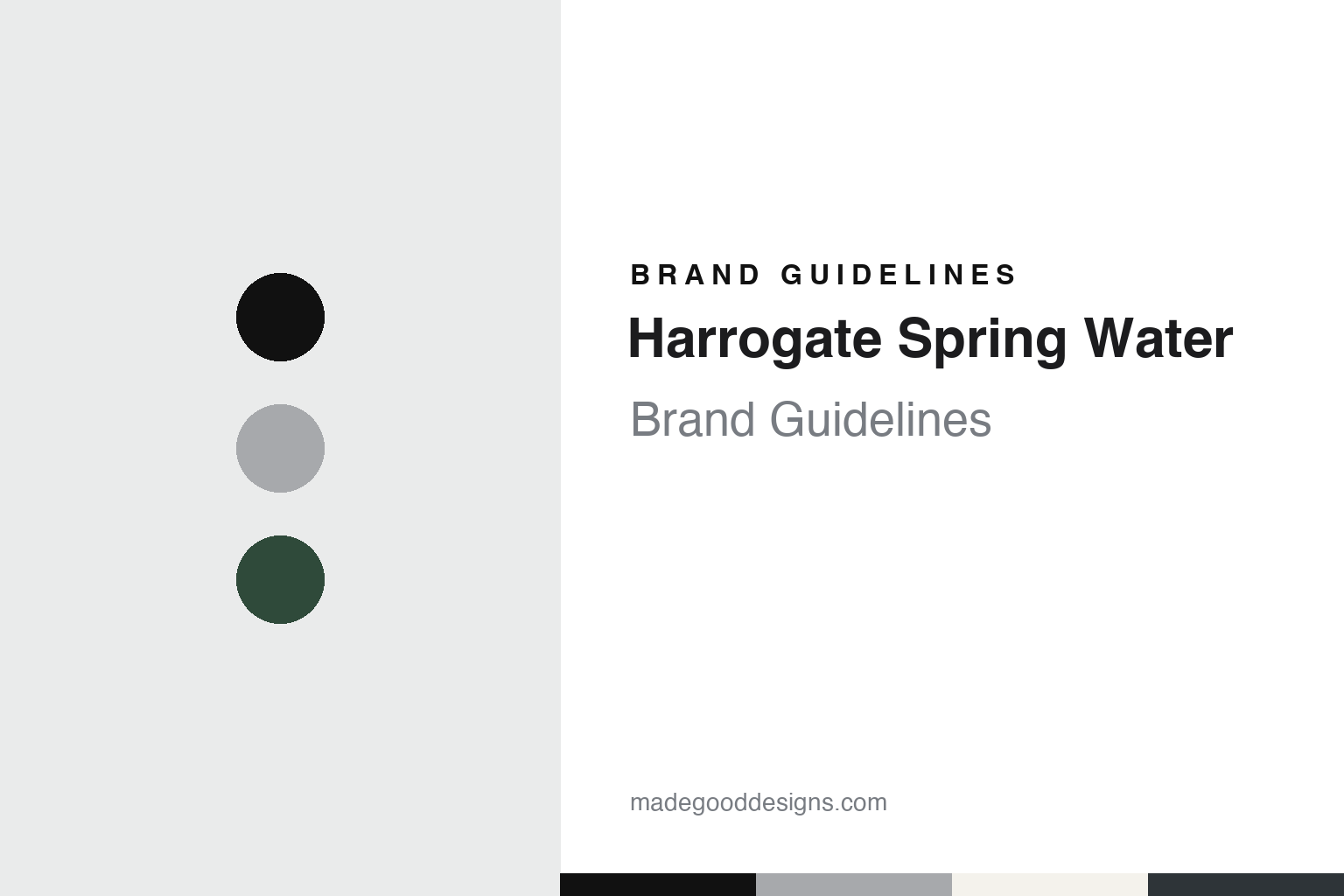
Harrogate Spring Water Brand Guidelines
The Yorkshire spa-town water, sold since 2002.
Aa
Two constants: a label black, Pump Room silver and spa white palette and a Victorian display serif register. Abstract homage — not a Harrogate Spring Water product or mark; no label, logo or bottle is reproduced.
A spa town’s name, bottled
From a Yorkshire spa resort to a bottling plant beside the Pinewoods.
Harrogate Spring Water borrows its name and much of its story from the North Yorkshire town where it is bottled. Harrogate’s history as a spa long predates the company. BBC News reported in May 2020 that the town’s spring opened in 1571 and that Harrogate grew around it into a fashionable spa resort; the company says the first mineral spring was discovered that year by William Slingsby. A North Yorkshire County Council local-history storyboard from 2003, cited by English Wikipedia, says water was bottled in glass for the town from the 1740s, and the BBC report described bottling as having begun in 1740. That history belongs to the town; the present company is far younger.
The business was set up in 2000. Companies House records show it was incorporated on 16 August 2000 as HSW Limited, renamed Harrogate Spa Water Limited in January 2002 and Harrogate Spring Water Limited in February 2010, with its registered office on Harlow Moor Road in Harrogate. The Harrogate Advertiser credited Tony Cain with launching Harrogate Spring Water on a boggy field in 2000 and his son James Cain with running it after him; Companies House lists both men among the company’s officers. English Wikipedia, citing TheBusinessDesk.com in 2013, gives January 2002 as the date the product went on sale, and the company’s own site says it has been sharing Harrogate’s water since 2002.
The company says its water is drawn from about 50 metres below ground and bottled at source in its facility on Harlow Moor Road in central Harrogate, and English Wikipedia, citing the company, places the aquifer in the millstone grit beneath the town’s Pinewoods. The parent company was called Harrogate Water Brands, and the UK Competition and Markets Authority described it in 2020 as selling still and sparkling water in the UK under two names: Harrogate and Thirsty Planet, which the authority called a multi-source ethical brand funding water-access initiatives. The Yorkshire Post reported on Harrogate Water Brands and Thirsty Planet in July 2014.
Colour
A faceted bottle and a label taken from the town’s spa buildings.
The look that defines the brand today dates from the mid-2010s. Design Week reported in May 2014 that the Leeds agency Thompson Brand Partners had refreshed Harrogate Spring Water. The centrepiece was a new diamond-faceted bottle. Glass International reported in September 2015 that the glass version was made by Ardagh, and quoted Sharon Crayton, Ardagh’s head of marketing in Europe, as saying that Harrogate’s classic architecture had inspired the diamond pattern. The same report quoted James Cain, then managing director of Harrogate Water Brands, on an image of the town’s Royal Pump Room now carried on the pack, and described a new label with classic typography from Harrogate’s heyday set against art deco and Middle-Eastern background patterns.
The design drew attention from the industry. Glass International said the bottle had won silver in the UK Starpack awards after an earlier gold at the Roses Creative Awards. In 2017 the project won Gold in the beverages category of the Design Business Association’s Design Effectiveness Awards; the published winner’s summary describes the diamond-shaped bottle, a silver and black label with patterns inspired by Harrogate’s Royal Baths, and a symbol on the bottle lid, all centred on the Victorian taste for Middle Eastern and Oriental decoration seen in the Royal Baths. The company itself calls its black and white branding distinctively Harrogate and says its classic styling and typography date from the town’s refined heyday.
The brand also took a place in sport. The Caterer reported in May 2014 that Harrogate Spring Water had become the official water of England cricket, supplied at home international matches from that summer’s series against Sri Lanka.
Typography
Design and documentation.
The seven brands in this group are all water names: vitaminwater, Liquid I.V., Core, Crystal Geyser, Deer Park, Arrowhead and Harrogate. Water brands in general sit at many different points in the trade, from family companies that still carry a founder’s name to labels that now belong to much larger food and drinks groups, and a single brand can be sold everywhere from a corner shop to a restaurant table.
A water brand’s identity is usually carried less by what is in the bottle than by a label, a name and the place or idea it promises, because the company behind the name may have changed hands, moved its production or grown far beyond the place where it started. That makes the questions behind each name worth asking plainly: who started it, who owns it now, and where its products are actually made and bottled.
Each guide separates what independent sources record from what the company says about itself — its founding story, its owners over time, where its products are made and how its labels have changed — and marks plainly what rests only on the company’s own word.
Aa
A Victorian display serif for a black-and-white spa-town label. (Specimen set in Playfair Display, a serif STAND-IN; NOT the Harrogate Spring Water logo.)
Harrogate Spring Water
A family company, a French owner and a dispute over a wood.
The family ownership ended in 2020. just-drinks reported on 26 February 2020 that Danone was to acquire a majority stake in the family-owned Harrogate Water, and BBC News reported in May 2020 that the Cain family would keep a minority stake and that the brand would join Danone’s Evian and Volvic. The Competition and Markets Authority examined the deal and cleared it in June 2020 without a further investigation. Its decision, published in July 2020, recorded Danone’s stated reason: to gain a UK water source and bottling facilities, which it did not have, and to compete more effectively in the on-trade channel, which the authority said includes foodservice providers. The brand’s website now carries a Nutricia Ltd ownership notice alongside a Harrogate Water Brands copyright line, and the Stray Ferret named Richard Hall as managing director in April 2026.
The company’s plans to grow its plant have been contested for years. The Guardian reported in January 2020 that the firm, which had outline planning permission from 2017, wanted to build on part of Rotary Wood, community woodland planted beside the Pinewoods; on 17 April 2026 a North Yorkshire Council planning committee unanimously refused the detailed plans on landscaping and appearance grounds, the Stray Ferret reported.
The name needs a little care. Harrogate is first of all a town, with its own Royal Pump Room, Royal Baths and Valley Gardens; the water brand’s own site is harrogatespring.com, and its parent company trades as Harrogate Water Brands.
For a design guide, Harrogate Spring Water shows how a young company can build a premium identity out of a town’s older architecture, turning the patterns of Victorian spa buildings into a faceted bottle and a black-and-white label. Compare Font Vella, the Catalan spring water that is also owned by Danone, and Vittel, the water of a French spa town in the Vosges. For this guide we use label black, Pump Room silver and spa white with a serif, an unofficial interpretation; no product or logo is reproduced.
Explore & save
Keep Harrogate Spring Water’s identity on hand — save it to a board in the Made Good inspiration library.
Harrogate Spring Water identity set
Pin the Harrogate Spring Water label black, Pump Room silver and spa white palette and the Victorian display serif register to your own board.