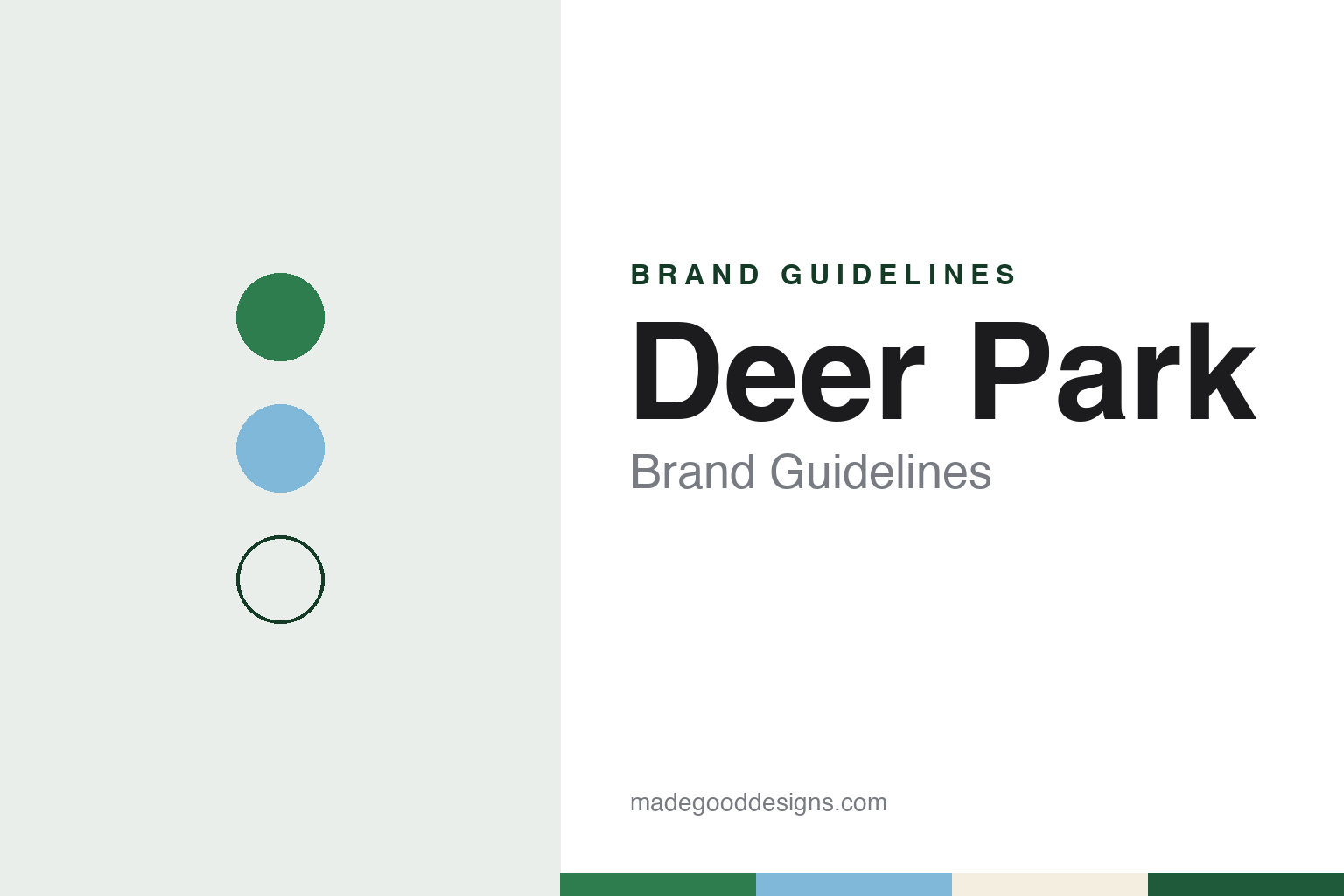
Deer Park Brand Guidelines
The Maryland railroad spring water, bottled since 1873.
Aa
Two constants: a forest green, spring blue and sand white palette and a sturdy gothic sans register. Abstract homage — not a Deer Park product or mark; no label, logo or bottle is reproduced.
A railroad, a hotel and a spring
Bottled by the railroad for its hotel guests and dining cars.
Deer Park began with a railroad. The town of Deer Park sits high in Garrett County, in the far west of Maryland, on the line of the Baltimore and Ohio Railroad. In the early 1870s the B&O opened a resort hotel there to draw passengers up into the mountains for the cool summer air; English Wikipedia’s article on the town dates the Deer Park Hotel to 1872 and describes it as the focal point for visitors who came for the scenery. The town itself was incorporated in 1884, and its best-known guests were President Grover Cleveland and Frances Cleveland, who spent the first night of their honeymoon there on 3 June 1886, the Washington Post Magazine recalled in 2014.
The water came with the hotel. A post on the archives blog of Georgetown University Library says the railroad built its Deer Park hotel in 1873 and began bottling water from a nearby spring, and that the water proved popular enough for the B&O to serve it on its trains from around 1905. A B&O dining-car menu reproduced in that post notes that Deer Park, Maryland spring water was “used exclusively”; the post dates that menu to 1927, the railroad’s centennial year. English Wikipedia gives the same year, 1873, for the start of bottling, and says the spring was known locally as the Boiling Spring, after the way the water bubbled up through white sand on its way to the surface.
For almost a century the water and the railroad stayed together. English Wikipedia says that in 1966 a company called the Boiling Spring Holding Corporation bought the spring and its surrounding woods from the B&O and incorporated as Deer Park Spring Water, Inc., taking its name from the town; at that stage it bottled mainly for the New York metropolitan market.
Colour
A town’s name, a green palette and a catchphrase.
The brand’s identity rests on its name. “Deer Park” is first the name of a Maryland town, and the brand carried it from a single railroad spring into a regional bottled water sold across the eastern United States.
Its most quoted line is spoken rather than drawn. English Wikipedia records the 1980s television catchphrase “Deer Park, that’s good water!,” citing a 1989 commercial, and the brand’s current website still runs a variation on it in its page titles: “Deer Park! That’s Still Good Water!”, marked as a trademark.
Packaging has followed the wider changes at its owners. English Wikipedia says the Aquapod bottle was released under the Deer Park name in 2006, and that the brand moved to bottles made without bisphenol A in 2015, citing the brand’s own site.
The water no longer comes from one spring. English Wikipedia, citing the former Nestlé Waters site, lists sources in several eastern states, from Maryland and Pennsylvania to Florida; the brand says today that it draws Deer Park water from selected springs in five states of the Mid-Atlantic region, the area English Wikipedia names as its main market.
Typography
Design and documentation.
The seven brands in this group are all water names: vitaminwater, Liquid I.V., Core, Crystal Geyser, Deer Park, Arrowhead and Harrogate. Water brands in general sit at many different points in the trade, from family companies that still carry a founder’s name to labels that now belong to much larger food and drinks groups, and a single brand can be sold everywhere from a corner shop to a restaurant table.
A water brand’s identity is usually carried less by what is in the bottle than by a label, a name and the place or idea it promises, because the company behind the name may have changed hands, moved its production or grown far beyond the place where it started. That makes the questions behind each name worth asking plainly: who started it, who owns it now, and where its products are actually made and bottled.
Each guide separates what independent sources record from what the company says about itself — its founding story, its owners over time, where its products are made and how its labels have changed — and marks plainly what rests only on the company’s own word.
Aa
A sturdy American gothic sans for a plain regional name. (Specimen set in Libre Franklin, a sans-serif STAND-IN; NOT the Deer Park logo.)
Deer Park
From Clorox to Perrier, Nestlé, BlueTriton and Primo Brands.
Deer Park has changed hands several times since leaving the railroad. English Wikipedia says the Deer Park water company was bought by The Clorox Company, which sold the water under the Deer Park name along much of the East Coast. In October 1993 The New York Times reported that Perrier Group of America, the American bottled water arm of Nestlé, had bought Deer Park; Nestlé had taken over Perrier itself in 1992. The brand then sat inside the company known from 2002 as Nestlé Waters North America, alongside regional spring waters such as Poland Spring in Maine and Arrowhead in California.
Nestlé let the business go in 2021. The Globe and Mail reported in February 2021 that Nestlé had agreed to sell its North American water brands to the investment firms One Rock Capital Partners and Metropoulos & Co., and the sale closed in early April 2021, when the business was renamed BlueTriton Brands, based in Stamford, Connecticut. On 8 November 2024 BlueTriton completed a merger with Primo Water, creating Primo Brands Corporation, according to the company’s release issued from Tampa, Florida and Stamford; its shares began trading on the New York Stock Exchange days later. Deer Park remains one of that group’s regional spring waters, sold mainly in the Mid-Atlantic; English Wikipedia lists it among the BlueTriton brands with Ice Mountain in the Midwest, Ozarka in the South Central states and Arrowhead in the West, each sold in its own part of the country.
The name needs care online. Deer Park is also a town in Maryland and the name of places in Texas, New York and elsewhere; the brand’s own site is deerparkwater.com.
For a design guide, Deer Park shows how a resort town’s name, first printed on bottles for railroad passengers in 1873, can outlive the hotel, the railroad’s ownership and a string of corporate owners. Compare Arrowhead, its Californian sister brand named after a mountainside landmark, and Vittel, the spa water from the Vosges. For this guide we use forest green, spring blue and sand white with a sans, an unofficial interpretation; no product or logo is reproduced.
Explore & save
Keep Deer Park’s identity on hand — save it to a board in the Made Good inspiration library.
Deer Park identity set
Pin the Deer Park forest green, spring blue and sand white palette and the sturdy gothic sans register to your own board.