Old Forester Brand Guidelines
George Garvin Brown’s sealed-bottle bourbon from Louisville, 1870.
Aa
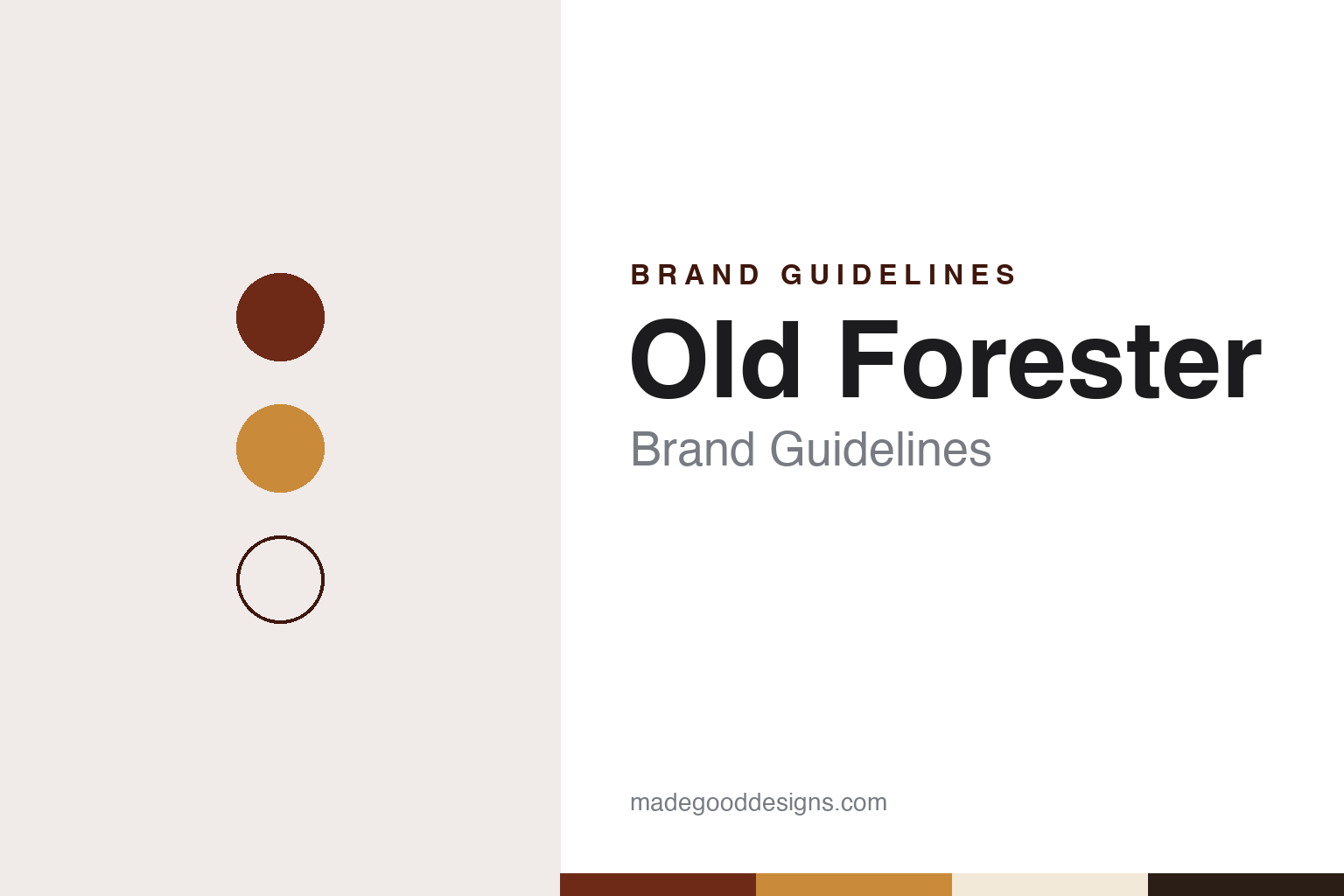
Two constants: a Whiskey Row brick, bourbon amber and label cream palette and a Victorian book serif register. Abstract homage — not an Old Forester product or mark; no label, logo or bottle is reproduced.
A salesman’s bourbon
Brown-Forman’s founding brand, created by a pharmaceutical salesman.
Old Forester is the bourbon on which Brown-Forman was built. English Wikipedia, citing the company’s brand portfolio, calls it “the company’s 1870 founding brand,” and says the company was founded in Louisville in 1870 by George Garvin Brown, a young pharmaceuticals salesman. The brand’s own history says Brown moved to Louisville in 1863 to attend high school and that his work selling medicines led him to create Old Forester.
The idea the brand is built on is the bottle. In 1870, according to a reference work cited by English Wikipedia, whiskey was typically drawn and sold straight from the barrel, which left room for dilution and adulteration. The company says Brown batched bourbon from three nearby distilleries — Mattingly, Mellwood and Atherton — for consistency, sealed it exclusively in glass bottles and signed each one as his personal guarantee of quality. English Wikipedia says the whiskey was sold at first through pharmacies, and describes Old Forester as the first bourbon available exclusively in sealed bottles; the company has trademarked the phrase “America’s First Bottled Bourbon.”
The name has a medical root too. English Wikipedia says the whiskey was first spelled “Old Forrester,” with two r’s, after Dr. William Forrester, a Louisville physician who endorsed it; the company says the bourbon was named after him. English Wikipedia says the spelling may have been changed to avoid naming him directly, but calls that explanation conjecture.
Brown’s firm went through several names and partners before it became Brown-Forman. English Wikipedia notes that sources disagree over the dates, and over whether the partner, an accountant named Forman, was called George or John. What is not in doubt is the line of control: about 40 members of the Brown family hold more than 70 per cent of Brown-Forman’s voting shares, The Globe and Mail reported, and in spring 2015, the company says, Campbell Brown, a fifth-generation member of the family, became Old Forester’s president and managing director.
Colour
A timeline of “firsts,” told through the bottle.
Old Forester tells its own history as a list of firsts, and those claims are the company’s own. It says the whiskey went from 90 to 100 proof to comply with the Bottled-in-Bond Act of 1897, and that in 1910 a fire on the bottling line forced whiskey that was ready to bottle into a second barrel — the origin, it says, of a “Very Old Fine Whisky” and what it calls the first double-barrelled bourbon. It credits Old Forester with the first holiday gift decanter in 1950, the 86-proof bottling in 1959 and President’s Choice in 1962, which it calls the industry’s first single-barrel bourbon.
Prohibition is the centre of the story. English Wikipedia says Brown-Forman was granted one of six national licences to produce medicinal whiskey when Prohibition began in 1920. The company goes further: it says Old Forester is the only bourbon continually sold by the same company before, during and after Prohibition, and English Wikipedia’s article on Shively, Kentucky, calls it the oldest continually produced brand.
Since 2002 the brand has issued Birthday Bourbon, released each September to mark the founder’s birthday, which the company calls the first vintage-dated bourbon. English Wikipedia lists medals at the San Francisco World Spirits Competition for both Birthday Bourbon and the 100-proof Signature, and records that Malt Advocate named Birthday Bourbon American Whiskey of the Year in 2007.
In 2014, the company says, it began the Whiskey Row series, four bottlings named for years in the brand’s history: 1870 Original Batch, 1897 Bottled in Bond, 1910 Old Fine Whisky and 1920 Prohibition Style. The 1920 bottling was announced in August 2016, according to the Lexington Herald-Leader as cited by Wikipedia. In 2019 the company reintroduced a rye recipe, tracing it to the Normandy rye brand that Owsley Brown acquired with the Old Kentucky Distillery in 1940, and in 2021 it began a 117 Series sold only at the distillery.
Typography
Design and documentation.
The seven brands in this group are all bourbon names: Elijah Craig, Eagle Rare, Blanton’s, Angel’s Envy, Old Forester, Michter’s and Basil Hayden. Bourbon brands in general sit at many different points in the trade, from family distillers that still carry a founder’s name to labels that now belong to much larger drinks groups, and a single brand can be sold everywhere from a corner shop to a hotel bar.
A bourbon brand’s identity is usually carried less by the whiskey itself than by a bottle, a label and a name, because the company behind the name may have changed hands, moved its distilling or grown far beyond the place where it started. That makes the questions behind each name worth asking plainly: who started it, who owns it now, and where its whiskey is actually distilled, aged and bottled.
Each guide separates what independent sources record from what the company says about itself — its founding story, its owners over time, where its whiskey is made and how its bottles and labels have changed — and marks plainly what rests only on the company’s own word.
Aa
A Victorian book serif for a brand built on a signed, sealed label. (Specimen set in Libre Caslon Text, a serif STAND-IN; NOT the Old Forester logo.)
Back on Whiskey Row
A distillery in the building the brand left in 1919.
For most of the twentieth century Old Forester was not made downtown. English Wikipedia says the firm used a building on Louisville’s Whisky Row, on Main Street, from 1882 to 1919, and that Brown bought Ben Mattingly’s distillery in Marion County around the turn of the century; the company dates that purchase to 1901, Wikipedia to 1902. English Wikipedia says Brown-Forman’s Early Times distillery operates in Shively, on the edge of Louisville.
In 2018, the company says, the Old Forester Distilling Co. opened on West Main Street in the same building the brand had occupied from 1882 to 1919. It describes the site as the only downtown distillery with an active cooperage, charring barrels in the building where its spirit is aged, and runs tours, a bottle shop and a cocktail bar there named George’s Bar. Its labels name the Old Forester Distilling Company at Louisville as the producer, under Brown-Forman Distillers.
Old Forester’s “first” claims are worth reading as the company states them: they are the brand’s own account of its history, several are registered as trademarks, and independent sources such as Wikipedia rest partly on the same company material.
For a design guide, Old Forester shows how a single act of packaging — a sealed, signed bottle — can carry a brand for more than 150 years. Compare Jim Beam, another Kentucky bourbon that leans on family lineage, and Michter’s, its neighbour on Louisville’s Main Street. For this guide we use brick, amber and cream with a serif, an unofficial interpretation; no product or logo is reproduced.
Explore & save
Keep Old Forester’s identity on hand — save it to a board in the Made Good inspiration library.
Old Forester identity set
Pin the Old Forester brick, amber and cream palette and the Victorian book serif register to your own board.