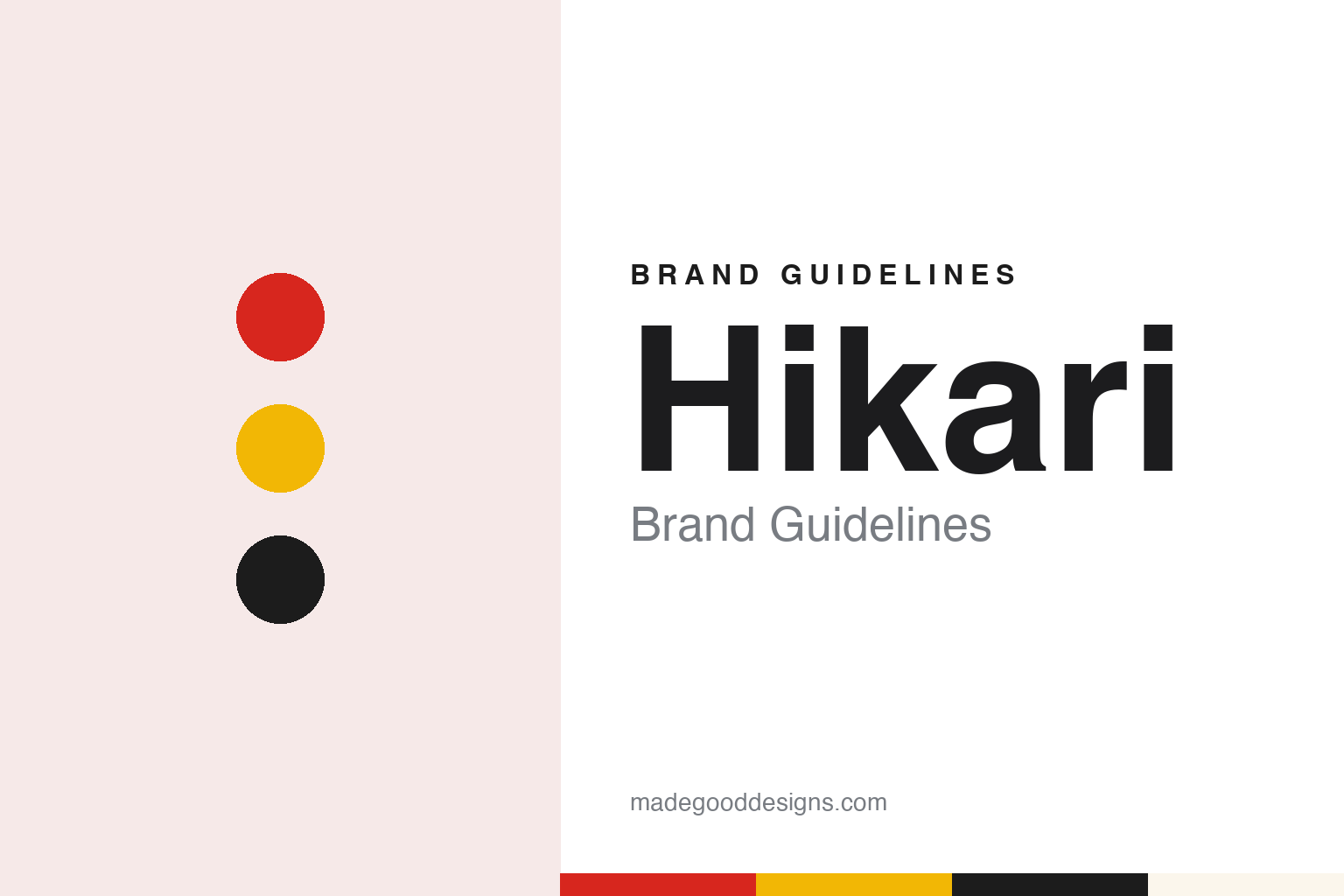
Hikari Brand Guidelines
Kyorin’s fish food from Himeji, born of the Kamihata koi family.
Aa
Two constants: a koi red, golden light and rice paper palette and a clean Japanese gothic sans register. Abstract homage — not a Hikari product or mark; no pack, logo or label is reproduced.
From koi ponds to fish food
A Himeji family business that split its feed trade into a company of its own.
Hikari is a brand, not a company. The fish foods sold under the name are made by Kyorin, part of the Kamihata Fish Industry Group of Himeji, in Hyōgo Prefecture, and English Wikipedia describes Hikari as a line of fish food made by Kyorin Food Industries. Behind it is a family business that began with fish rather than feed.
The group’s own Japanese history traces its roots to 1877, when Tozaemon Kamihata began farming carp for the table. In 1946 Tokichi Kamihata opened a carp wholesale shop in Himeji, and in 1961 Shigezo Kamihata established Kamihata Fish Industries, which began breeding nishikigoi, the ornamental koi. In 1973, the group says, it completed a koi farm in Yamasaki, in the hills of western Hyōgo, and began exporting koi to markets abroad.
Fish food became a business of its own in 1968. That year, the group history says, the feed wholesale division was separated from Kamihata Fish Industries to form Kyorin Co., Ltd.; the group explains that the name is written 共鱗 in kanji, and reads as “with fish.” In 1979 the group set up Kyorin Food Industries as the manufacturing arm, with a factory at Kasai in Hyōgo, and, it says, began making floating pellets with an expanded-pellet extruder.
Production spread across Japan from there. The group’s history lists a Kanto factory at Kujukuri in Chiba from 1984, a Kyushu factory at Chikugo in Fukuoka from 1990, and a new factory at Fukusaki in Hyōgo in 2007, with a second Fukusaki plant added in 2015. In 1985 Kamihata Fish Industries opened an import centre for tropical fish in Himeji, and the group says that was the point at which its core business moved from koi to tropical fish. The group moved its headquarters to a new building in Himeji in 2014. Company profiles on the group site describe Kyorin as the domestic wholesaler and exporter of fish foods and Kyorin Food Industries as their developer and maker.
Colour
A single word for light, a space-shuttle food and a trademark fight over wafers.
The name is short and portable. Hikari is the Japanese word for light, and the Kyorin site uses it in two scripts: the brand appears in Latin letters as “Hikari” across the company’s Japanese pages, while some products carry the name in hiragana, ひかり, as in the Japanese title of the Crest Carnival food. The same site presents Hikari as Kyorin’s worldwide brand, and the group history from 2019 onward speaks of the “Hikari brand” as a thing in its own right, separate from the company names behind it.
In the United States the brand has been built around a phrase. The about page of Hikari Sales USA, as archived in 2016, presented Hikari as the originator of “Species Specific” diets, a phrase it marked as a trademark, and named Kyorin Co., Ltd. as the maker. The page described Kyorin’s koi farm at Yamasaki and its Hikari Aquatic Laboratory, which the group history says was completed in 2001.
The brand’s most unusual product went into orbit. Kyorin says it was asked by Japan’s National Space Development Agency to produce food for medaka, the Japanese rice fish, for a space-shuttle experiment, and that the result was a food called Hikari Orihime. English Wikipedia records that the shuttle mission STS-65, launched on 8 July 1994, carried four Japanese rice fish in an experiment on mating in microgravity, and that the fish laid eggs in orbit. Kyorin says the same sponge-like food technology later went into foods for large carnivorous aquarium fish sold under its Crest names.
Names can also be lost. The law firm Katten reported in April 2019 that the US Trademark Trial and Appeal Board, in a precedential decision that year, had affirmed the refusal of Hikari Sales USA’s application to register ALGAE WAFERS for fish food, finding the term generic.
Typography
Design and documentation.
The seven brands in this group are all aquarium and pond names: Fluval, Juwel, Seachem, Hikari, OASE, EHEIM and API. Aquarium and pond brands in general sit at many different points in the trade, from family firms that still carry a founder’s name to labels that now belong to much larger pet care groups, and a single brand can be sold everywhere from a specialist aquatics shop to a general pet store.
An aquarium brand’s identity is usually carried less by a single product than by a name, a logo and the look of its packs, because the company behind the name may have changed hands, moved its production or grown far beyond the place where it started. That makes the questions behind each name worth asking plainly: who started it, who owns it now, and where its tanks, filters, foods or treatments are actually made.
Each guide separates what independent sources record from what the company says about itself — its founding story, its owners over time, where its products are made and how its packaging has changed — and marks plainly what rests only on the company’s own word.
Aa
A clean Japanese gothic sans for a one-word brand used in Latin letters and in hiragana. (Specimen set in Zen Kaku Gothic New, a sans-serif STAND-IN; NOT the Hikari logo.)
Hikari
A family group that both makes fish food and distributes other brands.
Kyorin took direct control of the brand’s biggest export market in 2006. The group history says that in that year Kyorin acquired Hikari Sales USA as a wholly owned subsidiary, gaining the sales rights for Hikari across North America. The same year, it says, Kyorin’s operation in China completed a five-storey head office in Guangzhou; the group had set up a joint venture, Kamihata China, in Shenzhen in 1999.
The Kamihata group also works the other side of the trade, bringing foreign brands into Japan. Its history says Kamihata Fish Industries became the Japanese import agent for the American brands Marineland and Coralife in 1997, and that in 2016 it signed an agreement to act as sole Japanese agent for the German filter maker EHEIM. In 2019, the history adds, it became the Japanese agent for Marshall Pet Products of the United States.
The name needs care online. Kyorin’s fish-food business is unrelated to Kyorin Pharmaceutical, a separate drug company, and “Hikari” is a common Japanese word that also names a Shinkansen service and many other businesses. Kyorin’s Japanese site is kyorin-net.co.jp; the English-language site for the brand is hikari.info, which carries the Kamihata Fish Industry Group name in its header.
For a design guide, Hikari shows how a family business from Himeji can turn a single Japanese word into a brand that travels, carried in Latin letters abroad and in hiragana at home, while the company names behind it stay in the background. Compare EHEIM, whose filters the Kamihata group distributes in Japan, and Seachem, the family-owned aquarium company from Georgia. For this guide we use koi red, golden light and rice paper with a sans, an unofficial interpretation; no product or logo is reproduced.
Explore & save
Keep Hikari’s identity on hand — save it to a board in the Made Good inspiration library.
Hikari identity set
Pin the Hikari koi red, golden light and rice paper palette and the clean Japanese gothic sans register to your own board.


