Rittenhouse Brand Guidelines
A Philadelphia name on a Kentucky-made bonded rye.
Aa
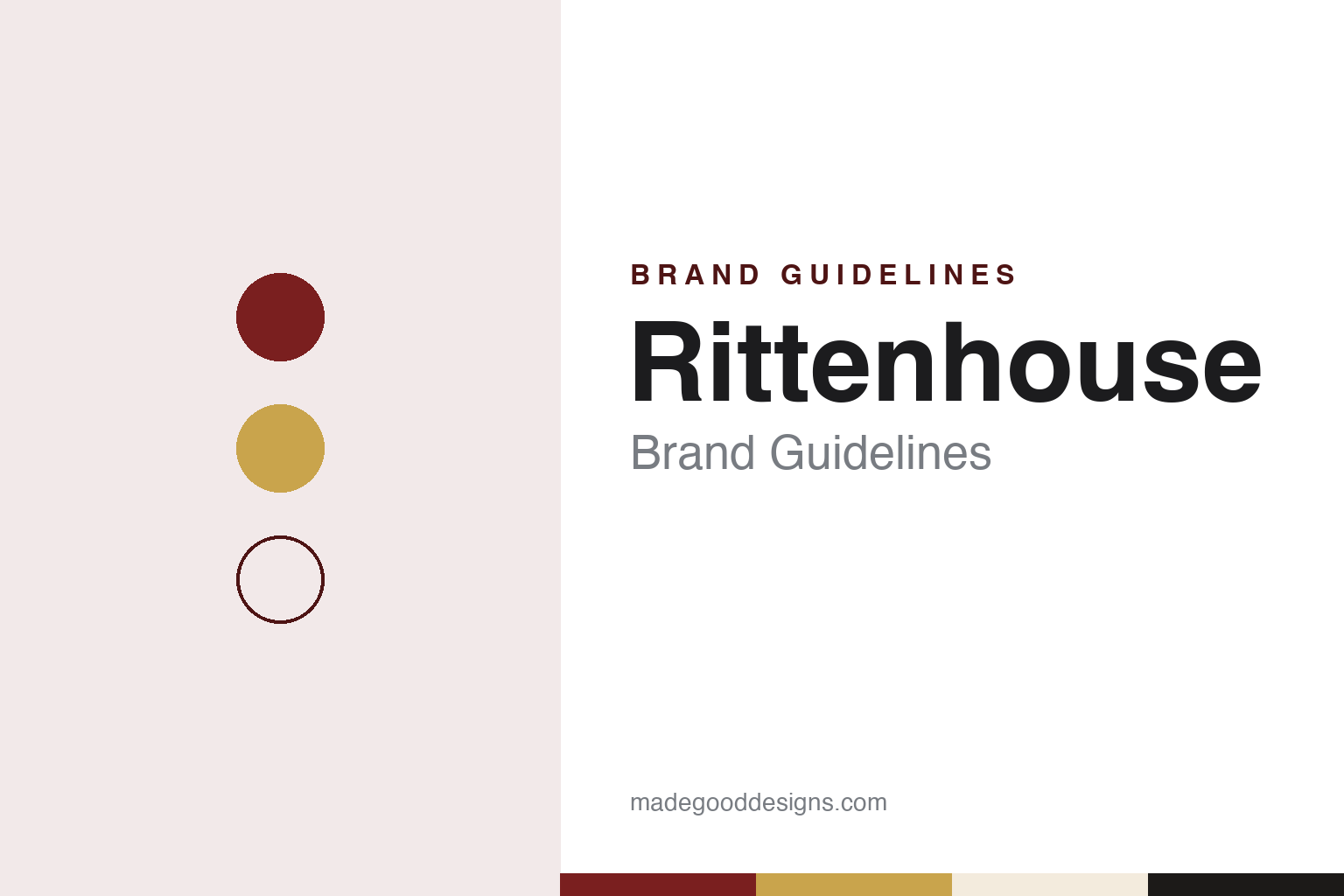
Two constants: a bond red, old gold and parchment palette and a modern serif register. Abstract homage — not a Rittenhouse product or mark; no label, logo or bottle is reproduced.
A square in Philadelphia
A rye named after a park, made in a state that once lived on rye.
Rittenhouse is a straight rye whiskey owned and made by Heaven Hill, the family-owned distiller of Bardstown, Kentucky. The name looks east, to Pennsylvania. Heaven Hill says the whisky’s name commemorates Rittenhouse Square in Philadelphia, one of the five open squares laid out in William Penn’s plan for the city in the late seventeenth century. English Wikipedia says the square, first called Southwest Square, was renamed in 1825 after David Rittenhouse, the Philadelphia clockmaker and astronomer, citing the local news site Billy Penn.
The choice of name is a nod to a regional style. Heaven Hill says rye was once the most popular whiskey of the American Northeast, especially in Pennsylvania and Maryland, and English Wikipedia describes Rittenhouse as a rye originally made in Pennsylvania and now produced in Kentucky. The brand’s earlier owner was Philadelphian too. The whiskey historian Chuck Cowdery wrote on his blog in January 2011 that Rittenhouse Rye had been a brand of Publicker, the large Philadelphia distilling company, and was among the Publicker brands sold off and still on sale. In a 2007 post he listed Rittenhouse among the old rye names that survived after rye production moved from Pennsylvania and Maryland to Kentucky in the 1980s.
Its owner today has its own long history. English Wikipedia says Heaven Hill was founded in 1935, shortly after the end of Prohibition, by a group of investors that included the distiller Joseph L. Beam, a first cousin of Jim Beam, and a member of the Shapira family; the five Shapira brothers later bought out the other investors, and their descendants still own and run the company. Every master distiller at Heaven Hill since its founding has been a member of the Beam family, the same article says. Rittenhouse sits in Heaven Hill’s portfolio alongside another rye, Pikesville, and bourbons such as Evan Williams and Elijah Craig.
Colour
One bottle, one proof and the law of 1897.
The core of the brand is a single, plainly described whiskey. Heaven Hill’s brand page calls it Rittenhouse Bottled-in-Bond Straight Rye Whiskey and gives its specification: 100 proof, at least four years old and made from a mash of at least 51 percent rye, the legal minimum for an American rye. The brand’s own site spells the name of the spirit the older way, “Straight Rye Whisky,” without the “e.”
“Bottled-in-Bond” is a legal term rather than a marketing phrase. It goes back to the federal Bottled-in-Bond Act of 1897, whose anniversary Cowdery marked in a post on 3 March 2020; under it a bonded spirit must come from one distillery and one distilling season, be aged under government bond for at least four years and be bottled at 100 proof. In that 2020 post Cowdery called Rittenhouse the top-selling bonded rye. Cowdery wrote in 2014 that the exact grain recipe is not published and that the master distiller had confirmed only that it was at least 51 percent rye.
Heaven Hill presents Rittenhouse as a rye in the classic American tradition. The brand’s site shows award badges including double gold medals from the San Francisco World Spirits Competition for 2021, 2022 and 2023, and quotes the bartender Dale DeGroff on how a bonded rye “stands up to the vermouth.”
The brand has also been used to show off very old rye. Cowdery reported in November 2007 that Heaven Hill had released a 23-year-old Rittenhouse Very Rare, a single-barrel, non-chill-filtered rye from a batch distilled in October 1984; a 21-year-old from the same batch had come out the year before, and in 2009 he reported that a 25-year-old was expected.
Typography
Design and documentation.
The seven brands in this group are all whisky names: WhistlePig, Rittenhouse, Hakushu, Mars Shinshu, Slane, Roe & Co and The Sexton. Whisky brands in general sit at many different points in the trade, from family distilleries that still carry a founder’s name to labels that now belong to much larger drinks groups, and a single brand can be sold everywhere from a corner shop to a hotel bar.
A whisky brand’s identity is usually carried less by a single bottle than by a label, a name and the place it promises, because the company behind the name may have changed hands, moved its production or grown far beyond the place where it started. That makes the questions behind each name worth asking plainly: who started it, who owns it now, and where its whisky is actually distilled, matured and bottled.
Each guide separates what independent sources record from what the company says about itself — its founding story, its owners over time, where its whisky is made and how its labels have changed — and marks plainly what rests only on the company’s own word.
Aa
A nineteenth-century modern serif for a plain, statutory register. (Specimen set in Old Standard TT, a serif STAND-IN; NOT the Rittenhouse logo.)
Rittenhouse
A fire, a borrowed still and a rye that came back.
Where Rittenhouse is made has changed with Heaven Hill’s own fortunes. On 7 November 1996 a fire destroyed most of the company’s production plant in Bardstown, English Wikipedia says. Cowdery wrote in 2009 and 2010 that afterwards all of Heaven Hill’s rye, including Rittenhouse, was distilled for it by Brown-Forman. In 1999 Heaven Hill bought the Bernheim distillery in Louisville from Diageo, as The New York Times reported that February; English Wikipedia says mashing, fermenting and distilling now happen there, while ageing, bottling and shipping stay in Bardstown, which is the town the brand’s site gives as its home. Cowdery reported in July 2010 that Heaven Hill had moved all of its rye production to Bernheim nearly two years earlier.
The rye revival made the bonded bottle hard to find for a while. Cowdery wrote in 2010 that supplies were very tight, with rye mashed only one day a month, and in January 2012 that the bonded rye had been in short supply. Recognition arrived in the same years: Cowdery reported in 2010 that WHISKY Magazine had named Rittenhouse Bottled-in-Bond the best American whiskey that year. One neutral note of debate: in 2013 Cowdery questioned a distributor’s listing of Rittenhouse as a “craft” brand.
Today Rittenhouse remains a Heaven Hill brand, made in Kentucky and named for Philadelphia. The name needs a little care online: “Rittenhouse” is also a Philadelphia neighbourhood, a hotel and several other businesses, and the whiskey’s own site is rittenhouserye.com.
For a design guide, Rittenhouse shows how a borrowed place-name, a legal designation and a single fixed proof can carry a rye brand through changes of owner, still and fashion. Compare WhistlePig, the Vermont rye built on a farm story, and Jim Beam, whose family supplied Heaven Hill’s master distillers. For this guide we use bond red, old gold and parchment with a modern serif, an unofficial interpretation; no product or logo is reproduced.
Explore & save
Keep Rittenhouse’s identity on hand — save it to a board in the Made Good inspiration library.
Rittenhouse identity set
Pin the Rittenhouse bond red, old gold and parchment palette and the modern serif register to your own board.