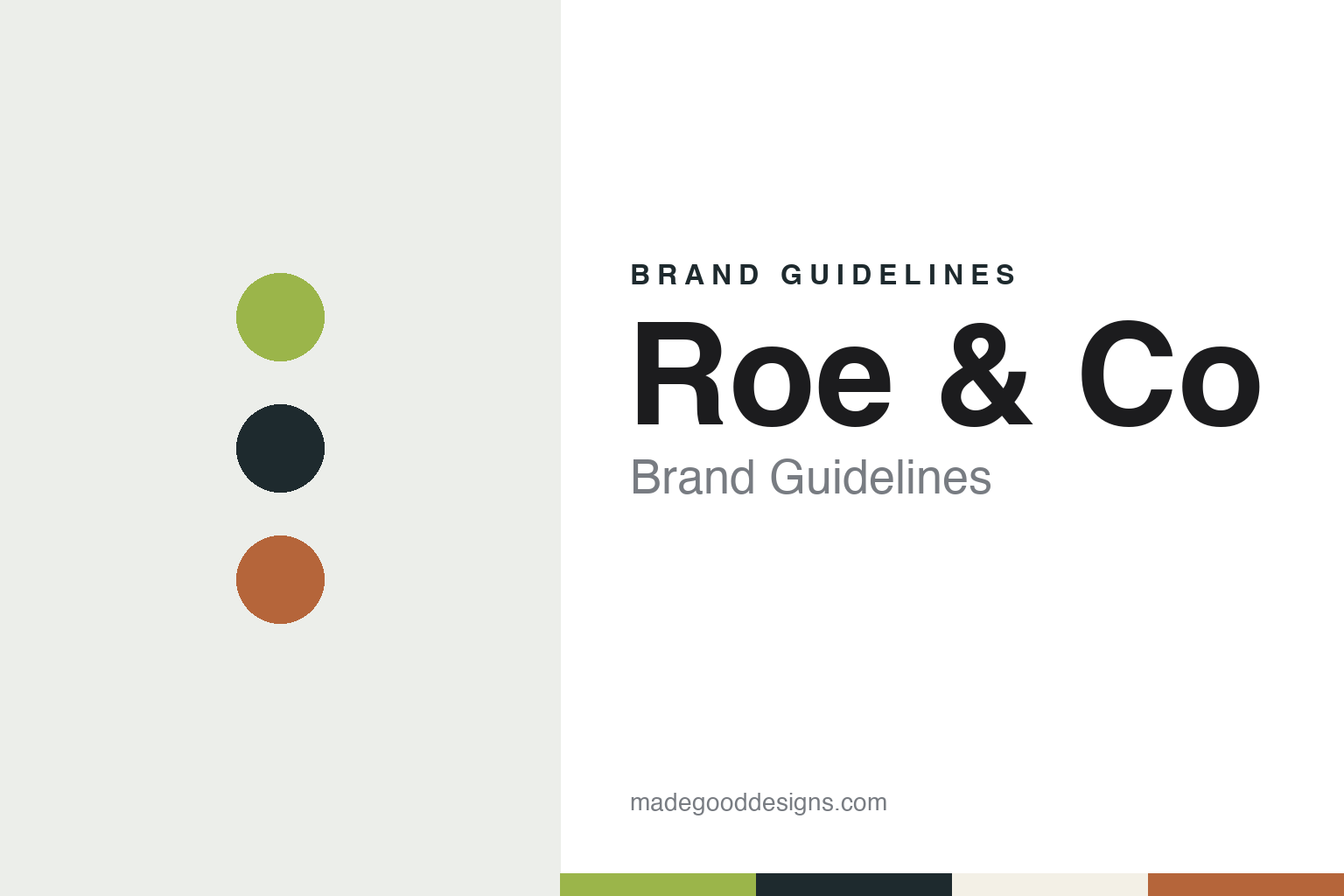
Roe & Co Brand Guidelines
A lost Dublin distilling name, revived in a brewery power house.
Aa
Two constants: a pear green, copper and power-house slate palette and a geometric sans register. Abstract homage — not a Roe & Co product or mark; no label, logo or bottle is reproduced.
George Roe’s Thomas Street
A great Dublin distillery, closed in 1926 and nearly forgotten.
Roe & Co borrows a name from Dublin’s first golden age of whiskey. In the 19th century the Roe family ran the Thomas Street Distillery, which stood opposite the Guinness brewery at St. James’s Gate. Brian Townsend’s The Lost Distilleries of Ireland, as cited by English Wikipedia, describes it at its peak as the largest distillery in Britain and Ireland, producing around two million gallons a year. It closed in 1926, and some of its buildings were later absorbed into the Guinness brewery.
Little of it survives. The brand’s own history says that all that remains of George Roe’s distillery is a windmill tower and a pear tree that still flowers, both across the road from the brewery, and that the story of George Roe and his family’s whiskies had “largely been lost to history.” Forbes reported in April 2019 that the brand is named in honour of George Roe, and the company calls him a pioneer of Irish whiskey.
The revival came from the brewery’s owner. Diageo, the British drinks group that owns Guinness, announced on 31 January 2017 that it would build a new whiskey distillery in the old brewery power house on Thomas Street, close to the original Roe site, The Irish Times reported, and that it would launch a whiskey under the revived Roe & Co name. The Spirits Business and Bloomberg covered the announcement the same week. Diageo had earlier agreed in November 2014 to swap its Bushmills brand to Proximo Spirits for the half of Don Julio tequila it did not already own, The Guardian reported.
Colour
A non-chill-filtered blend, then a distillery for Dublin 8.
The whiskey came before the distillery. The first Roe & Co, released in 2017, was a premium blended Irish whiskey of malt and grain whiskeys aged in bourbon casks, non-chill-filtered and bottled at 45% ABV, higher than the usual strength, as English Wikipedia and the company both note. The company says the blend was created with Master Blender Caroline Martin. The brand reached the United States in March 2019, starting in Massachusetts, Connecticut, Rhode Island, New Jersey, Maryland and Washington, DC, Forbes reported.
Distilling began in June 2019, The Spirits Business reported, in the converted Guinness Power Station, which the brand describes as being in the heart of the Liberties, the old quarter of south-west Dublin; the company gives its address as James’s Street. Its range has since widened beyond the original blend. The company lists a Signature Blend, the premium blend, a Single Grain: Flor, inspired by the biological ageing used for sherry in Jerez, and a Single Malt: Solera, which it calls its first-release single malt made in Dublin 8 and describes as triple distilled.
The identity is pitched at bars rather than heritage alone. The company calls the distillery “the home of cocktail exploration and modern Irish whiskey” and uses the line “Irish Whiskey reimagined,” and the site runs a Powerhouse Bar and tasting experiences alongside its tours. The approach has won recognition in the trade: at the Icons of Whisky Awards 2025 the distillery was named Ireland’s Visitor Attraction of the Year and Brand Innovator of the Year, Drinks Industry Ireland reported.
Typography
Design and documentation.
The seven brands in this group are all whisky names: WhistlePig, Rittenhouse, Hakushu, Mars Shinshu, Slane, Roe & Co and The Sexton. Whisky brands in general sit at many different points in the trade, from family distilleries that still carry a founder’s name to labels that now belong to much larger drinks groups, and a single brand can be sold everywhere from a corner shop to a hotel bar.
A whisky brand’s identity is usually carried less by a single bottle than by a label, a name and the place it promises, because the company behind the name may have changed hands, moved its production or grown far beyond the place where it started. That makes the questions behind each name worth asking plainly: who started it, who owns it now, and where its whisky is actually distilled, matured and bottled.
Each guide separates what independent sources record from what the company says about itself — its founding story, its owners over time, where its whisky is made and how its labels have changed — and marks plainly what rests only on the company’s own word.
Aa
A clean geometric sans for a modern whiskey with a 19th-century name. (Specimen set in Josefin Sans, a sans-serif STAND-IN; NOT the Roe & Co logo.)
Roe & Co
A brewery neighbourhood that distils again.
Roe & Co is part of a wider return of distilling to the Liberties. The company says the Thomas Street area is once again becoming a hub of brewing and distilling in Dublin, and it frames the brand as a celebration of the memory of George Roe rather than a continuation of his business. The surviving windmill tower and pear tree across from St. James’s Gate are the brand’s physical link to the old distillery, and the pear appears in the company’s tasting notes as well as its story.
Inside Diageo the brand sits beside the group’s Irish cream liqueur Baileys and its Guinness neighbour across the road. English Wikipedia notes that some of the old Roe buildings were later bought and incorporated into the Guinness brewery, so the company that absorbed part of the old distillery is also the one that revived its name.
The name needs a little care online. “Roe” is also the word for fish eggs and for a species of deer, and other businesses trade as Roe and Co; the whiskey’s own site is roeandcowhiskey.com, and the brand writes its name with an ampersand.
For a design guide, Roe & Co shows how a drinks company can revive a lost local name, anchor it to two surviving landmarks — a tower and a pear tree — and present it as a modern, cocktail-led whiskey rather than a period piece. Compare Bushmills, the County Antrim whiskey Diageo once owned, and Slane, the Irish whiskey from the Conyngham estate in County Meath. For this guide we use pear green, copper and power-house slate with a sans, an unofficial interpretation; no product or logo is reproduced.
Explore & save
Keep Roe & Co’s identity on hand — save it to a board in the Made Good inspiration library.
Roe & Co identity set
Pin the Roe & Co pear green, copper and power-house slate palette and the geometric sans register to your own board.