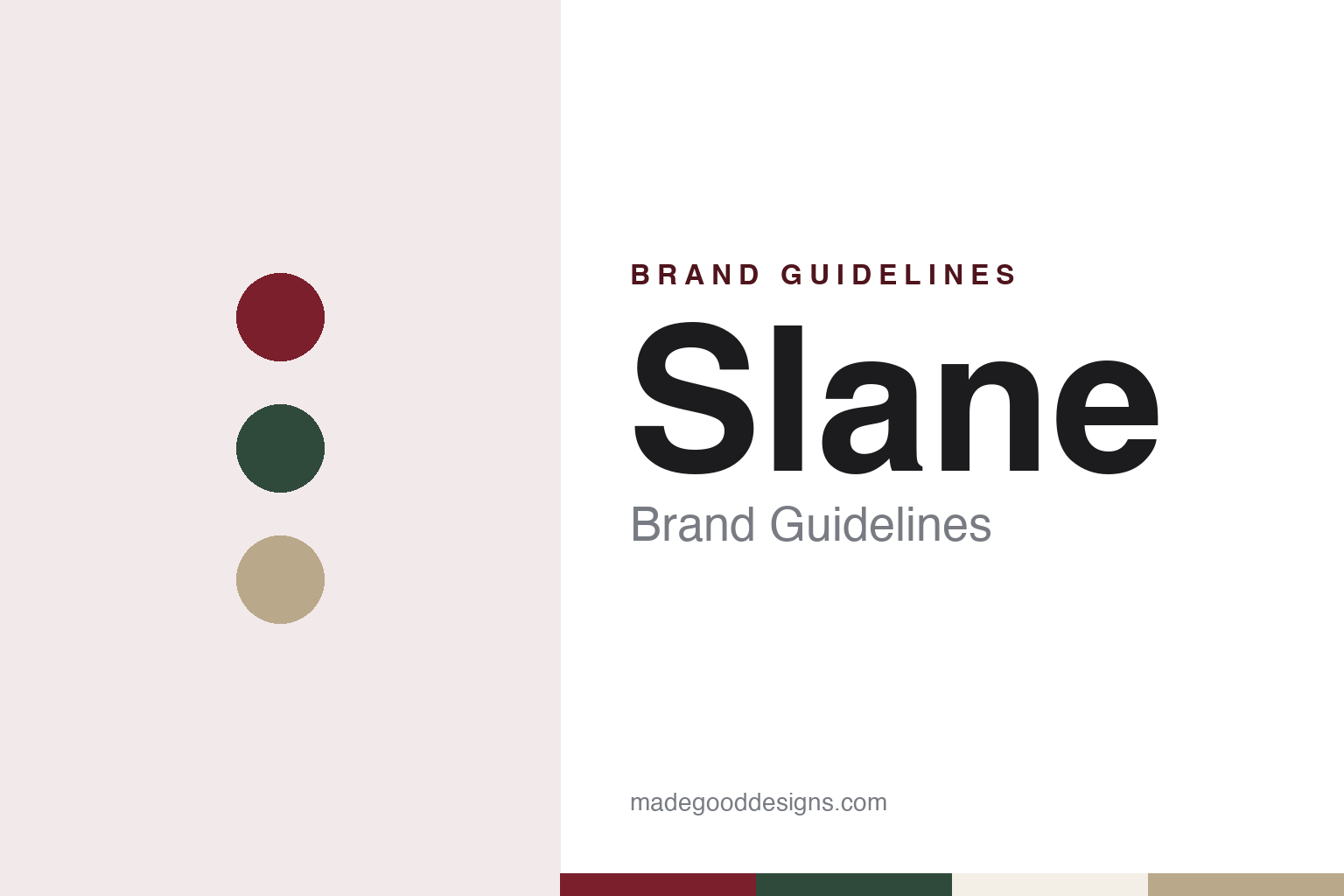
Slane Brand Guidelines
A castle estate’s whiskey, distilled in its old stables since 2017.
Aa
Two constants: a sherry cask red, Boyne green and castle stone palette and a high-contrast serif register. Abstract homage — not a Slane product or mark; no label, logo or bottle is reproduced.
A castle, a family and a whiskey
From a rock-concert estate to a distillery in the stable yard.
Slane Irish Whiskey takes its name from Slane Castle, the seat of the Conyngham family above the River Boyne in County Meath, about 30 miles north of Dublin. English Wikipedia dates the family’s hold on the land to the early 18th century, giving both 1701 and 1703 in its account, and The Spirits Business wrote in 2017 that the family had owned the 1,500-acre estate since 1701. To most people in Ireland the castle is known for something else: rock concerts have been staged in its natural amphitheatre since 1981, when, The Irish Times recalled in 1998, Thin Lizzy and U2 played the first show. A fire in 1991 badly damaged the castle, which reopened in 2001 after a decade of restoration, English Wikipedia says.
The whiskey is a family project that grew into a corporate one. In June 2015 Brown-Forman, the Louisville, Kentucky, company behind Jack Daniel’s and Woodford Reserve, announced that it had bought all the shares of Slane Castle Irish Whiskey Limited and would build a distillery on the estate, Drinks International and BevNET reported. At the time the castle’s owner was Henry Conyngham, the 8th Marquess Conyngham, better known as Henry Mountcharles, the man who started the concerts; he said his family would be “a key part of the brand-building model.” His son Alex Conyngham, then the Earl of Mount Charles, spoke of the family’s commitment to caring for the land and growing barley.
The plan announced in 2015 was for a distillery to open in late 2016 and new whiskeys to follow in spring 2017, with early releases made from whiskey bought from other Irish distilleries and finished to Slane’s specification, Drinks International reported. The distillery opened later than first planned. Slane Irish Whiskey was launched in Dublin in May 2017, ShelfLife reported, and Brown-Forman opened the Slane Distillery and its visitor centre in September 2017, The Spirits Business reported, describing it as the company’s first distillery outside the United States.
Colour
Stable yards, copper stills and three kinds of cask.
The distillery reuses the estate’s farm buildings. The Spirits Business reported in 2017 that construction, begun in 2015, converted 18th-century horse stables and courtyards on the estate, and ShelfLife described them as the castle’s newly renovated gothic farm buildings, about 250 years old. Inside are three copper pot stills and six column stills made by McMillan of Scotland, and the company said water from the nearby River Boyne would be used in future Slane blends. The visitor side added a tasting area, a heritage room, a shop, a café and two cocktail areas.
The liquid’s defining idea is in the cask. The core whiskey is a blend matured in three types of cask — virgin oak, seasoned whiskey casks and Oloroso sherry casks, the company says — and it is sold as the Triple Casked blend at 40% ABV. The Spirits Business noted in 2017 that the first release had been distilled by a third party, and that the company planned to keep the three-cask method for whiskey made at Slane. According to ShelfLife, Alex Conyngham created the whiskey with Brown-Forman’s master blenders Chris Morris and Steve Hughes.
The brand’s story leans on two families. The whiskey’s website presents it as the work of the “Brown Family,” the founding family behind Brown-Forman, and the “Conyngham Family,” on whose land it was born. The site also lists the brand’s themes as music, sustainability, provenance and people, tying the whiskey directly to the castle’s concert history. Alongside the core blend, the company lists a Special Edition, a Batch Strength and an Extra Sherry Wood release.
Typography
Design and documentation.
The seven brands in this group are all whisky names: WhistlePig, Rittenhouse, Hakushu, Mars Shinshu, Slane, Roe & Co and The Sexton. Whisky brands in general sit at many different points in the trade, from family distilleries that still carry a founder’s name to labels that now belong to much larger drinks groups, and a single brand can be sold everywhere from a corner shop to a hotel bar.
A whisky brand’s identity is usually carried less by a single bottle than by a label, a name and the place it promises, because the company behind the name may have changed hands, moved its production or grown far beyond the place where it started. That makes the questions behind each name worth asking plainly: who started it, who owns it now, and where its whisky is actually distilled, matured and bottled.
Each guide separates what independent sources record from what the company says about itself — its founding story, its owners over time, where its whisky is made and how its labels have changed — and marks plainly what rests only on the company’s own word.
Aa
A high-contrast serif for an estate whiskey with a castle behind it. (Specimen set in Playfair Display, a serif STAND-IN; NOT the Slane logo.)
Slane
An American owner and an Irish estate.
Slane sits inside a large American spirits portfolio. English Wikipedia lists it among Brown-Forman’s Irish whiskeys, alongside a group that includes Jack Daniel’s, Woodford Reserve, Old Forester and the raspberry liqueur Chambord. Brown-Forman was founded in Louisville in 1870, English Wikipedia says, and the whiskey’s website notes that it is imported into the United States by Brown-Forman Beverages of Louisville. The same portfolio has changed shape in recent years: English Wikipedia records that Brown-Forman sold Southern Comfort in 2016 and Finlandia vodka in 2023, while Slane stayed.
What the brand has that few rivals can claim is a place. The Boyne Valley, Alex Conyngham told The Spirits Business in 2017, was an important centre for Irish whiskey production in the 18th and 19th centuries. The company gives the distillery’s location as Slane village and offers tours, tastings and private events there.
The name needs a little care online. Slane is also a village, a castle and a long-running concert venue, so searches often land on concert listings or the castle’s own site; the whiskey has its own website, slaneirishwhiskey.com.
For a design guide, Slane shows how a whiskey can borrow the authority of a historic estate — its stable yards, its river and its rock-music fame — while being built and distributed by one of the largest American drinks companies. Compare Bushmills, the County Antrim whiskey, and Tullamore D.E.W., the Irish whiskey named for a Midlands town. For this guide we use sherry cask red, Boyne green and castle stone with a serif, an unofficial interpretation; no product or logo is reproduced.
Explore & save
Keep Slane’s identity on hand — save it to a board in the Made Good inspiration library.
Slane identity set
Pin the Slane sherry cask red, Boyne green and castle stone palette and the high-contrast serif register to your own board.