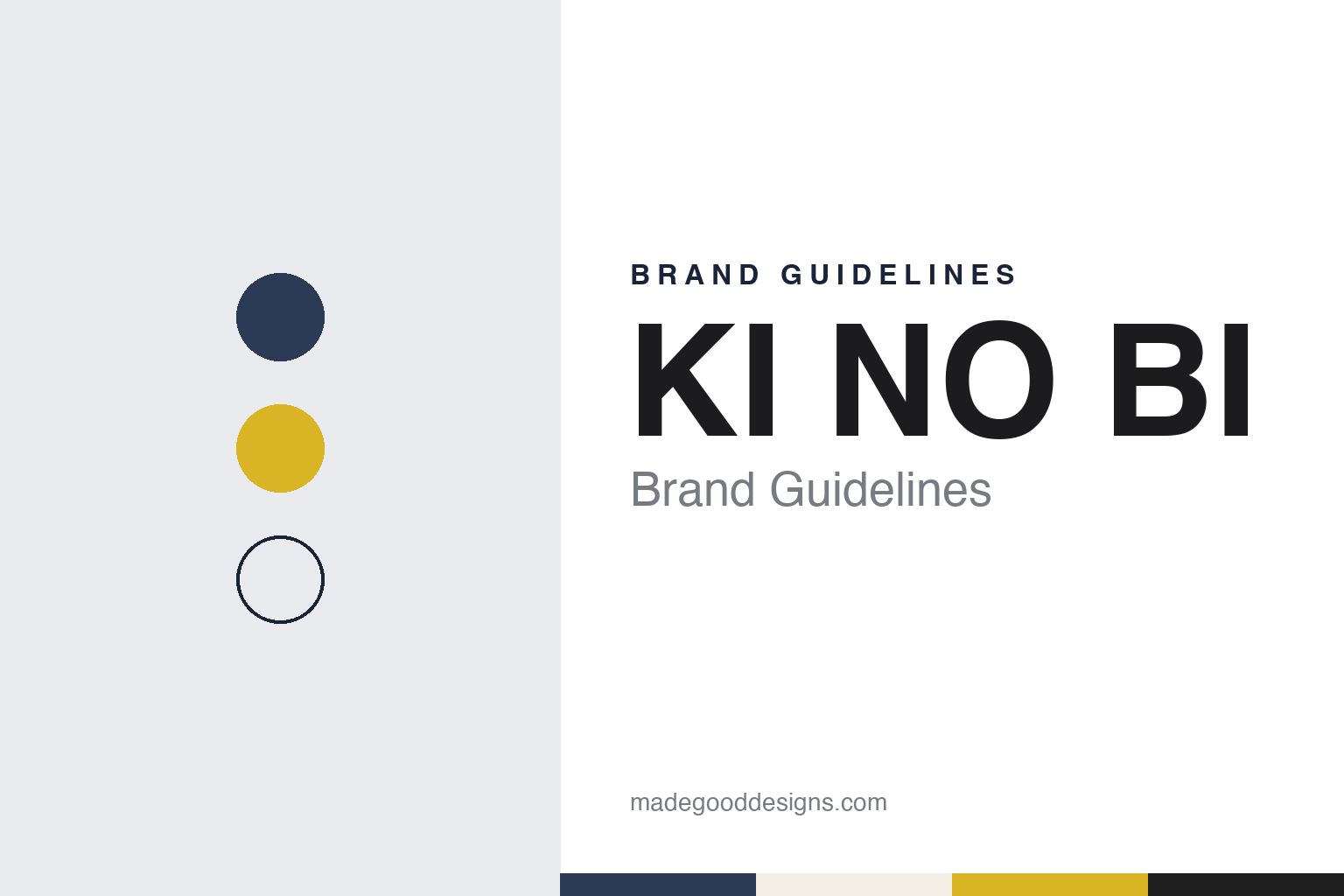
KI NO BI Brand Guidelines
The Kyoto Dry Gin named for the beauty of the seasons.
Aa
Two constants: a Kyoto indigo, yuzu and washi palette and a Mincho serif register. Abstract homage — not a KI NO BI product or mark; no label, karakami pattern, logo or bottle is reproduced.
From whisky to Kyoto gin
Three whisky people and Kyoto’s first gin licence.
KI NO BI, which the brand writes in capitals, is the gin of The Kyoto Distillery, which describes itself as Japan’s first dedicated artisanal gin distillery. The company’s Japanese-language founders’ story says it was founded in 2014 by three people: David Croll, Noriko Kakuda Croll and Marcin Miller. The distillery is in Minami-ku, in the south of Kyoto City, close to Fushimi, the district famous for centuries for its sake.
The founders came from whisky. The company says David and Noriko set up a whisky import business in Tokyo in the 1990s, bringing Scottish single malts to Japan, and met Miller when he was editor of the British Whisky Magazine; in 2000 they launched a Japanese edition of the magazine and the first Whisky Live event. In 2005 the three founded Number One Drinks to introduce rare Japanese single malts, including Karuizawa and Hanyu, to whisky drinkers abroad, the company says.
Kyoto came next. According to the founders’ story, David and Noriko had long thought of the city as a second home, and the three began planning a gin distillery there around 2014. After two years of research and preparation they obtained the first licence to make gin in Kyoto, and KI NO BI Kyoto Dry Gin went on sale in October 2016. The company says the gin is distilled, blended and bottled in Kyoto. On 1 June 2020 it opened the House of KI NO BI in the city, with a blending room, seminars for gin enthusiasts and a shop, according to its announcement.
Colour
The beauty of the seasons, in a karakami pattern.
The name carries the idea. The company translates KI NO BI, written 季の美 in Japanese, as “The Beauty of the Seasons,” and says it buys its botanicals in season, when they are at their best, and stores them for the distilling year. Its English line, “Inspired by tradition, crafted in Kyoto,” appears on the bottle; the company’s “Why Kyoto?” page says the bottles carry that message in as short a form as it could manage, and that the city’s centuries of fabric, pottery and paper-making were part of why no other place was considered.
The recipe is built from Japanese ingredients. The company says the gin uses a rice spirit base and soft water from Fushimi, and eleven botanicals in six groups: a base of juniper, orris and hinoki cypress; citrus from yuzu grown in the north of Kyoto Prefecture and lemon; gyokuro tea from Uji; ginger; red shiso and bamboo leaves; and sansho pepper with its young leaves. Each group is macerated in the rice spirit and distilled separately before the distillates are blended, a step the company describes with the Japanese word “konwa.” Each new batch is then married with the previous one, the company says, with half of the vatted gin kept back to blend with the next.
The package is where the brand’s Kyoto craft shows most clearly. The company says the pattern on the label comes from Kira Karacho, which it calls the oldest workshop of karakami, the decorated woodblock-printed paper, in Japan, founded in Kyoto in 1624. Kira Karacho prints by hand on washi paper from a stock of around 600 woodblocks handed down through the generations, the company says, and the block used for KI NO BI dates from the 1600s and shows berries and fruit, a reference to the botanicals. The company’s website credited the pattern’s supervision to Kira Karacho. The bespoke bottle is by Sakai Glass, a family firm the company says was founded in 1906, and the gin is bottled by hand at the distillery.
Typography
Design and documentation.
The seven brands in this group are all gin, vodka and brandy names: Four Pillars, Ki No Bi, Deep Eddy, New Amsterdam, Chopin, Christian Brothers and Paul Masson. Spirits brands in general sit at many different points in the trade, from independent distilleries that still carry a founder’s name to labels that now belong to much larger drinks groups, and a single brand can be sold everywhere from a corner shop to a cocktail bar.
A gin, vodka or brandy brand’s identity is usually carried less by a single bottle than by a label, a name and the place it promises, because the company behind the name may have changed hands, moved its production or grown far beyond the place where it started. That makes the questions behind each name worth asking plainly: who started it, who owns it now, and where its spirit is actually distilled and bottled.
Each guide separates what independent sources record from what the company says about itself — its founding story, its owners over time, where its spirit is made and how its labels have changed — and marks plainly what rests only on the company’s own word.
Aa
A Mincho serif for a Kyoto gin and its seasonal name. (Specimen set in Shippori Mincho, a serif STAND-IN; NOT the KI NO BI logo.)
KI NO BI
A Kyoto gin inside a global gin portfolio.
In 2020 the founders brought in a large partner. On 5 March 2020 Pernod Ricard announced an agreement to take a significant stake in KI NO BI, saying the investment would mainly go towards building a new distillery to meet rising demand. The release named Croll, Kakuda Croll and Miller as entrepreneurs who would stay fully involved in the business, gave Croll’s title as chief executive and Miller’s as chairman of The Kyoto Distillery, and placed KI NO BI in Pernod Ricard’s gin portfolio alongside Beefeater, Plymouth, Malfy and Monkey 47.
The range has grown beyond the single dry gin. By 2017 the company’s website also listed KI NO BI Navy Strength and KI NO TEA, and the company has since released limited editions. The company says it has been named International Gin Producer of the Year at the International Wine & Spirit Competition in London.
The name needs a little care online. The distillery’s original address, kyotodistillery.jp, now redirects to the brand site at kinobigin.com.
For a design guide, KI NO BI shows how a gin can borrow its whole identity from one city, from the seasonal name and the Fushimi water to a label pattern cut in Kyoto in the 1600s, while keeping the shape of a classic dry gin. Compare Monkey 47, the Black Forest gin in Pernod Ricard’s portfolio, and Beefeater, the London dry gin from the same group. For this guide we use Kyoto indigo, yuzu and washi with a serif, an unofficial interpretation; no product or logo is reproduced.
Explore & save
Keep KI NO BI’s identity on hand — save it to a board in the Made Good inspiration library.
KI NO BI identity set
Pin the KI NO BI Kyoto indigo, yuzu and washi palette and the Mincho serif register to your own board.


