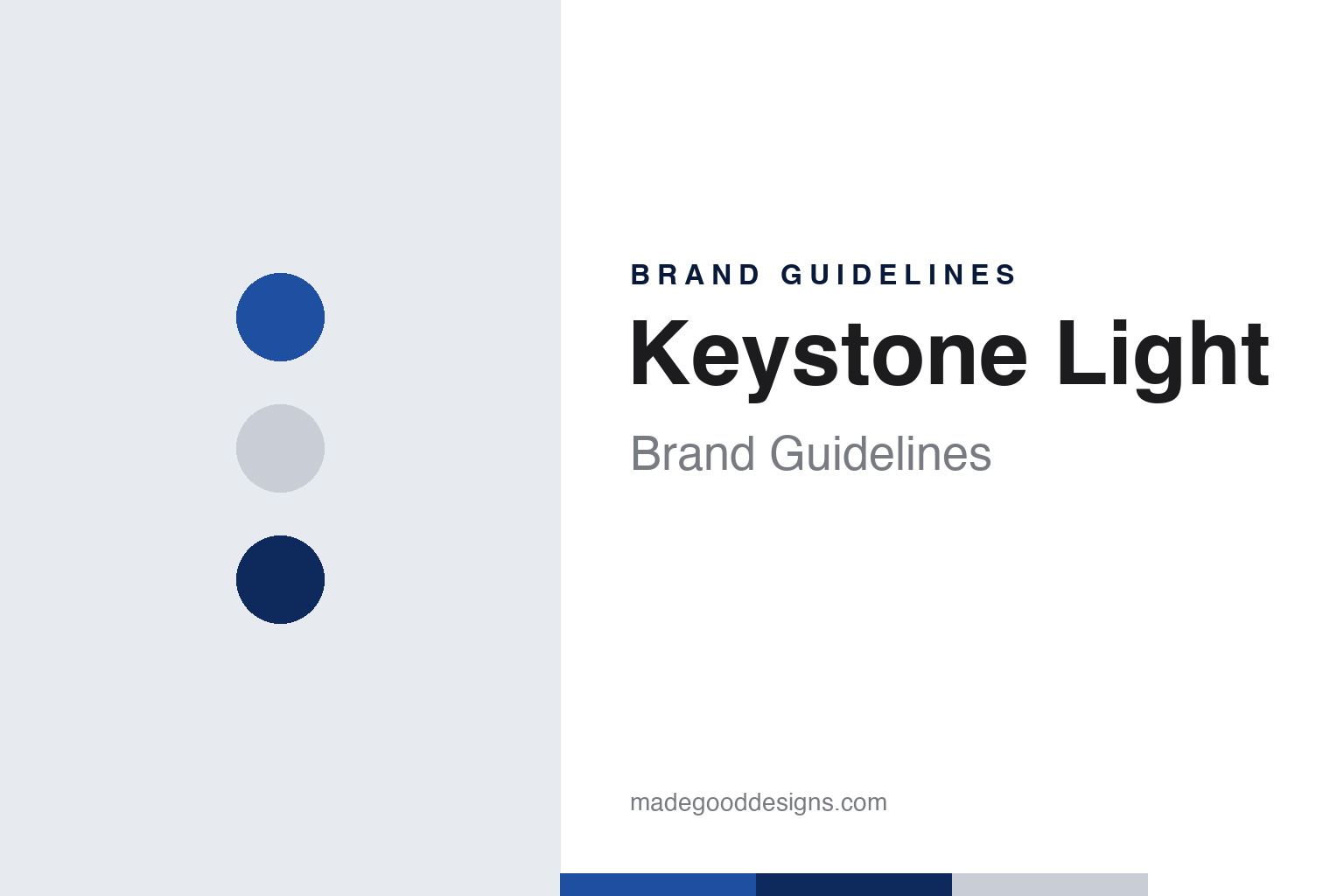
Keystone Light Brand Guidelines
Coors’s 1989 light lager, sold on smoothness.
Aa
Two constants: a Keystone blue, navy and can silver palette and a condensed sans register. Abstract homage — not a Keystone Light product or mark; no can, label or logo is reproduced.
A Coors beer for the value shelf
A lighter lager from Golden, introduced in 1989.
Keystone is a beer brand of Coors, the brewer founded in Golden, Colorado, and today part of the Molson Coors Beverage Company. English Wikipedia says Keystone was first introduced in Chico, California, in September 1989, and lists Keystone Light, with its blue label, among the varieties introduced that same year, alongside a regular Keystone in a gold can with a red label that was later renamed Keystone Premium.
The brand’s own history page starts in the same year. “The smoothest beer in the universe was born,” the company says of 1989, and it says Keystone was “originally introduced as ‘bottled beer taste in a can.’” English Wikipedia adds that the line rested on what Coors described as specially lined cans, and that an early-1990s television campaign ran on the formula “Wouldn’t it be great if…,” ending each fantasy with a beer “like Keystone and Keystone Lite.”
The family grew and then contracted. English Wikipedia lists Keystone Dry from 1991, and Keystone Ice and Keystone Amber Light from 1994; the Dry and Amber Light varieties had gone by the late 1990s. Citing PennLive in August 2021, it says Keystone Ice was discontinued in 2021, one of a group of beers Molson Coors discontinued that year. Light and Ice had long been the most widely stocked versions, English Wikipedia says.
The company around the beer has changed several times. English Wikipedia’s history of Molson Coors, citing the CBC and The Guardian, says Molson of Canada and Coors of the United States announced their merger in July 2004 and completed it in February 2005. In June 2008 Molson Coors and SABMiller combined their American brewing in a joint venture, MillerCoors; Molson Coors took full ownership of it in October 2016, according to the company’s release of 11 October 2016. In October 2019 the company announced it would rename itself the Molson Coors Beverage Company, CNBC reported.
Colour
Smooth, never bitter — and a face to prove it.
Keystone Light’s advertising has returned again and again to one idea: smoothness. The company says it introduced the tagline “Smooth, Never Bitter Taste” in 1995, and that by 1998 its commercials were warning drinkers about a particular grimace. English Wikipedia describes the campaign as selling Keystone Light as the “Never Bitter Beer,” a remedy for “Bitter Beer Face,” and records a 2007 slogan, “Always Smooth, Even When You’re Not,” and an older one, “All Stones Must Be Thrown.”
In the 2010s the brand gave its humour a spokesman. English Wikipedia says Coors created a fictitious character named Keith Stone, a play on the brand name, who appeared in a run of television spots; Ad Age’s Creativity catalogued two of them, “Rescue” in April 2010 and “Bride” in May 2010, and English Wikipedia credits both to the commercial director Tom Kuntz.
Much of the brand’s identity is built outdoors. The company says it sponsored its first NASCAR driver, Wally Dallenbach Jr., in 1992 and printed a Winston Cup can carrying the season schedule; that the same year it partnered with Field & Stream on a fishing hotline run with the North American Fishing Club; and that in 1993 a “Drive Like a Pro” sweepstakes sent fifteen winners to racing school in Atlanta.
The can itself became the promotion. The company says it first ran “The Hunt” in 2006, hiding an orange can in its packs for fans to find; in 2014 it partnered with Realtree on a camouflage can for The Hunt, and in 2016 it printed a series of fish cans. In 2025, it says, Keystone Light became the official beer of the arcade game Big Buck Hunter, and it says it has supported the USO for more than twenty years.
Flavour has been a newer lever. English Wikipedia, citing the trade site just-drinks in January 2020, says Molson Coors launched Keylightful, a raspberry-lime version of Keystone Light, on 1 March 2020 in 40 US states, and lists a Keystone Light Apple in a red can in 2026.
Typography
Design and documentation.
The seven brands in this group are all American beer names: Busch, Natural Light, Keystone Light, Rolling Rock, Bell’s, Deschutes and Allagash. American beer brands in general sit at many different points in the trade, from independent breweries that still carry a founder’s name to labels that now belong to much larger brewing groups, and a single brand can be sold everywhere from a corner shop to a stadium bar.
A beer brand’s identity is usually carried less by a single bottle or can than by a label, a name and the place it promises, because the company behind the name may have changed hands, moved its brewing or grown far beyond the town where it started. That makes the questions behind each name worth asking plainly: who started it, who owns it now, and where its beer is actually brewed and packaged.
Each guide separates what independent sources record from what the company says about itself — its founding story, its owners over time, where its beer is brewed and how its labels have changed — and marks plainly what rests only on the company’s own word.
Aa
A tall condensed sans for a light-lager can. (Specimen set in Oswald, a sans-serif STAND-IN; NOT the Keystone Light logo.)
Keystone Light
One light lager inside a large brewing family.
Inside Molson Coors, Keystone Light sits in a crowded family of light beers. English Wikipedia’s article on Coors Light names Miller Lite and Keystone Light, both Molson Coors brands, as Coors Light’s main competitors, together with Bud Light. The same company owns the Denver-born wheat beer Blue Moon, and in September 2020 it announced a joint venture with the Pennsylvania brewer Yuengling to brew and distribute Yuengling beers in new markets, English Wikipedia says. For a light lager from Anheuser-Busch, see Natural Light.
Today the brand speaks for itself online at keystonelight.com, where the footer carries the copyright of Coors Brewing Company, Golden, CO, and where its history ends with the line “Smooth is as smooth does,” claiming “more than 30 years and counting.” The name needs a little care in search: Keystone is also the nickname of Pennsylvania, the Keystone State, and the name of a ski resort in Colorado, neither of which has any connection with the beer.
For a design guide, Keystone Light shows how a brand can hold one word — smooth — for more than three decades and let cans, sweepstakes and a single facial expression carry it, from a 1989 launch to a Molson Coors staple. Compare Miller Lite, its Molson Coors stablemate, and Natural Light, its Anheuser-Busch rival. For this guide we use Keystone blue, deep navy and can silver with a condensed sans, an unofficial interpretation; no product or logo is reproduced.
Explore & save
Keep Keystone Light’s identity on hand — save it to a board in the Made Good inspiration library.
Keystone Light identity set
Pin the Keystone Light blue, navy and can silver palette and the condensed sans register to your own board.