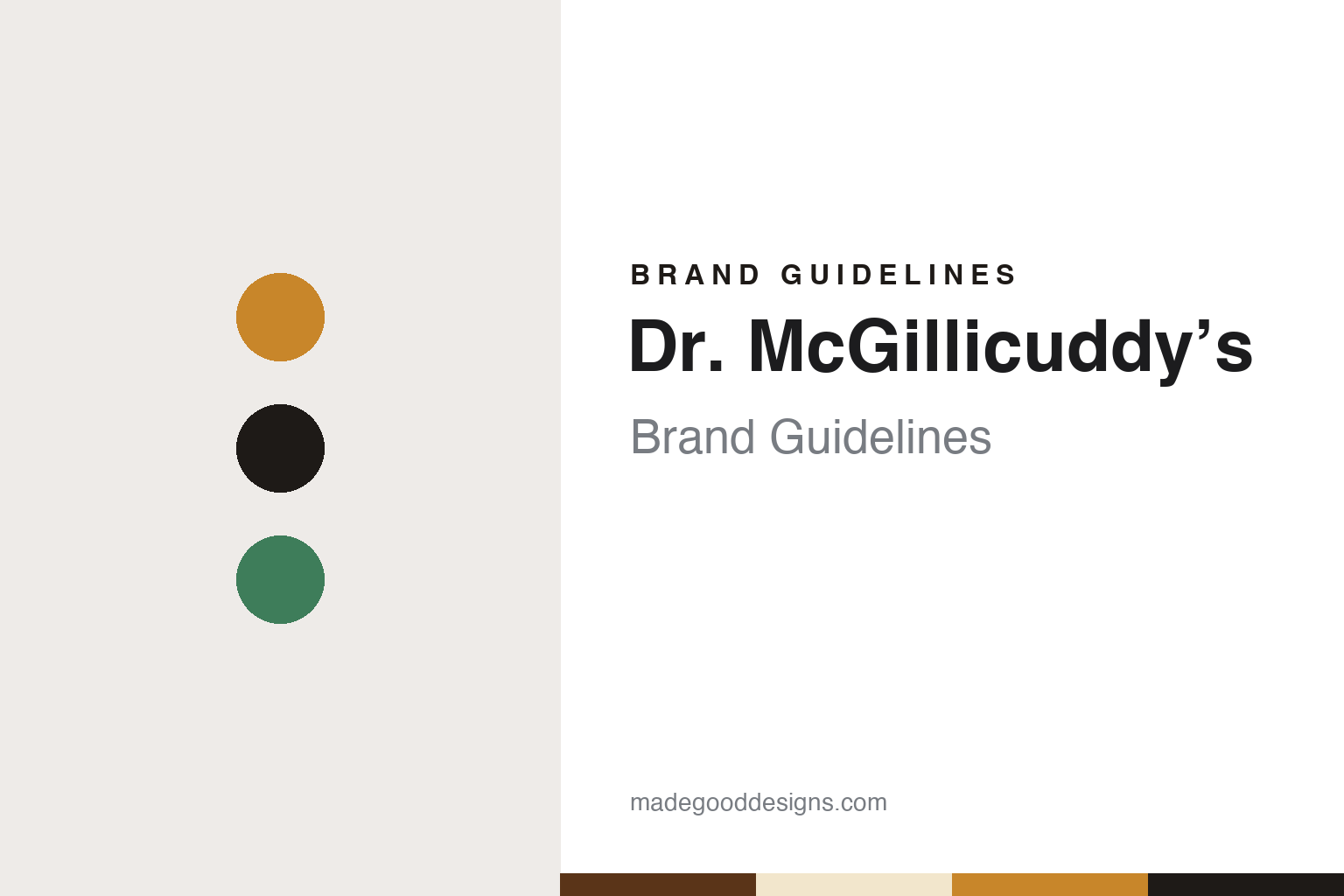
Dr. McGillicuddy’s Brand Guidelines
The fictional Shot Doctor and his saloon of flavoured schnapps.
Aa
Two constants: a Dr. McGillicuddy’s saloon brown, whisky amber and moustache black palette and a Western slab serif register. Abstract homage — not a Dr. McGillicuddy’s product or mark; no bottle, label, character or logo is reproduced.
The Shot Doctor
A Seagram schnapps family from Canada.
Dr. McGillicuddy’s is a family of flavoured schnapps and liqueurs that began in Canada in the mid-1980s. Bloomberg Businessweek reported in April 2014 that the line was part of Seagram’s range of flavoured schnapps, which were briefly in vogue at the time, and that it came with what the magazine called a “gaudy mythology.” Seagram was a Canadian drinks group headquartered in Montreal, English Wikipedia notes. Today English Wikipedia describes Dr. McGillicuddy’s as a line of liqueurs produced in Canada and the United States by the Sazerac Company.
The handover came at the end of that decade. As the flavoured-schnapps fad began to fade, Seagram sold the rights to the Dr. McGillicuddy portfolio to Sazerac in 1989, Bloomberg Businessweek reported. Sazerac, a privately held company based in the New Orleans area, traces its origins to the Sazerac Coffee House and its purchase by Thomas H. Handy in 1869, English Wikipedia says; after that purchase, the encyclopedia says, Handy’s company began to acquire and market more brands of liquor.
For years the line was sold in the United States as an import. The brand’s website in August 2000 called the range “Dr. McGillicuddy’s Imported Schnapps” and stated that it was imported from Canada by the Sazerac Company of New Orleans, bottled at 24% alcohol by volume, according to a Wayback Machine capture. A Sazerac press release issued from New Orleans in October 2011 still described the product as imported by Sazerac from Canada and gave the range a strength of 30 to 60 proof depending on the flavour. The current website names Sazerac Co., New Orleans, in its footer and gives the liqueurs a strength of 15–30% alcohol by volume.
Colour
Aloysius Percival McGillicuddy.
The brand’s centre is a man who never existed. Bloomberg Businessweek described the face of the line as the fictitious Aloysius Percival McGillicuddy, a “world famous” physician with a handlebar moustache who supposedly lived in the 19th century and made vaguely pharmaceutical drinks, among them a mint schnapps and a black liquorice schnapps; he was also known, the magazine added, as “the Shot Doctor.” English Wikipedia, citing the brand’s website, describes him as a late-19th-century bartender in an old western town.
The website tells the story as a wake. Its “The Legend” page opens in the Shady Eye Saloon, where the Doctor lies in a casket on the bar; he is said to have won the saloon in a duel and brought a run-down shanty back to life. The mourners include the sheriff, the blacksmith and the mayor; his widow, Lady Hermione McGillicuddy, with four earlier wives beside her; a town barber who tended the Doctor’s moustache “as though it were a bonsai tree”; a barkeep named Cleve August; and the saloon’s longest-standing customer. The Doctor’s duelling pistols, watch, pipe and leather-bound journal sit nearby, and the page ends with the line that “a Legend Begins.”
The voice has long been the Doctor’s own. The website in 2000 greeted visitors with “Welcome to Dr. McGillicuddy’s Saloon! Which Doctor do you want to visit?” and carried a line saying that it did not offer medicinal advice. By 2009 the home page spoke in the first person, inviting visitors to see the Doctor “without making an appointment” and to “start your examination.” Today the products page gives each flavour a short tale from the saloon, and the site includes a feature called the Mustache Machine.
Typography
Design and documentation.
The seven brands in this group are all whisky, schnapps and rum names: Black Velvet, Seagram’s 7 Crown, Alberta Premium, Lot No. 40, Rumple Minze, Dr. McGillicuddy’s and Bumbu. Whisky, schnapps and rum brands in general sit at many different points in the trade, from names that still carry a founder’s or a distillery’s story to labels that now belong to much larger drinks groups, and a single brand can be sold everywhere from a corner shop to a bar rail.
A spirits brand’s identity is usually carried less by a single bottle than by a label, a name and the place it promises, because the company behind the name may have changed hands, moved its production or grown far beyond the place where it started. That makes the questions behind each name worth asking plainly: who started it, who owns it now, and where its spirit is actually distilled and bottled.
Each guide separates what independent sources record from what the company says about itself — its founding story, its owners over time, where its spirit is made and how its labels have changed — and marks plainly what rests only on the company’s own word.
Aa
A Western slab serif for a saloon-sign wordmark. (Specimen set in Rye, a decorative serif STAND-IN; NOT the Dr. McGillicuddy’s logo.)
Fireball and the flavours
The cinnamon whisky that left the family.
The line’s most famous member no longer carries the Doctor’s name. Bloomberg Businessweek reported that Fireball was introduced in Canada in the mid-1980s as Dr. McGillicuddy’s Fireball Cinnamon Whisky, caught on with hockey players and ice fishermen there, and came to Sazerac with the rest of the portfolio in 1989. In 2007 Sazerac freed Fireball from its association with the Shot Doctor and made it a free-standing product, the magazine reported; English Wikipedia, citing the New York Daily News, says the “Dr. McGillicuddy’s” name was dropped from the label that year to set it apart from the rest of the line.
The rest of the family has kept growing. In October 2011 Sazerac announced four new Dr. McGillicuddy’s flavours, Apple Pie, Root Beer, Wild Grape and Ice Mint, alongside a “Stick It Out Tour” of football, baseball and hockey events and the line “Best Tasting Shot Ever.” English Wikipedia records flavoured whiskeys under the Doctor’s name from 2016, in apple, peach, honey and blackberry. The website now lists Mentholmint, Butterscotch, Root Beer and Peppermint among its liqueurs, and English Wikipedia notes that earlier flavours, black liquorice among them, no longer appear there.
The name needs a little care online. McGillicuddy was also the birth surname of the baseball manager Connie Mack and the maiden name of Lucy Ricardo in I Love Lucy, English Wikipedia notes; the brand’s official site is drmcgillicuddy.com, without a final “s.”
For a design guide, Dr. McGillicuddy’s shows how an invented 19th-century doctor, a handlebar moustache and a saloon full of characters can hold together a long line of flavoured shots for around four decades. Compare Southern Comfort, the New Orleans whiskey liqueur now also owned by Sazerac, and Seagram’s 7 Crown, a whisky from the Seagram stable the Doctor came from. For this guide we use saloon brown, whisky amber and moustache black with a Western slab serif, an unofficial interpretation; no product or logo is reproduced.
Explore & save
Keep Dr. McGillicuddy’s’s identity on hand — save it to a board in the Made Good inspiration library.
Dr. McGillicuddy’s identity set
Pin the Dr. McGillicuddy’s saloon brown, whisky amber and moustache black palette and the Western slab serif register to your own board.