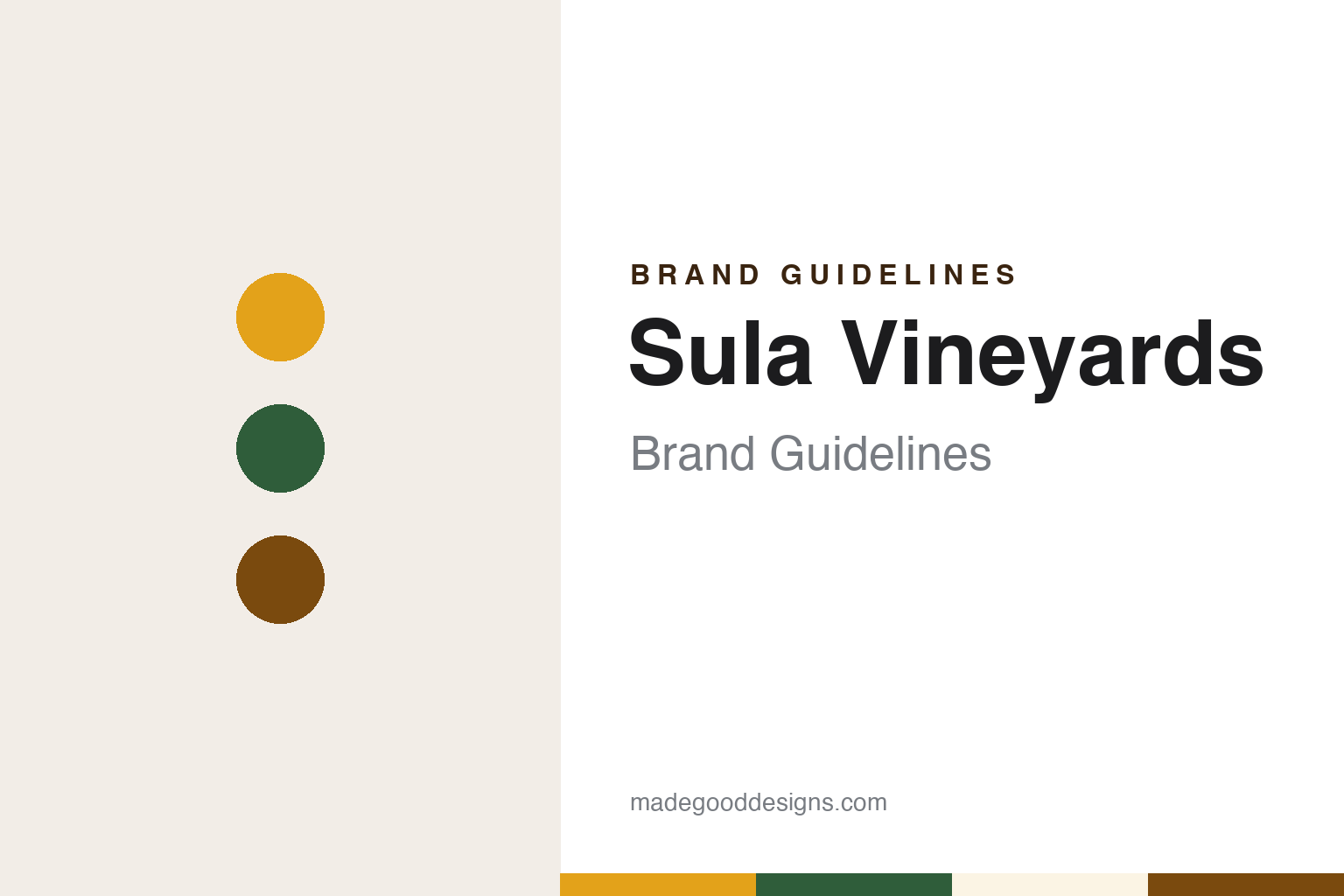
Sula Vineyards Brand Guidelines
Rajeev Samant’s Nashik winery and its sun badge.
Aa
Two constants: a sun gold, harvest brown and vine green palette and a warm editorial serif register. Abstract homage — not a Sula Vineyards product or mark; no label, logo or bottle is reproduced.
Nashik, 1997
A Stanford graduate, a Sonoma winemaker and a farm near Nashik.
Sula Vineyards is a wine company based in Nashik, Maharashtra, about 180 km north-east of Mumbai, English Wikipedia says, citing The Hindu BusinessLine. Its founder is Rajeev Samant, who studied at Stanford University and worked at Oracle in California before returning to India, Mint reported in 2007. English Wikipedia’s article on Samant says that in 1996 he concluded the Nashik area’s climate suited wine grapes. The name honours his mother, Sulabha, according to English Wikipedia.
The winemaking partner was Kerry Damskey, a California winemaker. In an interview with Sommelier India published in April 2024, Damskey said he met Samant in Glen Ellen, in Sonoma Valley, in 1997, and that Samant worked that year’s harvest at one of Damskey’s wineries in Mendocino County to learn how wine was made. English Wikipedia’s article on Samant says the pair planted Sauvignon Blanc and Chenin Blanc in the region in 1997. Sources give different founding years: that article gives 1998, while English Wikipedia’s article on the company, and Damskey himself, give 1999. Both Wikipedia articles put the release of the first wines in 2000.
Damskey told Sommelier India that grapes for the first vintage came from vineyards he had planted two years earlier with the grower Hambir Phadatare, that the Zinfandel came from cuttings the two of them took in 1997, and that a Dindori Shiraz aged in American oak followed in 2002. He retired as Sula’s master winemaker in December 2023, the magazine reported, and he and his wife remain shareholders. Business Standard, cited by English Wikipedia, dates Sula’s Sauvignon Blanc and Chenin Blanc to 2000, its Zinfandel to 2003 and its Riesling to 2008.
Colour
A festival and a family of labels.
The brand also built a public face at its home estate. English Wikipedia’s article on Samant says Sula began operating a tasting room and winery facilities in 2005, and the company article lists two resorts near the Nashik plant, The Source at Sula and Beyond by Sula. From 2008 Sula staged SulaFest, an annual wine and music festival, English Wikipedia says. After a five-year gap it returned for a 14th edition on 1–2 February 2025, Rolling Stone India reported, and a 15th edition took place on 31 January and 1 February 2026, according to Mediainfoline.
Its labels extend well beyond the Sula name. English Wikipedia lists Rasa, Dindori and The Source among its ranges, and records Dia, a wine in a can launched in 2019, and Kadu, launched in December 2019. In 2014 Sula supplied an exclusive label for Air India, Express Food Hospitality reported. The company article also lists its grape varieties as Chenin Blanc, Riesling, Sauvignon Blanc, Viognier, Grenache and Zinfandel, and says Sula was the first Indian wine listed by Marks & Spencer in the United Kingdom. The same article says solar panels meet more than half of the Nashik winery’s energy needs, and The Ecologist reported in 2010 that the company had planted more than 30,000 trees around Nashik.
Typography
Design and documentation.
The seven brands in this group are all German, Indian and Chinese wine and Sekt producers: Dr. Loosen, Schloss Johannisberg, Henkell, Rotkäppchen, Sula Vineyards, Grover Zampa and Changyu. Wine and Sekt producers in general sit at many different points in the trade, from family estates that still carry a founder’s name to labels that now belong to much larger drinks groups, and a single brand can be sold everywhere from a corner shop to a restaurant list.
A wine or Sekt brand’s identity is usually carried less by a single bottle than by a label, a name and the place it promises, because the company behind the name may have changed hands, moved its production or grown far beyond the place where it started. That makes the questions behind each name worth asking plainly: who started it, who owns it now, and where its wine or Sekt is actually made and bottled.
Each guide separates what independent sources record from what the company says about itself — its founding story, its owners over time, where its wine or Sekt is made and how its labels have changed — and marks plainly what rests only on the company’s own word.
Aa
A warm editorial serif for a winery built around one emblem. (Specimen set in Fraunces, a serif STAND-IN; NOT the Sula Vineyards logo.)
Sula Vineyards
A listed company, with wineries in two states.
Sula became a listed company in December 2022. Its initial public offering, open from 12 to 14 December, consisted entirely of existing shares sold by Samant and by investors including Verlinvest, Saama Capital and Cofintra, so the company itself received none of the proceeds, according to the law firm Shardul Amarchand Mangaldas, which advised on the deal. The shares began trading on the BSE and the National Stock Exchange of India later that month, under the symbol SULA on the NSE. English Wikipedia lists Samant as founder and chief executive.
Sula’s 2024–25 annual report describes wineries in Maharashtra and Karnataka. Nashik is the original home. In Karnataka, Sula took over Heritage Winery, on the Mysuru highway near Bengaluru, becoming its sole owner on 1 February 2017, the Indian Wine Academy reported that week; the company now calls the estate Domaine Sula. In 2021 a Sula subsidiary acquired the winery business of its Nashik neighbour, York Winery, the annual report says. In March 2026 Just Drinks reported that Sula had agreed to buy Moët Hennessy’s Chandon production facility and estate at Dindori, in Nashik district — the land, buildings and winery, but not the Chandon brand — and that Chandon would stop making wine in India once the deal closed, with wine from the estate to be sold under Sula’s own labels.
For a design guide, Sula Vineyards shows a wine brand built around one emblem, the sun, and one region, Nashik, then stretched across many sub-labels. Compare Grover Zampa, the Karnataka-born winery that also grows in Nashik, and Chandon, whose Indian estate Sula agreed to buy. For this guide we use sun gold, harvest brown and vine green with a serif, an unofficial interpretation; no product or logo is reproduced.
Explore & save
Keep Sula Vineyards’s identity on hand — save it to a board in the Made Good inspiration library.
Sula Vineyards identity set
Pin the Sula Vineyards sun gold, harvest brown and vine green palette and the warm editorial serif register to your own board.


