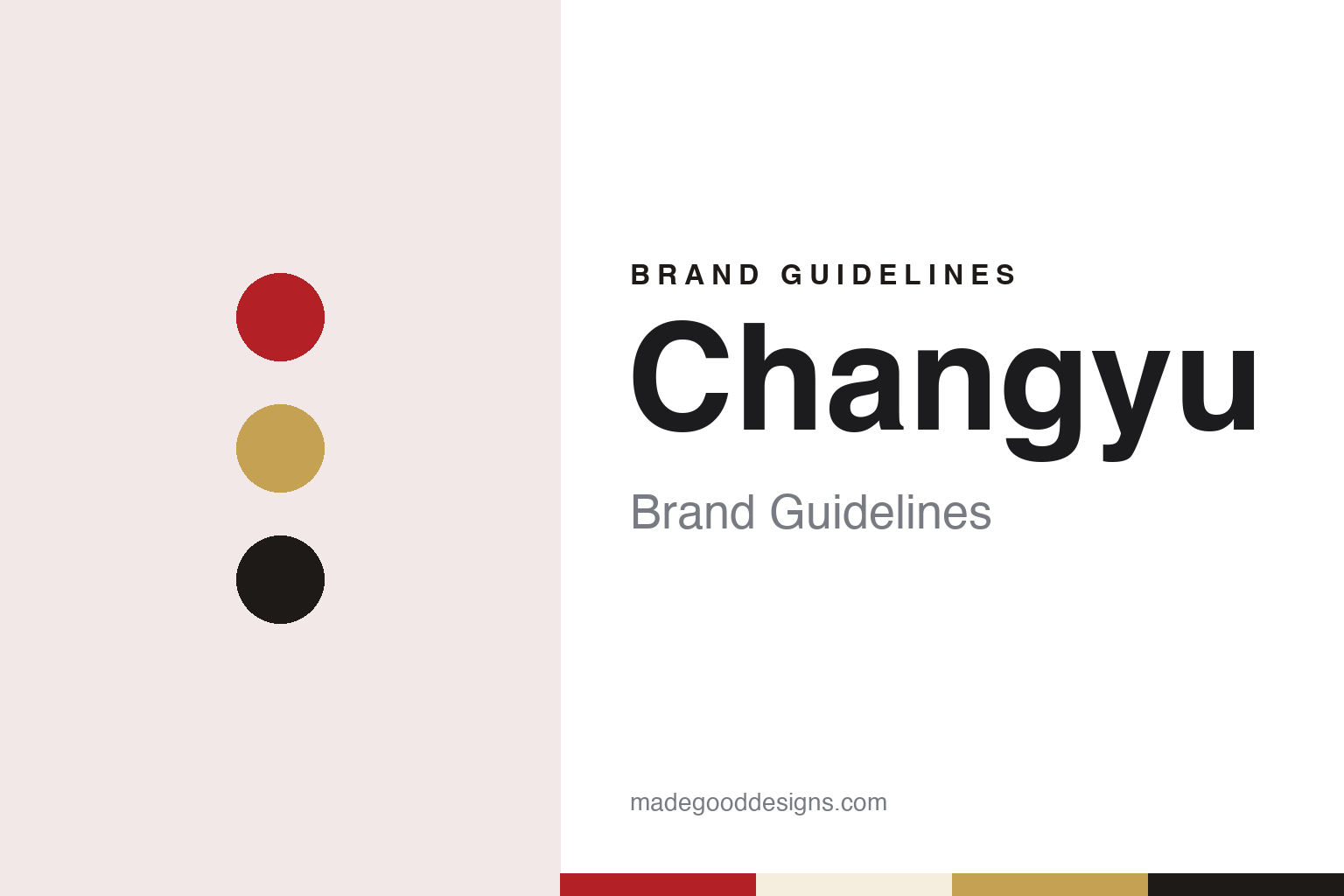
Changyu Brand Guidelines
The Yantai winery founded in 1892.
Aa
Two constants: a Yantai red, medal gold and cellar black palette and a high-contrast display serif register. Abstract homage — not a Changyu product or mark; no label, logo or bottle is reproduced.
A merchant’s winery on the Yantai shore
From a Penang consul’s vineyard to China’s first industrial winery.
Changyu began in Yantai, a port city on the northern coast of Shandong province, in 1892. Its founder was Zhang Bishi, known in Southeast Asia as Cheong Fatt Tze, a merchant from Dabu in Guangdong whose business was based in Southeast Asia. Chinese Wikipedia calls him a leader of the Malaysian Chinese community and records that he became the Qing government’s first vice-consul in Penang in 1893. English Wikipedia names his nephew Zhang Chengqing as the company’s first general manager, and The Wall Street Journal described Changyu in 2013 as China’s oldest and largest winery.
The early years were a long experiment in getting vines to grow. Changyu says it brought in 124 grape varieties from Europe and that most of the vines failed, so it turned to wild vines from northeast China as rootstock. The company names its first chief winemaker as Baron von Babo, written Balboa in its English history, and English Wikipedia says the Xinjiang estate Château Changyu Baron Balboa is named after him. Changyu dates its underground cellar to the years 1894 to 1905, its first bottle of wine to 1899 and the first Chinese brandy to 1914.
International notice followed quickly. Changyu says that at the Panama–Pacific International Exposition in San Francisco in 1915 its rose red wine, Riesling, Koya brandy, Traminer and vermouth each won the Grand Prize; other accounts describe the awards as gold medals. In December 2017 the Chinese news service China News reported that the company’s Yantai site had been named in the first batch of China’s national industrial heritage list, compiled by the Ministry of Industry and Information Technology.
Colour
A family name, a cellar and a brandy called Koya.
The name itself is the brand’s oldest asset. Chinese Wikipedia gives the company’s predecessor as the Shandong Changyu Brewing Company. Jiebaina, one of the company’s wine names, appears among the wine brands listed in its annual report for 2025 alongside Changyu itself, the château names and Longyu.
Brandy has been part of the identity almost from the start. The company’s 2025 annual report describes its main business as making and selling wine and brandy, with Koya among its brandy brands. The Drinks Business reported in February 2021 on the launch of Koya brandy in the United Kingdom.
From 2002 the company also began to build its image around estates. Changyu says that in 2002 it set up Château Changyu-Castel near Yantai with the Bordeaux wine group Castel, which it calls China’s first professional château. In August 2013 it opened Château Changyu Moser XV near Yinchuan in the Ningxia wine region, a joint venture with the Austrian winemaker Lenz M. Moser; Grape Wall of China reported in August 2013 that the “XV” refers to Moser being the fifteenth generation of his family to make wine. English Wikipedia describes the building as a Bordelais-style château with a moat. English Wikipedia also lists Château Changyu-AFIP near Beijing, the Golden Icewine Valley estate in Liaoning, where the main grape is Vidal, and Château Changyu Reina in Shaanxi. At the Yantai château it names Cabernet Gernischt as the main grape. Changyu says it now has eight châteaux in China.
Typography
Design and documentation.
The seven brands in this group are all German, Indian and Chinese wine and Sekt producers: Dr. Loosen, Schloss Johannisberg, Henkell, Rotkäppchen, Sula Vineyards, Grover Zampa and Changyu. Wine and Sekt producers in general sit at many different points in the trade, from family estates that still carry a founder’s name to labels that now belong to much larger drinks groups, and a single brand can be sold everywhere from a corner shop to a restaurant list.
A wine or Sekt brand’s identity is usually carried less by a single bottle than by a label, a name and the place it promises, because the company behind the name may have changed hands, moved its production or grown far beyond the place where it started. That makes the questions behind each name worth asking plainly: who started it, who owns it now, and where its wine or Sekt is actually made and bottled.
Each guide separates what independent sources record from what the company says about itself — its founding story, its owners over time, where its wine or Sekt is made and how its labels have changed — and marks plainly what rests only on the company’s own word.
Aa
A high-contrast display serif for a century-old wine name. (Specimen set in Playfair Display, a serif STAND-IN; NOT the Changyu logo.)
Changyu
A listed company, a 2005 sale and wineries abroad.
The company that sells Changyu wine today is Yantai Changyu Pioneer Wine Company, whose shares trade on the Shenzhen Stock Exchange; Chinese Wikipedia records that its B shares were listed in 1997 and its A shares in 2000. Its largest shareholder is the parent Yantai Changyu Group, which held 52.56% at the end of 2025, according to the annual report summary published in April 2026.
That parent was once owned by the city. In February 2005 BeverageDaily reported that the Italian drinks group Illva Saronno, the maker of Disaronno, was buying 33% of the Changyu group, then majority-owned by the state-controlled Yantai State Asset Management Bureau. The International Finance Corporation, part of the World Bank Group, took a further 10% the same year. English Wikipedia says Château Changyu Reina is named after the Reina family, Changyu’s Italian partner.
Changyu then looked abroad. Wine Spectator reported in December 2017 that the company was buying 80% of Kilikanoon in South Australia’s Clare Valley, and listed its other holdings at the time: Château Mirefleurs in Bordeaux, the cognac house Roullet-Fransac, Marques del Atrio in Spain and a majority stake in Chile’s Bethwines. China Daily reported in January 2018 that the Kilikanoon deal, signed in Adelaide, was the company’s fifth overseas acquisition. In June 2025 The Beijing News reported that Changyu planned to sell Roullet-Fransac, which it had bought in 2013. The company’s own site is changyu.com.cn.
For a design guide, Changyu shows how a founder’s name, an 1890s cellar and a cluster of European-style châteaux can carry a Chinese wine brand for more than 130 years. Compare Penfolds, the South Australian winery behind Grange, and Sula Vineyards, the Nashik winery. For this guide we use Yantai red, medal gold and cellar black with a serif, an unofficial interpretation; no product or logo is reproduced.
Explore & save
Keep Changyu’s identity on hand — save it to a board in the Made Good inspiration library.
Changyu identity set
Pin the Changyu Yantai red, medal gold and cellar black palette and the high-contrast display serif register to your own board.