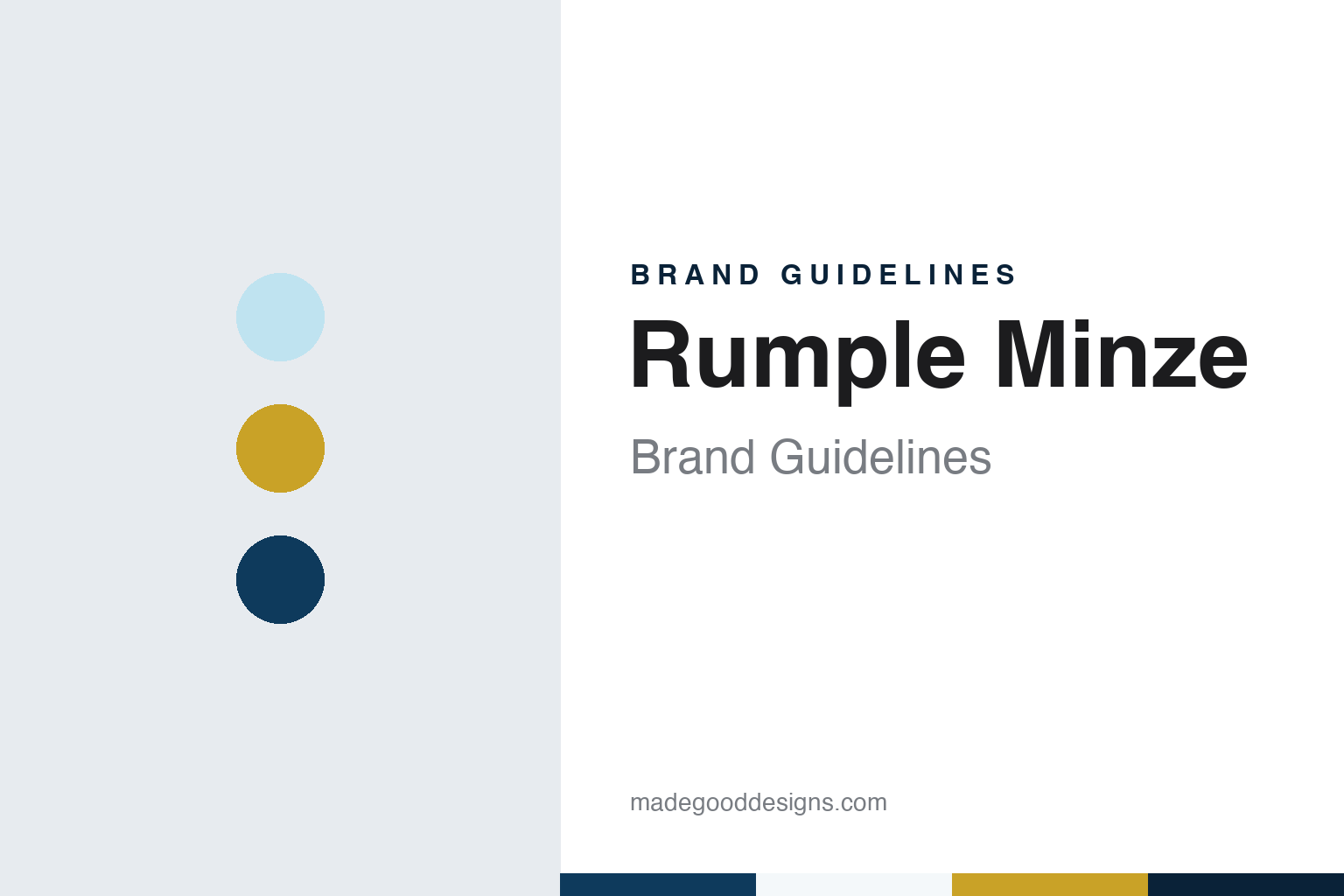
Rumple Minze Brand Guidelines
The 100-proof German peppermint schnapps that America adopted.
Aa
Two constants: a Rumple Minze glacier navy, polar white and eagle gold palette and a condensed sans register. Abstract homage — not a Rumple Minze product or mark; no bottle, label, eagle or logo is reproduced.
Imported from Germany
A German-style schnapps built for American bars.
Rumple Minze is a peppermint schnapps sold as a German product, and it is one of the strongest bottles in its category. English Wikipedia describes it as a German-style liqueur brand best known for peppermint schnapps, bottled at 50% alcohol by volume, or 100 proof, well above the 40% of most spirits. VinePair, in a history of the brand published in February 2025, called it a relative newcomer that first appeared in the 1980s, and reported that every Rumple Minze product is made at the Scharlachberg distillery in Wiesbaden, Germany. The Scharlachberg name itself comes from a celebrated vineyard site at Bingen am Rhein, German Wikipedia explains, where a brandy distillery took the name in 1898.
The brand reached America through an importer. VinePair reported that the Paddington Corporation, later Paddington Brands, began importing Rumple Minze peppermint schnapps into the United States in 1981. By 1997 the brand’s first website carried a copyright line for IDV North America of Fort Lee, New Jersey, and named it as the owner of the registered trademark, according to a Wayback Machine capture from June 1998. International Distillers & Vintners, the IDV of that name, had become part of Grand Metropolitan in the 1970s, and in 1997 Grand Metropolitan merged with Guinness to form Diageo, English Wikipedia says.
Diageo has kept the brand since. Its brand page of the mid-2000s listed Rumple Minze under schnapps, named the United States as its top market and called it an “authentic German-style peppermint schnapps.” English Wikipedia notes that the United States remains the main market and that the brand is little known in Germany itself. When Diageo agreed in November 2018 to sell 19 brands to the Sazerac Company, Drinks International reported, the list included Goldschläger, Yukon Jack and the blackberry schnapps Black Haus, which the 1990s Rumple Minze website had introduced as coming “from the makers of Rumple Minze.” Rumple Minze was not among them, and VinePair still described it as a Diageo brand in 2025.
Colour
Peppermint, an eagle and 100 proof.
The name is half German. English Wikipedia explains it as an invented compound: “rumple,” which recalls the German verb “rumpeln,” to rumble or clatter, joined to Minze, the German word for mint. The same article describes the emblem on the front of the bottle as a double-headed golden eagle, a device that recalls the eagle of the German coat of arms, although the national eagle has a single head.
The liquid is simple to describe. English Wikipedia notes its strong peppermint smell and taste and says the schnapps is usually served chilled and neat or mixed into cocktails. The brand’s own website in 2002 called it “authentic German Peppermint Schnapps,” stressed that it was “Imported from Germany,” gave its strength as 100 proof and recommended it as a chilled shot. VinePair reported that the range has also included lime and berry liqueurs alongside the peppermint original; the peppermint schnapps is the product English Wikipedia says the brand is best known for.
VinePair headlined its 2025 history with the idea that the schnapps had become a “bartender’s handshake,” and its account traced how a peppermint liqueur from Wiesbaden became a fixture of American bars rather than German ones.
Typography
Design and documentation.
The seven brands in this group are all whisky, schnapps and rum names: Black Velvet, Seagram’s 7 Crown, Alberta Premium, Lot No. 40, Rumple Minze, Dr. McGillicuddy’s and Bumbu. Whisky, schnapps and rum brands in general sit at many different points in the trade, from names that still carry a founder’s or a distillery’s story to labels that now belong to much larger drinks groups, and a single brand can be sold everywhere from a corner shop to a bar rail.
A spirits brand’s identity is usually carried less by a single bottle than by a label, a name and the place it promises, because the company behind the name may have changed hands, moved its production or grown far beyond the place where it started. That makes the questions behind each name worth asking plainly: who started it, who owns it now, and where its spirit is actually distilled and bottled.
Each guide separates what independent sources record from what the company says about itself — its founding story, its owners over time, where its spirit is made and how its labels have changed — and marks plainly what rests only on the company’s own word.
Aa
A tall condensed sans for a strong, upright wordmark. (Specimen set in Oswald, a sans-serif STAND-IN; NOT the Rumple Minze logo.)
Polar bears
Advertising that leaned into the cold.
Rumple Minze’s advertising has long favoured the Arctic. VinePair reported that in the late 1980s the brand launched magazine advertising that set it up as a hardcore alternative to rival schnapps, and that from the late 1980s into the early 1990s it ran advertisements in men’s magazines, Playboy among them, showing a female warrior riding a polar bear and wielding a sword; one advertisement called the drink “Primal Peppermint Schnapps.” The brand’s website of 1997 ran a fan club called the “Rumple Room” and a fan quiz that offered a pack of temporary tattoos to adult fans who completed it, according to the 1998 Wayback Machine capture.
The bears returned in 2019. The advertising site shots reported in August 2019 that VaynerMedia’s Los Angeles office had remade Wreckx-N-Effect’s 1992 hit “Rump Shaker” as a Rumple Minze remix, with the group’s original members Aqil Davidson and Markell Riley, a character called Uncle Rumpy described as the brand’s “mysterious face,” and a video of partygoers, bartenders, polar bears and a cameo by a yeti, directed by Dante Crisafulli. The campaign quoted Jay Sethi, a Diageo vice-president, describing Rumple Minze as a brand about being playful, rallying friends and “always keeping it 100.” English Wikipedia’s article on Aqil Davidson also records the remix.
For a design guide, Rumple Minze shows how a peppermint schnapps can borrow the heraldry of a German eagle, the bluntness of a 100-proof figure and an Arctic advertising world of polar bears to build a lasting shot-bar identity in the United States. Compare Baileys, the Irish cream that Diageo also owns, and Captain Morgan, Diageo’s spiced rum. For this guide we use glacier navy, polar white and eagle gold with a condensed sans, an unofficial interpretation; no product or logo is reproduced.
Explore & save
Keep Rumple Minze’s identity on hand — save it to a board in the Made Good inspiration library.
Rumple Minze identity set
Pin the Rumple Minze glacier navy, polar white and eagle gold palette and the condensed sans register to your own board.