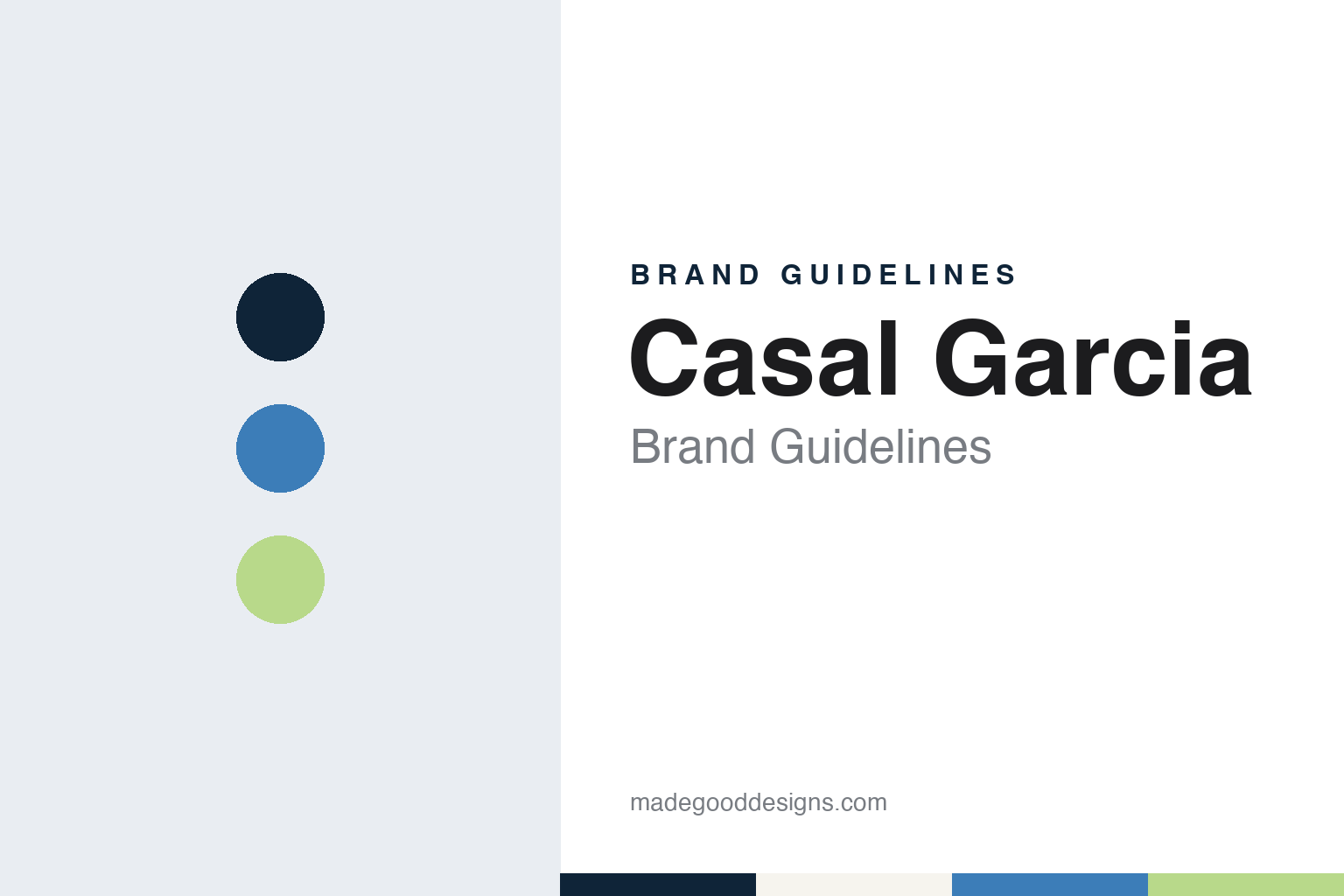
Casal Garcia Brand Guidelines
Aveleda’s lace-labelled Vinho Verde, born in 1939.
Aa
Two constants: a bottle blue, Minho night and green grape palette and a display serif register. Abstract homage — not a Casal Garcia product or mark; no bottle, label or logo is reproduced.
A lace handkerchief
A train, a vineyard and a French oenologist.
Casal Garcia is a brand, not a winery. It belongs to Aveleda, S.A., the family wine company based at Quinta da Aveleda in Penafiel, in Portugal’s Vinho Verde region, and the brand’s own website is signed “© 2026 Aveleda.” The company behind it has its own guide, Aveleda; this one is about the label and the wine.
The company dates Casal Garcia to 1939, “a year in which the vintage was particularly good,” and tells its origin as a story. In its version, the French oenologist Eugène Hélisse was returning by train from the grape harvest in the Douro when he saw the vineyards of Quinta da Aveleda from the window, broke his journey to Porto and walked to the cellar to ask for the owner, whom the company names as Roberto Guedes. Hélisse, the company says, had been struck by vines divided by grape variety “in French style,” which was unusual in the region, and Guedes hired him on the promise of better winemaking.
The best-known part of the story concerns the label. At the end of that harvest, the company says, Hélisse drew a sample from a wooden barrel into an old glass bottle and, to improve its look, passed a lace handkerchief over it to clean off the dust — “And there the lace remained!” The name, the company adds, “came about by itself”: the wine came from one of Aveleda’s vineyards, that of Casal Garcia.
Like many founding stories, it is the company’s own account, and it is best read that way. What is independently reported is the brand’s age: the Portuguese daily Correio da Manhã wrote in January 2016 that Casal Garcia was 75 years old, which matches a 1939 start.
Colour
Two birds and a motto.
The lace was joined early by a second motif. Because wine “is for celebrating and sharing,” the company says, Casal Garcia came to be represented by two birds — “a true couple” — and its advertising and calendars showed two birds of paradise against springs and scenery of the Minho, the province around the Vinho Verde region. A third element came later: a slogan. The company says the motto “Haja Alegria, Haja Casal Garcia” — which its English site renders as “Let there be Happiness, Let there be Casal Garcia!” — was turned into a song that became the brand’s anthem. Alegria, Portuguese for joy, now runs through the whole website, from the “Discover Alegria” tagline to an events programme.
The brand also travelled early. In the company’s telling, the 1960s brought large commercial success in markets including the United Kingdom, Italy and Brazil, and the 1980s brought strong growth in the UK as Portugal became a holiday destination for northern Europeans. Correio da Manhã reported in 2016 that Aveleda began exporting in 1950, to Brazil; that it was by then in more than 70 countries; and that Casal Garcia accounted for 75 per cent of the company’s sales. The paper also reported that Japan’s postal service had issued a stamp carrying the brand’s symbol.
The range has widened around the original white. The company says it launched a commemorative Casal Garcia World Wine edition in 2007 to mark the brand’s arrival in 60 countries, and added Casal Garcia Rosé around the brand’s 70th anniversary at the end of that decade. Correio da Manhã reported a sweeter Casal Garcia Sweet made for Germany. Today the brand’s site lists white, rosé and red wines in dry and sweet styles, a Loureiro, several sangrias and Fruitzy, a drink the Brazilian business site NeoFeed described in March 2026 as Vinho Verde blended with fruit such as strawberry and passion fruit, launched less than a year earlier; there is also an alcohol-free Fruitzy 0%.
Typography
Design and documentation.
The seven brands in this group are all Spanish and Portuguese wine names: Vega Sicilia, Muga, La Rioja Alta, Ramón Bilbao, Esporão, Casal Garcia and Aveleda. Wine brands in general sit at many different points in the trade, from family houses that still carry a founder’s name to labels that now belong to much larger drinks groups, and a single brand can be sold everywhere from a corner shop to a restaurant list.
A wine brand’s identity is usually carried less by a single bottle than by a label, a name and the place it promises, because the company behind the name may have changed hands, moved its production or grown far beyond the place where it started. That makes the questions behind each name worth asking plainly: who started it, who owns it now, and where its wine is actually made and bottled.
Each guide separates what independent sources record from what the company says about itself — its founding story, its owners over time, where its wine is made and how its labels have changed — and marks plainly what rests only on the company’s own word.
Aa
A display serif for a lace-labelled Vinho Verde. (Specimen set in DM Serif Display, a serif STAND-IN; NOT the Casal Garcia logo.)
Casal Garcia
A Vinho Verde brand inside a family company.
Who owns Casal Garcia is simple: Aveleda does. The brand’s website names Aveleda, S.A. as the business handling its customer data and gives Rua da Aveleda in Penafiel as its address, and its product sheet for the white wine names the producer as Aveleda. Correio da Manhã reported in 2016 that Aveleda had been run by the same family since 1870, and NeoFeed reported in March 2026 that the business was in its fifth generation of the Guedes family, led by the cousins António and Martim Guedes as co-chief executives.
Where the wine is made is set by its appellation. Casal Garcia white is a Vinho Verde, from the demarcated region in Portugal’s north-west. The company’s technical sheet gives its grapes as Trajadura, Loureiro, Arinto and Fernão Pires, grown on granitic and sandy soils, names its winemaker as Diogo Campilho, and lists an alcohol content of 9.5 per cent. The company calls Casal Garcia the world’s best-selling Vinho Verde; NeoFeed called it the best-selling Portuguese wine in Brazil, which Correio da Manhã had identified in 2016 as Aveleda’s first export market.
The brand keeps building on Brazil. Its events page lists Casal Garcia at the Lollapalooza festival in São Paulo in March 2026, describing it as a return after an earlier debut, and at the Maracujália event in Porto in September 2024.
The identity has stayed recognisable because its parts are few and old: a lace pattern with a story attached, a pair of birds, a single word — alegria — and the name of one Aveleda vineyard. The brand’s current range, from rosé to sangria to Fruitzy, is sold under that same name.
For a design guide, Casal Garcia shows how a single founding anecdote can supply a label motif that lasts for decades. Compare Aveleda, the company that owns it, and Mateus, Sogrape’s flask-bottled Portuguese rosé. For this guide we use bottle blue, Minho night and green grape with a serif, an unofficial interpretation; no product or logo is reproduced.
Explore & save
Keep Casal Garcia’s identity on hand — save it to a board in the Made Good inspiration library.
Casal Garcia identity set
Pin the Casal Garcia bottle blue, Minho night and green grape palette and the display serif register to your own board.