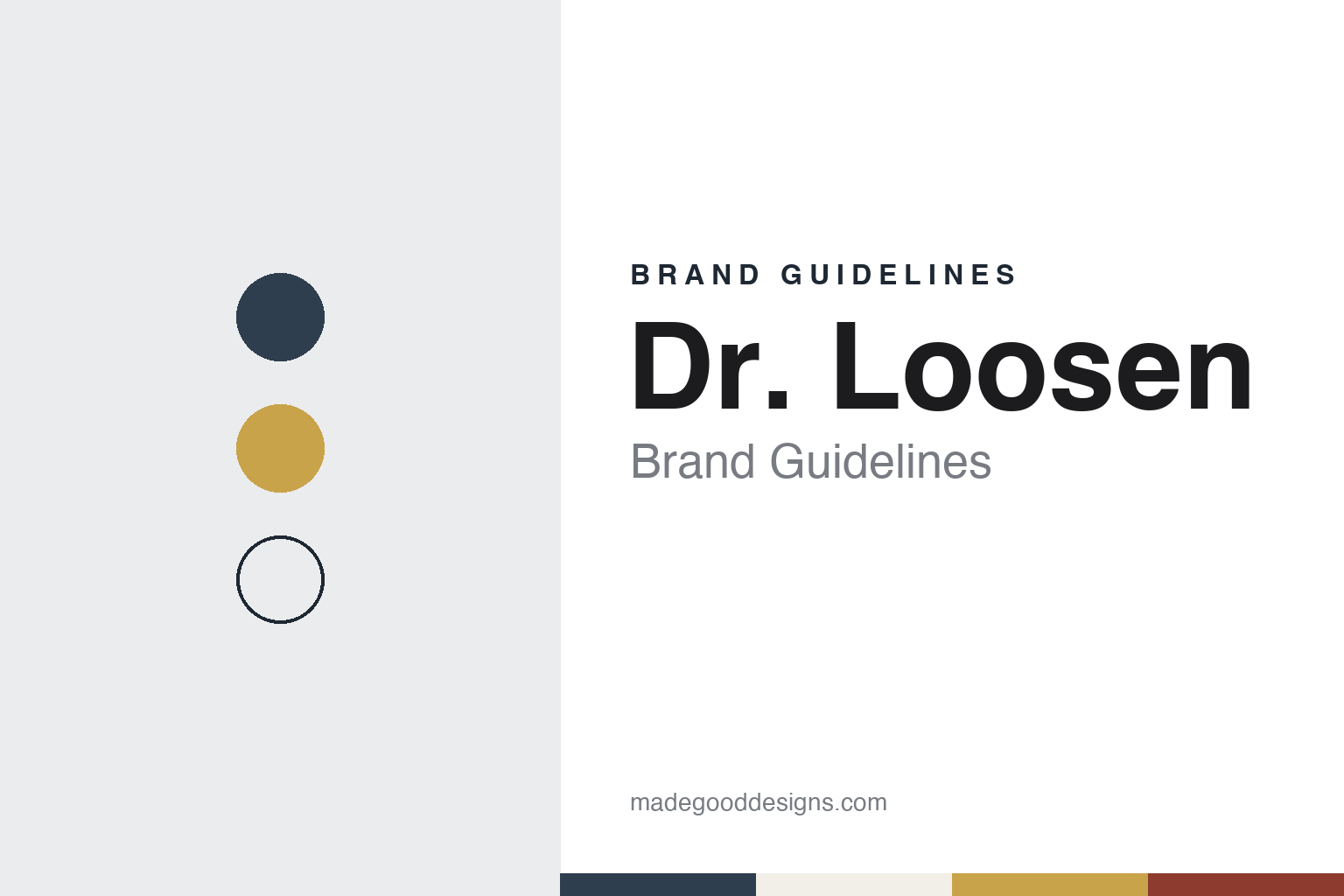
Dr. Loosen Brand Guidelines
The Bernkastel Riesling estate led by Ernst Loosen since 1988.
Aa
Two constants: a blue slate, Riesling gold and chalk white palette and a book serif register. Abstract homage — not a Dr. Loosen product or mark; no label, logo or bottle is reproduced.
Old vines on the Middle Mosel
A family estate, an archaeologist and a hillside of ungrafted Riesling.
Weingut Dr. Loosen is based at the St. Johannishof in Bernkastel-Kues, on the Middle Mosel in western Germany. The estate says it has been in family ownership for more than 200 years, and that Ernst F. Loosen, known as Erni, has led it since 1988. A profile published by the Wine Travel Awards in 2026 dates the handover to 1 January 1988 and says Loosen had trained as an archaeologist before he took charge of the family vineyards. The estate’s legal notice names Ernst Friedrich Loosen as its proprietor.
What he took on was, above all, a collection of old vines. The company says all of its parcels are still planted with own-rooted, ungrafted vines, some of them up to 100 years old, because the rocky, skeletal soils of the Mosel kept much of the valley free of phylloxera. The soils it lists are blue slate, red slate and volcanic rock, on steep, south-facing slopes above the river. The company says the slate reflects sunlight onto the grapes during the day and releases its stored warmth at night, and that the river does something similar, giving the grapes a long, slow ripening season.
The vineyard names read like a roll call of the Middle Mosel. Dr. Loosen lists holdings in the Wehlener Sonnenuhr, Erdener Prälat, Erdener Treppchen, Ürziger Würzgarten, Graacher Himmelreich, Graacher Domprobst and Bernkasteler Lay, among others, plus the very steep Bremmer Calmont further downstream. The estate says it has been a member of the VDP, the association of German Prädikat wine estates, since 1993, and its range follows the association’s tiers, from estate wine and village wine up to the Grosse Lage wines from its best sites.
Colour
An 1868 tax map, a cellar rule and a return to older methods.
Dr. Loosen ties its range to an old map. The company says the 1868 vineyard map for the Trier administrative district, drawn up by the Prussian state as a basis for taxing Mosel wine estates, rated seven of its sites in the top class, a ranking it compares with the grand crus of Burgundy. It adds that the classification was updated by Stuart Pigott and Hugh Johnson in their German wine atlas of 1995, and that it deliberately returns to this historic system today. Since 1988, the company says, only Rieslings from those classified sites have been bottled under single-vineyard names; everything else is sold as estate Riesling.
The winemaking is described as a return to older ways. The estate says that since the late 1980s Ernst Loosen has relied on spontaneous fermentation in wooden barrels, ageing on the lees for 12 or 24 months and no bâtonnage, methods it says were inspired by historical sources and by tasting old vintages. Its stated aim is Mosel Riesling that shows where it comes from and can age for decades. Alongside the dry Grosse Lage wines and the sweeter Prädikat wines, its shop lists Sekt, noble-sweet wines and alcohol-free wines.
Recognition came early in Loosen’s tenure. English Wikipedia says the Gault-Millau wine guide named him German winemaker of the year in 2001, and that Decanter named him its Man of the Year in 2005. In 2020, English Wikipedia says, citing Wines of Germany and the World’s Best Vineyards list, Dr. Loosen and Schloss Johannisberg were both named among the top 50 wine destinations in the world.
Typography
Design and documentation.
The seven brands in this group are all German, Indian and Chinese wine and Sekt producers: Dr. Loosen, Schloss Johannisberg, Henkell, Rotkäppchen, Sula Vineyards, Grover Zampa and Changyu. Wine and Sekt producers in general sit at many different points in the trade, from family estates that still carry a founder’s name to labels that now belong to much larger drinks groups, and a single brand can be sold everywhere from a corner shop to a restaurant list.
A wine or Sekt brand’s identity is usually carried less by a single bottle than by a label, a name and the place it promises, because the company behind the name may have changed hands, moved its production or grown far beyond the place where it started. That makes the questions behind each name worth asking plainly: who started it, who owns it now, and where its wine or Sekt is actually made and bottled.
Each guide separates what independent sources record from what the company says about itself — its founding story, its owners over time, where its wine or Sekt is made and how its labels have changed — and marks plainly what rests only on the company’s own word.
Aa
A book serif for a Mosel Riesling estate. (Specimen set in Crimson Pro, a serif STAND-IN; NOT the Dr. Loosen logo.)
Dr. Loosen
From the Mosel to Washington, the Pfalz, Oregon and Burgundy.
Loosen has carried the Dr. Loosen name well beyond the Mosel. The best known of these projects is Eroica, a Riesling made in Washington State with Chateau Ste. Michelle. Chateau Ste. Michelle Wine Estates says Eroica was launched in 1999 as a joint project between its winery and the Dr. Loosen estate, made from Washington-grown grapes and named after Beethoven’s Third Symphony; it credits Loosen with the view that a Riesling revival would have to start with a prominent New World winery. Wine Spectator, writing in May 2025, dated the partnership to 2000.
Closer to home, English Wikipedia says Loosen took over the historic J.L. Wolf estate in the Pfalz in 1996; now known as Villa Wolf, it makes Riesling and the Pinot varieties traditional in that region. In Oregon, Wine Spectator reported that he began making Pinot Noir with the winemaker Jay Somers under the J. Christopher label in 2005 and later bought 40 acres in the Chehalem Mountains for a vineyard called Appassionata; English Wikipedia dates that purchase to 2010. The newest venture is in Burgundy. Wine Spectator reported in May 2025 that Loosen had bought part of the Vieux Château de Puligny-Montrachet in 2019 and set up a négociant house there, Maison Perron de Mypont, with the Burgundian Manoël Bouchet. The Dr. Loosen website lists all four as its other estates.
For a design guide, Dr. Loosen shows how a family estate can build its identity on vineyard names and a nineteenth-century map, then lend that name to partners on other continents. Compare Schloss Johannisberg, the Rheingau estate that calls itself the first Riesling winery in the world, and Chateau Ste. Michelle, its Eroica partner in Washington State. For this guide we use blue slate, Riesling gold and chalk white with a book serif, an unofficial interpretation; no product or logo is reproduced.
Explore & save
Keep Dr. Loosen’s identity on hand — save it to a board in the Made Good inspiration library.
Dr. Loosen identity set
Pin the Dr. Loosen blue slate, Riesling gold and chalk white palette and the book serif register to your own board.