Schloss Johannisberg Brand Guidelines
The Rheingau estate that calls itself the first Riesling winery.
Aa
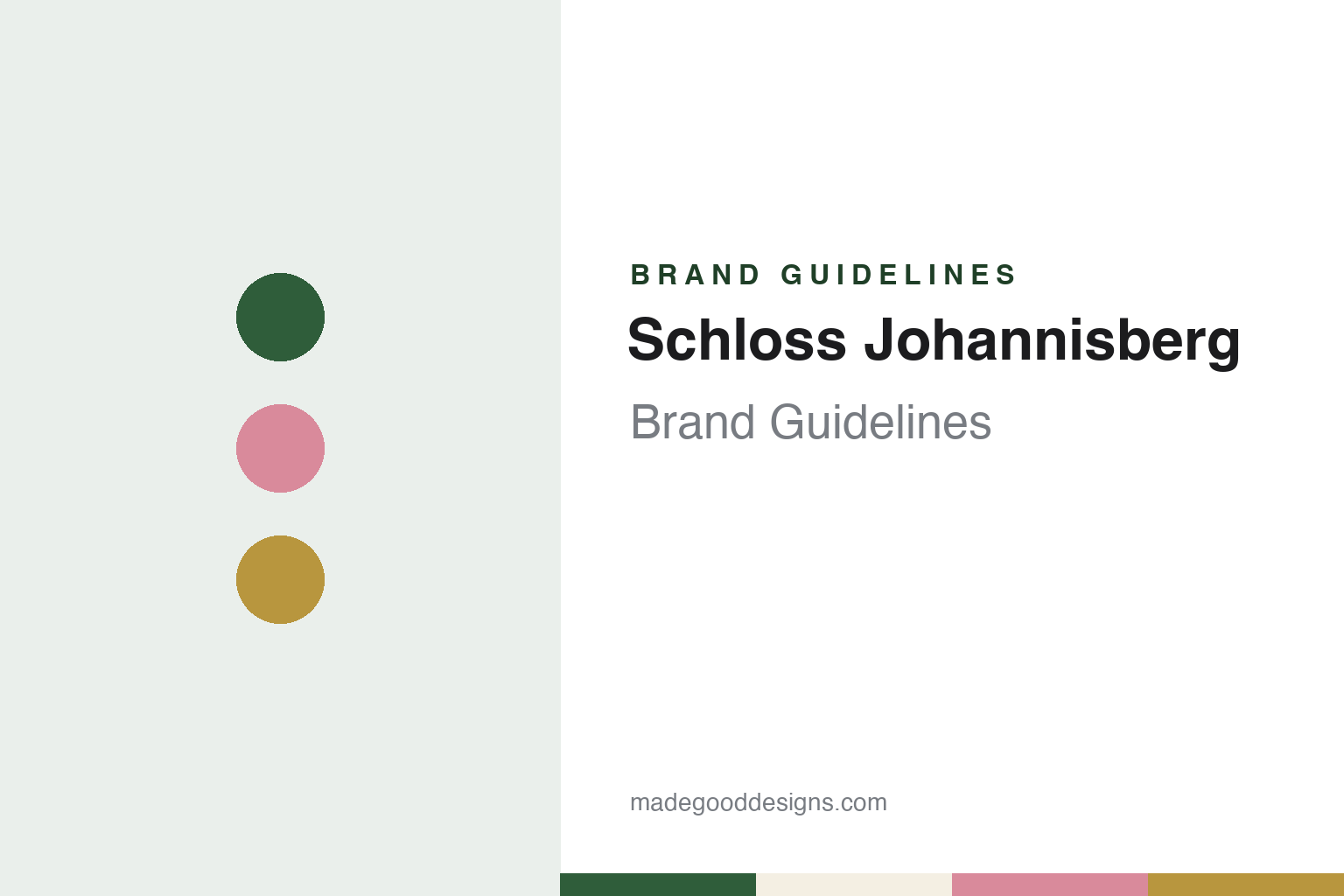
Two constants: a seal green, seal pink and gold palette and a classical serif register. Abstract homage — not a Schloss Johannisberg product or mark; no label, seal, logo or bottle is reproduced.
A Benedictine hill above the Rhine
Fulda, a monastery to St John and a prince-abbot’s summer palace.
Schloss Johannisberg stands on a hill above the Rhine at Geisenheim in the Rheingau, in the German state of Hesse. Its winemaking history reaches back more than a thousand years. German and English Wikipedia say a gift of Geisenheim lands to the Abbey of Fulda was recorded in 772, and that in 817 the monks exchanged holdings at the foot of the hill, by the Elsterbach stream, with the emperor Louis the Pious. The estate itself calls 817 the first documented mention of the Johannisberg vineyards. German Wikipedia also records a legend that Charlemagne, looking out from his palace at Ingelheim, noticed that the snow melted first on this slope.
Around 1100 the Archbishop of Mainz, Ruthard, gave the hill to the Benedictine abbey of St. Alban in Mainz, which founded a new monastery there dedicated to St John the Baptist. By the middle of the twelfth century the hill was known as “Sankt Johannisberg,” St John’s hill, and around 1130 the priory became an independent abbey. German Wikipedia says the monastery declined after the Peasants’ War of 1524–25 and was dissolved in 1563, and the estate then passed through a long, difficult period of changing owners.
A new chapter began in 1716, when the Prince-Abbot of Fulda, Konstantin von Buttlar, acquired Johannisberg and began building a baroque palace on the site of the ruined monastery; the estate dates the start of construction to 20 June 1716. A vaulted cellar some 260 metres long was finished in 1721. In 1720 and 1721, German Wikipedia says, almost 294,000 vines were planted, nearly all of them Riesling. The estate says the whole domain was planted with Riesling in 1720, creating “the first closed Riesling vineyard in the world,” and it still presents itself as the first Riesling winery in the world.
Colour
A late messenger, a gift to Metternich and a code of coloured seals.
The estate’s most famous story concerns a late messenger. Each year a courier carried a sample of grapes to Fulda to obtain the prince-abbot’s permission to begin the harvest. In 1775, the estate’s account goes, the permission arrived late; by then the grapes were overripe and touched by noble rot, but the wine was made anyway. German Wikipedia says the administrator Johann Michael Engert noted on 10 April 1776 that he had never tasted anything so fine, and that from then on the harvest was put off as long as possible. The estate calls this the birth of Spätlese, and a statue of the “Spätlesereiter,” the late-harvest rider, stands in the courtyard. German Wikipedia adds that wines from botrytised grapes were known from the sixteenth century, and that the estate’s first Eiswein followed in 1858.
The Napoleonic wars passed the estate from hand to hand: to the House of Orange-Nassau after secularisation, then, in 1807, from Napoleon to his marshal Kellermann, then into joint Allied administration from 1814. On 1 July 1816, the estate says, Emperor Franz I of Austria gave Schloss Johannisberg to his foreign minister, Prince Klemens von Metternich, in recognition of his work at the Congress of Vienna. The gift came with a condition: a yearly tithe of a tenth of the yield of the older vines, owed to the House of Habsburg. German and English Wikipedia say the tithe is still paid today, in cash since 1945.
The Metternich years gave the estate much of its present look. The architect Georg Moller remodelled the palace in a neoclassical style, and an English landscape park was laid out around it. German Wikipedia says the finest wines were again sold as “Cabinet” wines from 1818, that different qualities were marked with differently coloured sealing wax, and that from 1830 Metternich required every label to be signed by hand by the administrator and the cellar master. The colours survive in the range today: the estate lists wines from Gelblack (yellow) and Rotlack (red, Kabinett) to Grünlack (green, Spätlese) and Rosalack (pink, Auslese).
Typography
Design and documentation.
The seven brands in this group are all German, Indian and Chinese wine and Sekt producers: Dr. Loosen, Schloss Johannisberg, Henkell, Rotkäppchen, Sula Vineyards, Grover Zampa and Changyu. Wine and Sekt producers in general sit at many different points in the trade, from family estates that still carry a founder’s name to labels that now belong to much larger drinks groups, and a single brand can be sold everywhere from a corner shop to a restaurant list.
A wine or Sekt brand’s identity is usually carried less by a single bottle than by a label, a name and the place it promises, because the company behind the name may have changed hands, moved its production or grown far beyond the place where it started. That makes the questions behind each name worth asking plainly: who started it, who owns it now, and where its wine or Sekt is actually made and bottled.
Each guide separates what independent sources record from what the company says about itself — its founding story, its owners over time, where its wine or Sekt is made and how its labels have changed — and marks plainly what rests only on the company’s own word.
Aa
A classical serif for a palace estate. (Specimen set in EB Garamond, a serif STAND-IN; NOT the Schloss Johannisberg logo.)
Schloss Johannisberg
From the Metternich princes to the Oetker group.
In 1897 the Metternich domain was among the founders of the association of Rheingau estate owners from which today’s VDP grew, German Wikipedia says, and the estate is still a VDP member. In August 1942 the palace and church were destroyed by bombs dropped after a heavy raid on Mainz; the rebuilding lasted until 1964. Prince Paul Alfons von Metternich-Winneburg and his wife Tatiana made the estate their home after losing their Bohemian lands in 1945, and Tatiana, a co-founder of the Rheingau Musik Festival, turned the rebuilt east wing into a concert hall that staged ten of the festival’s nineteen concerts in its first season, 1988.
Ownership passed step by step to the Oetker group. German Wikipedia says the estate had supplied base wines to the Wiesbaden sparkling-wine house Söhnlein since 1865, a link that produced the Fürst von Metternich Sekt, whose blend is still assembled at Schloss Johannisberg. Söhnlein, by then part of the Oetker group, bought a share of the domain in 1974, which became a majority in 1980. German Wikipedia says the estate is now wholly owned by Henkell & Co. Sektkellerei, and English Wikipedia describes it as part of Henkell Freixenet, the Oetker group’s wine and spirits arm; Henkell Freixenet lists Schloss Johannisberg among its brands alongside Freixenet and Mionetto. The estate is the sole owner of its vineyard, where only Riesling is grown, and since the 1971 wine law it has been allowed to name the site on its labels without a village name, German Wikipedia says.
The cellar keeps its own archive. English Wikipedia describes a “Bibliotheca Subterranea” of about 25,000 bottles, the oldest dated 1748. German Wikipedia says around 130,000 people visit the estate each year, and English Wikipedia says the World’s Best Vineyards list placed it fifth in 2024.
For a design guide, Schloss Johannisberg shows how the colour of a wax seal can grow into a naming system that buyers have read for two centuries. Compare Henkell, the Wiesbaden Sekt house in the same group, and Dr. Oetker, the Bielefeld family company behind both. For this guide we use seal green, seal pink and gold with a classical serif, an unofficial interpretation; no product or logo is reproduced.
Explore & save
Keep Schloss Johannisberg’s identity on hand — save it to a board in the Made Good inspiration library.
Schloss Johannisberg identity set
Pin the Schloss Johannisberg seal green, seal pink and gold palette and the classical serif register to your own board.