Killepitsch Brand Guidelines
The Busch family’s Düsseldorf herbal liqueur, since 1955.
Aa
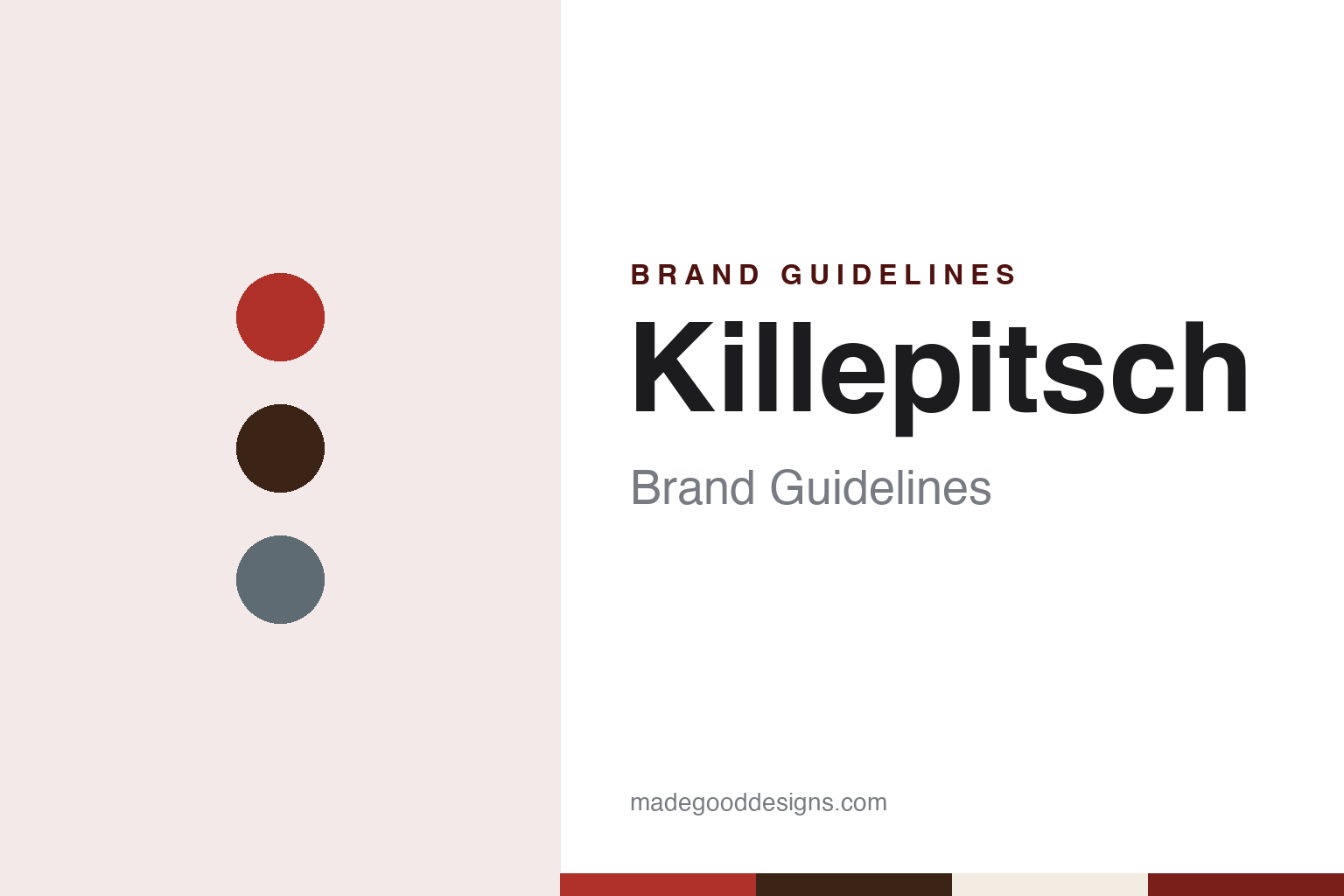
Two constants: an Altstadt red, liqueur brown and Rhine slate palette and an old-style text serif register. Abstract homage — not a Killepitsch product or mark; no bottle, label or logo is reproduced.
A Düsseldorf spirits family
A wine and spice shop, a liqueur works and a tasting room in the Altstadt.
Killepitsch is a herbal liqueur from Düsseldorf, made by the Likörfabrik Peter Busch GmbH & Co. KG, German Wikipedia says. The family company dates its business to 1858 and says it has produced spirits ever since. Its own history begins with a Peter Busch and his wife Johanna, who opened a shop for wine, spirits and spices on the Bolkerstraße in Düsseldorf’s old town. They later moved the business to the Hohestraße, near today’s Graf-Adolf-Platz, where a small distillation attached to the shop became, in the company’s words, the cradle of the liqueur works.
The shop passed down the family. The company says the founder’s son Peter Jacob Busch took it over and widened its range of wine and spirits in the 1920s, and that the third generation, Hans Busch, followed. When the shop on the Hohestraße was destroyed by bombs in 1943, the family moved into makeshift premises across the street and went on producing spirits as far as the wartime alcohol allocation allowed. After the war and the currency reform, Hans Busch and his brother Willi Busch rebuilt the business in the original building.
The 1950s set up everything that followed. In 1950, the company says, the brothers opened a modern winery and liqueur works on the Bastionstraße and a second shop in the house “Zum Helm” on the Flinger Straße, in the heart of the Altstadt. In 1955 they opened a small wine and liqueur tasting room in the same building, “Et Kabüffke”, and on the opening night they poured a new herbal liqueur for the first time: Killepitsch. German Wikipedia gives the same year and says the liqueur was first offered at the opening. It stands opposite the traditional Uerige tavern, German Wikipedia notes.
The family still runs the company. It says the fourth generation, Peter Busch — whom its timeline also calls Hans Peter Busch — took over the management in 1995, after opening a shop with a bar counter in the Delikatessa food hall of the Carsch-Haus department store in 1984. In 2018 his daughter Katharina Busch joined him in the management as the fifth generation, the company and German Wikipedia both say.
Colour
A name from an air-raid cellar and a liqueur served through a window.
The name is a piece of Düsseldorf dialect with a story attached. According to the family, recounted on the company site and in German Wikipedia, it was coined during the Second World War in an air-raid cellar, in a conversation between Willi Busch and his friend Hans Müller-Schlösser, the Düsseldorf writer best known for the comedy Schneider Wibbel. As the company tells it, Willi promised that if the two of them got out alive — if “they” did not kille them, kill them — he would brew his friend a drink to pitsche, the local word for having a drink, and that he could call it Killepitsch. The name, the company says, was born in that cellar, but the liqueur itself had to wait until the opening of Et Kabüffke in 1955, when Willi handed his friend the first glass.
The serving ritual is part of the brand. German Wikipedia says the liqueur is poured at Et Kabüffke through a small window onto the street. In June 2024 two bronze plaques telling the company’s history were mounted under that arcade; German Wikipedia says they were made in the workshop of the art founder Rolf Kayser.
The recipe, the company says, is still a closely kept family secret. It describes Killepitsch as a herbal liqueur of 42 percent alcohol made from more than 98 herbs, berries and fruits from around the world. German Wikipedia, drawing on the maker’s account, says the extracts are first mixed into a premix that rests for several months in temperature-controlled stainless-steel tanks before alcohol, water, sugar and caramel are added, and describes the finished liqueur as dark and bittersweet, with the sweetness to the fore. The company points out that, as a liqueur, Killepitsch is blended rather than distilled.
Killepitsch also has a place in local pop culture. German Wikipedia notes that the Düsseldorf rappers Blumio and JayJay released a song called “Killepitsch” in 2012 about a tour through the Altstadt.
Typography
Design and documentation.
The seven brands in this group are all German and Polish spirits and liqueurs: Asbach, Berentzen, Underberg, Killepitsch, Mampe, Żołądkowa Gorzka and Krupnik. Spirits and liqueur brands in general sit at many different points in the trade, from family houses that still carry a founder’s name to labels that now belong to much larger drinks groups, and a single brand can be sold everywhere from a corner shop to a bar shelf.
A spirit or liqueur brand’s identity is usually carried less by a single bottle than by a label, a name and the place it promises, because the company behind the name may have changed hands, moved its production or grown far beyond the place where it started. That makes the questions behind each name worth asking plainly: who started it, who owns it now, and where its spirits are actually distilled and bottled.
Each guide separates what independent sources record from what the company says about itself — its founding story, its owners over time, where its spirits are made and how its labels have changed — and marks plainly what rests only on the company’s own word.
Aa
An old-style serif for a family liqueur rooted in Düsseldorf dialect and the Altstadt. (Specimen set in Alegreya, a serif STAND-IN; NOT the Killepitsch logo or lettering.)
Killepitsch
From the Altstadt to a glass factory on the harbour.
By the early 2000s the old production site in the Altstadt had grown too small, German Wikipedia and the company say. Peter Busch planned a new building himself, and since 2005 Killepitsch has been made in a glass factory in Düsseldorf’s Medienhafen. The company describes a cube-shaped building 27 metres high with 5,500 square metres of floor space, two bottling lines and production on the first two upper floors, visible from the street through the glass. In 2025, it says, a Killepitsch museum opened on the ground floor, showing the original equipment used to make the liqueur in the 1950s.
The range has grown around the original. In 2018, the company and German Wikipedia say, Peter and Katharina Busch developed the recipes for Applepitsch, an apple liqueur on a vodka base, GIN Pitsch, a Düsseldorf dry gin whose bottle shows the city’s skyline, and Vodkapitsch, a vodka made in Düsseldorf. German Wikipedia says Killepitsch is sold across Germany and exported to more than 40 countries; Et Kabüffke on the Flinger Straße remains the place where it was first poured.
The name is easy to search: the company’s site is killepitsch.de, and its shop runs on a separate subdomain.
For a design guide, Killepitsch shows how a dialect name, a family story and a single bar window can carry a local liqueur since 1955, from a tasting room in the Altstadt to a glass factory on the harbour. Compare Underberg, the family-owned herbal bitter from Rheinberg, and Appenzeller Alpenbitter, the Swiss herbal liqueur with its own guarded recipe. For this guide we use Altstadt red, liqueur brown and Rhine slate with a serif, an unofficial interpretation; no product or logo is reproduced.
Explore & save
Keep Killepitsch’s identity on hand — save it to a board in the Made Good inspiration library.
Killepitsch identity set
Pin the Killepitsch Altstadt red, liqueur brown and Rhine slate palette and the old-style text serif register to your own board.