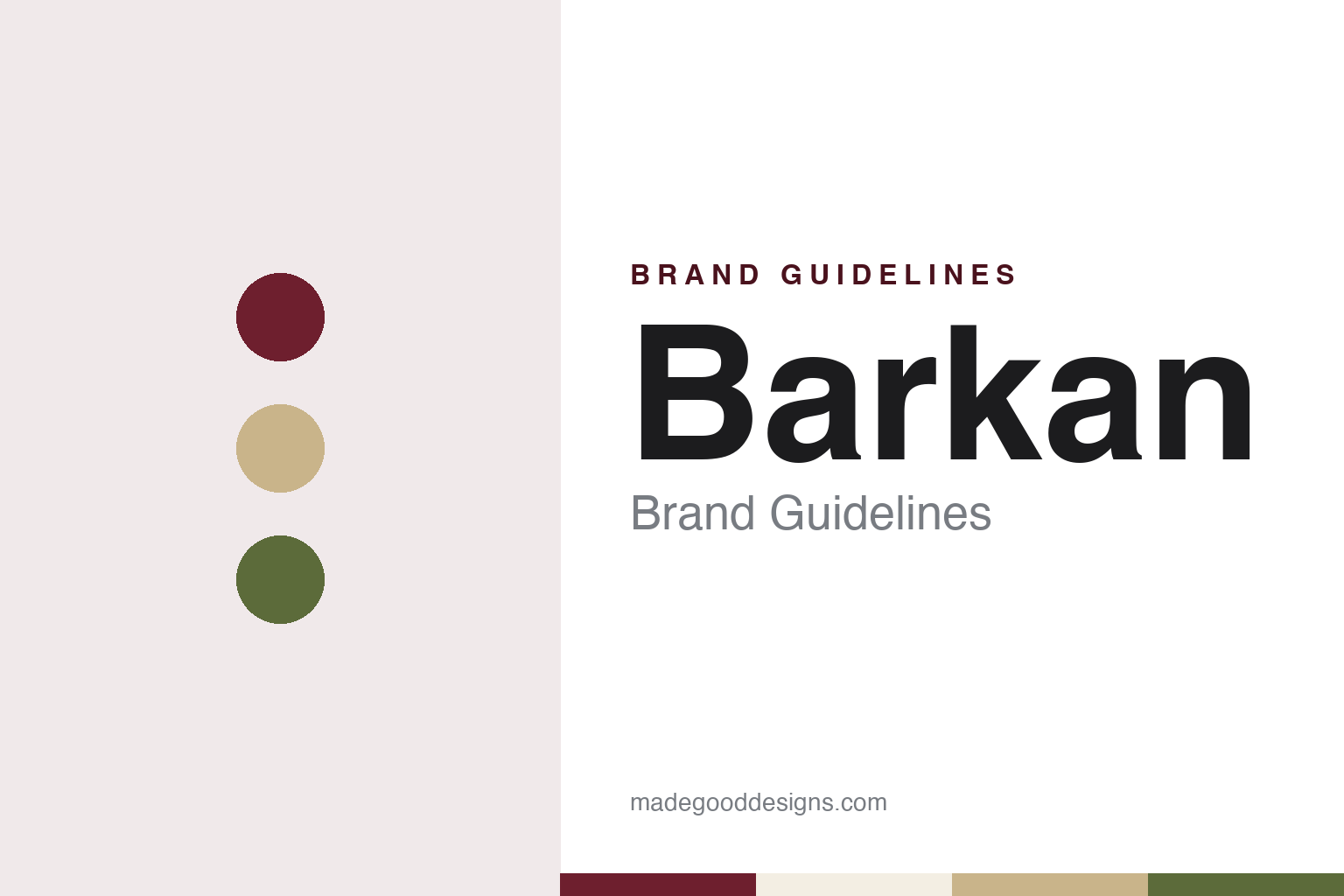
Barkan Brand Guidelines
The Hulda winery built from a Friedman cellar.
Aa
Two constants: a Hulda red, limestone and vine olive palette and a humanist sans register. Abstract homage — not a Barkan product or mark; no label, logo or bottle is reproduced.
From a Friedman cellar to Barkan
A sweet-wine winery, a dairy cooperative, a liqueur maker and two grape growers.
Barkan Wine Cellars is one of Israel’s largest wine producers, and its history runs through several owners before the name Barkan appears at all. The two Wikipedias tell the opening chapter slightly differently. English Wikipedia, citing the company’s own archived history, says the story begins in 1899, when Shlomo Friedman set up the Friedman Winery in Petah Tikva to make sweet Kiddush wine and brandy. Hebrew Wikipedia dates it to the end of 1889 and says the Friedman winery was founded in Haifa by Shimon Friedman before moving to Petah Tikva. Both agree on what came next.
In 1964 the winery was bought by Tnuva, the cooperative better known for dairy, which supplied the grapes and renamed it Tnuva-Friedman, English Wikipedia says. In 1971 Tnuva sold it to the liqueur company Stock, whose range was mostly brandy, vodka, liqueurs and vermouth; Hebrew Wikipedia lists Stock 84 and Keglevich vodka among its leading brands. Under Stock the winery was renamed HaMartef, “the cellar,” and began working with grape varieties such as Cabernet Sauvignon and Sauvignon Blanc.
In 1988 Stock began building a new winery in the Barkan industrial zone in the West Bank, near Ariel, to replace its older plants in Petah Tikva and Netanya, according to both Wikipedias. In 1990 the company passed to two of its large grape growers, Shmuel Boxer and Yair Lerner, and took the name Barkan Wine Cellars from that site. Hebrew Wikipedia says the company floated on the Tel Aviv Stock Exchange in 1994, selling about a quarter of its shares to the public, and in 2001 Barkan bought the Segal winery, TheMarker reported at the time.
Colour
One winery at Hulda, many vineyards, and a drinks group behind it.
Where Barkan’s wine is made today is Kibbutz Hulda, in central Israel east of Tel Aviv. Hebrew Wikipedia says that by the end of the 1990s the old winery could not handle the volume expected from new vineyards coming into bearing with the 2000 harvest, so the owners began building at Hulda. English Wikipedia, citing the company’s US importer Royal Wine, sets out the move in stages: the Hulda winery received its first grapes in 2000, bottling moved there in 2003, and once a new warehouse was finished in 2007 the whole operation was based at Hulda. A visitor centre opened there in 2012, Hebrew Wikipedia says. Segal wine has been made at the same winery since 2001 while being marketed as a separate label, The Jerusalem Post’s wine writer Adam Montefiore wrote in 2011.
The grapes come from much further afield. English Wikipedia lists vineyards in the Golan Heights, Upper and Lower Galilee, the Mount Tabor area, the Jerusalem Mountains and Mitzpe Ramon in the Negev; the company’s archived history describes its Hulda vineyard as the largest single vineyard in Israel.
Ownership changed again in the 2000s. Haaretz reported on 3 September 2004 that the Netanya-based drinks company Tempo, until then a brewer with no foothold in wine, had signed an agreement to buy control of Barkan from its founders, including the co-chief executives Yair Lerner and Shmuel Boxer, and would distribute the wines exclusively. Tempo, whose beers include Goldstar and Maccabee, completed a full tender offer for the remaining public shares in October 2013, and Barkan was delisted from the Tel Aviv exchange, TheMarker reported on 22 October 2013. The Institute of Masters of Wine says Ido Lewinsohn was appointed head winemaker of Barkan-Segal in 2017, which it describes as Israel’s largest producer, and became a Master of Wine in 2020.
Typography
Design and documentation.
The seven brands in this group are all wineries: Barkan, Royal Tokaji, Oremus, Tement, Weninger, Jermann and Bründlmayer, from Israel, Hungary, Austria and Friuli. Wineries in general sit at many different points in the trade, from family estates that still carry a founder’s name to labels that now belong to much larger drinks groups, and a single name can be sold everywhere from a corner shop to a restaurant list.
A winery’s identity is usually carried less by a single bottle than by a label, a name and the place it promises, because the company behind the name may have changed hands, moved its production or grown far beyond the place where it started. That makes the questions behind each name worth asking plainly: who started it, who owns it now, and where its wine is actually made and bottled.
Each guide separates what independent sources record from what the company says about itself — its founding story, its owners over time, where its wine is made and how its labels have changed — and marks plainly what rests only on the company’s own word.
Aa
A humanist sans for a short, two-script wine name. (Specimen set in Assistant, a sans-serif STAND-IN; NOT the Barkan logo.)
Barkan
A name that outlived its first address.
Barkan’s ranges are tiered rather than built around a single wine. English Wikipedia lists Village, Classic, Reserve and Superior among them, alongside the Altitude series. Other labels in the group include dOmaine and Derekh Eretz, English Wikipedia says, and Segal keeps its own name and identity on the shelf.
The name itself carries a small trap. Barkan is also the name of an Israeli settlement and industrial park in the West Bank, where the 1988 winery was built; the wine company kept the name after its production moved to Kibbutz Hulda. The winery’s own site is barkan-winery.co.il.
The arc of the business runs from a sweet-wine cellar owned in turn by a dairy cooperative, a liqueur maker, two grape growers, public shareholders and finally a brewer. Each owner changed the name or the address, and the brand that came out of it is named after a place the winery has since left.
For a design guide, Barkan shows how a wine brand can carry one short name through more than a century of owners and addresses, from a Friedman cellar to a single large winery at Hulda. Compare Tnuva, the cooperative that owned the winery from 1964 to 1971, and Osem, another Israeli food name that passed into a larger group. For this guide we use Hulda red, limestone and vine olive with a humanist sans, an unofficial interpretation; no product or logo is reproduced.
Explore & save
Keep Barkan’s identity on hand — save it to a board in the Made Good inspiration library.
Barkan identity set
Pin the Barkan Hulda red, limestone and vine olive palette and the humanist sans register to your own board.