Felton Road Brand Guidelines
The Bannockburn Pinot Noir estate at the end of the road.
Aa
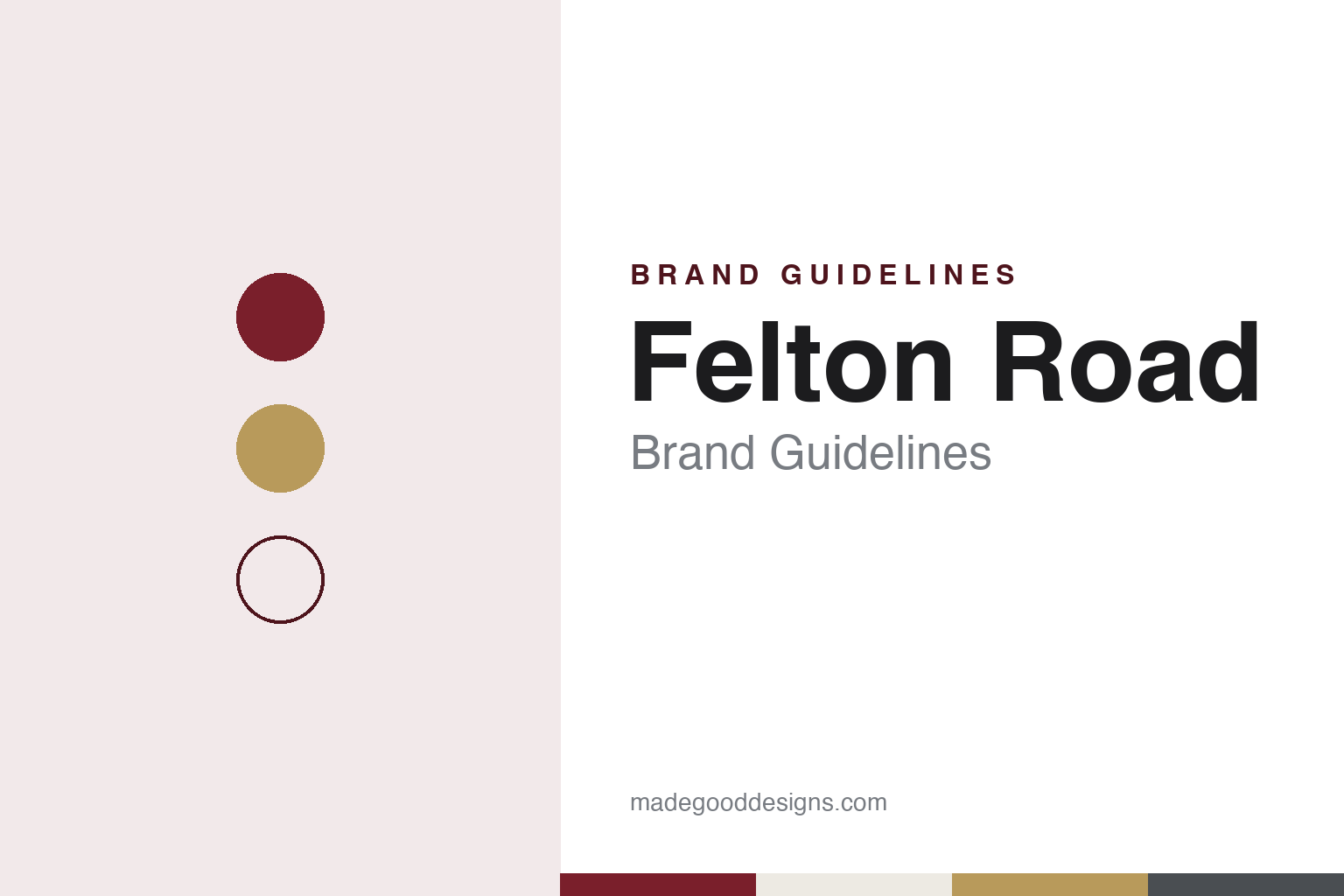
Two constants: a Pinot red, tussock gold and slate grey palette and a modern serif register. Abstract homage — not a Felton Road product or mark; no label, logo or bottle is reproduced.
Stewart Elms and the end of the road
A 1991 site study, an Elm tree logo and a first official vintage in 1997.
Felton Road takes its name from a road. The winery stands at the end of Felton Road in Bannockburn, in the Central Otago wine region of New Zealand’s South Island. The company says that research by its founder, Stewart Elms, in 1991 identified the north-facing slopes at the end of the road as one of the warmest and most suitable sites in Central Otago for fine wine, and that heat-summation data and soil maps drawn up during the construction of the Clyde Dam helped him decide. It adds that the Elm tree in its logo comes from his surname, and that the three soils it found are free-draining and low in fertility.
Elms came to wine as a second career. Jamie Goode, writing on wineanorak in October 2022, says he had been a blackcurrant farmer before studying wine at Lincoln University, and that the first vines on what became the Elms Vineyard were planted in 1992; Goode’s earlier profile of the winery dates the planting to 1991. The plantings made that year by Elms and by the neighbouring Olssens, Goode writes, doubled the area under vine in the region from 11 to 22 hectares. The Elms Vineyard went in over two phases, blocks 1 to 9 between 1992 and 1994 and blocks 10 to 13 in 2001.
The first crops did not carry the Felton Road name. Goode says the 1995 and 1996 harvests were sold to the Gibbston Valley winery, although two hogsheads of the 1995 were kept apart and bottled as Felton Road. In 1996 Elms hired Blair Walter as winemaker, and 1997 became the first official Felton Road vintage. The Pinot Noir newsletter Prince of Pinot tells how the two men met: at wine school Walter was the youngest student and Elms the oldest, and they were paired together. Walter had worked at nearby Rippon, and he toured winery designs in Oregon’s Willamette Valley before returning to oversee the building of the Felton Road winery, Prince of Pinot says. Goode writes that Walter has been at Felton Road since the 1997 vintage.
Colour
A British buyer, five Pinot Noirs and three vineyards around Bannockburn.
The winery changed hands in 2000. Nigel Greening, a British wine lover who, according to Prince of Pinot, lives mainly in Europe, had already bought land of his own nearby in the late 1990s: an 8.6-hectare apricot orchard called Cornish Point, across the water from the town of Cromwell, which he planned to plant with vines. Goode dates that purchase to 1998 in one account and 1999 in another. Greening had bought a good deal of the 1998 and 1999 Felton Road vintages, Goode writes, and when he heard the Elms project might be for sale he bought it, with about nine hectares of vines. Greening told Goode that on the first day of his ownership he and Walter had lunch to talk about the future.
Felton Road now farms several sites around Bannockburn. Cornish Point, named, Prince of Pinot says, after the Cornish gold miners who lived there in the late nineteenth century, was sold under its own label from 2003 to 2006 and became a single-vineyard Felton Road wine from 2007, Goode writes. Calvert, a gently sloping north-facing vineyard first planted in 1999, was for years leased and managed by the Felton Road team, with its fruit shared with Craggy Range and Pyramid Valley; when it was later put up for sale, Goode reported in 2022, Felton Road took its three Pinot Noir blocks and Cloudy Bay took the rest. A further site, MacMuir, next to Calvert, was planted with Pinot Noir in 2013.
The range is built on Pinot Noir, with Chardonnay and Riesling alongside. Goode lists five Pinot Noirs at its heart: the village-level Bannockburn, Block 3 and Block 5 from the Elms Vineyard, and the single-vineyard Calvert and Cornish Point. The Elms Vineyard is the home block and surrounds the winery building, Goode writes, and Walter prefers wild yeasts and minimal intervention, according to Prince of Pinot. The company says every grape is picked by hand, with differences between clones, rootstocks and trials kept separate within each block.
Typography
Design and documentation.
The seven brands in this group are all wine names: Henschke, Yalumba, Torbreck, d’Arenberg, Felton Road, Egon Müller and Robert Weil, wine estates from Australia, New Zealand and Germany. Wine brands in general sit at many different points in the trade, from family houses that still carry a founder’s name to labels that now belong to much larger groups, and a single name can be sold everywhere from a corner shop to a restaurant list.
A wine brand’s identity is usually carried less by a single bottle than by a label, a name and the place it promises, because the company behind the name may have changed hands, moved its production or grown far beyond the place where it started. That makes the questions behind each name worth asking plainly: who started it, who owns it now, and where its wine is actually made and bottled.
Each guide separates what independent sources record from what the company says about itself — its founding story, its owners over time, where its wine is made and how its labels have changed — and marks plainly what rests only on the company’s own word.
Aa
A modern serif for a Central Otago estate founded in 1991. (Specimen set in Fraunces, a serif STAND-IN; NOT the Felton Road logo.)
Felton Road
Biodynamic farming and a company that chose not to grow.
Felton Road says its vineyards have been farmed organically and biodynamically since 2002, that all four were awarded full Demeter certification in 2010, and that they were also certified by the New Zealand organic body BioGro in 2020. It describes making compost from winery waste, organic cow manure and straw, keeping Highland cattle and goats on the hills behind the vines and moving a coop of chickens on wheels around the Elms Vineyard. The company also lists Sustainable Winegrowing New Zealand, B Corp and International Wineries for Climate Action among its certifications and memberships, and it publishes a climate action plan for 2026 to 2035.
Its mission statement is unusual for a wine company. Felton Road says it exists “for the benefit of all stakeholders and not simply shareholders,” keeps a charitable trust focused on the developing world, and has held a zero-growth policy since 2000, calling growth “the single largest enemy of environmental responsibility”; it says it has been producing at the full limit of that policy since 2006. The statement says nothing about the quality of the wine, because, the company explains, writing down that it will make great wines does not make it happen.
Greening was still the owner in 2022, when Goode described him as the custodian of Felton Road for 22 of its 25 years. The company’s team page says that his daughter Nicola, the first of the family’s second generation to join, runs its UK distribution, and that Felton Road sells into more than forty export markets. With roughly 130,000 vines, it says, the vineyard team walks about 145 kilometres to cover every row once.
For a design guide, Felton Road shows how a small estate can build a name from places — a road, a numbered block, a vineyard — and a tree drawn from its founder’s surname. Compare Cloudy Bay, the Marlborough winery that took the rest of the Calvert vineyard, and Villa Maria, another New Zealand wine name. For this guide we use Pinot red, tussock gold and slate grey with a modern serif, an unofficial interpretation; no product or logo is reproduced.
Explore & save
Keep Felton Road’s identity on hand — save it to a board in the Made Good inspiration library.
Felton Road identity set
Pin the Felton Road Pinot red, tussock gold and slate grey palette and the modern serif register to your own board.