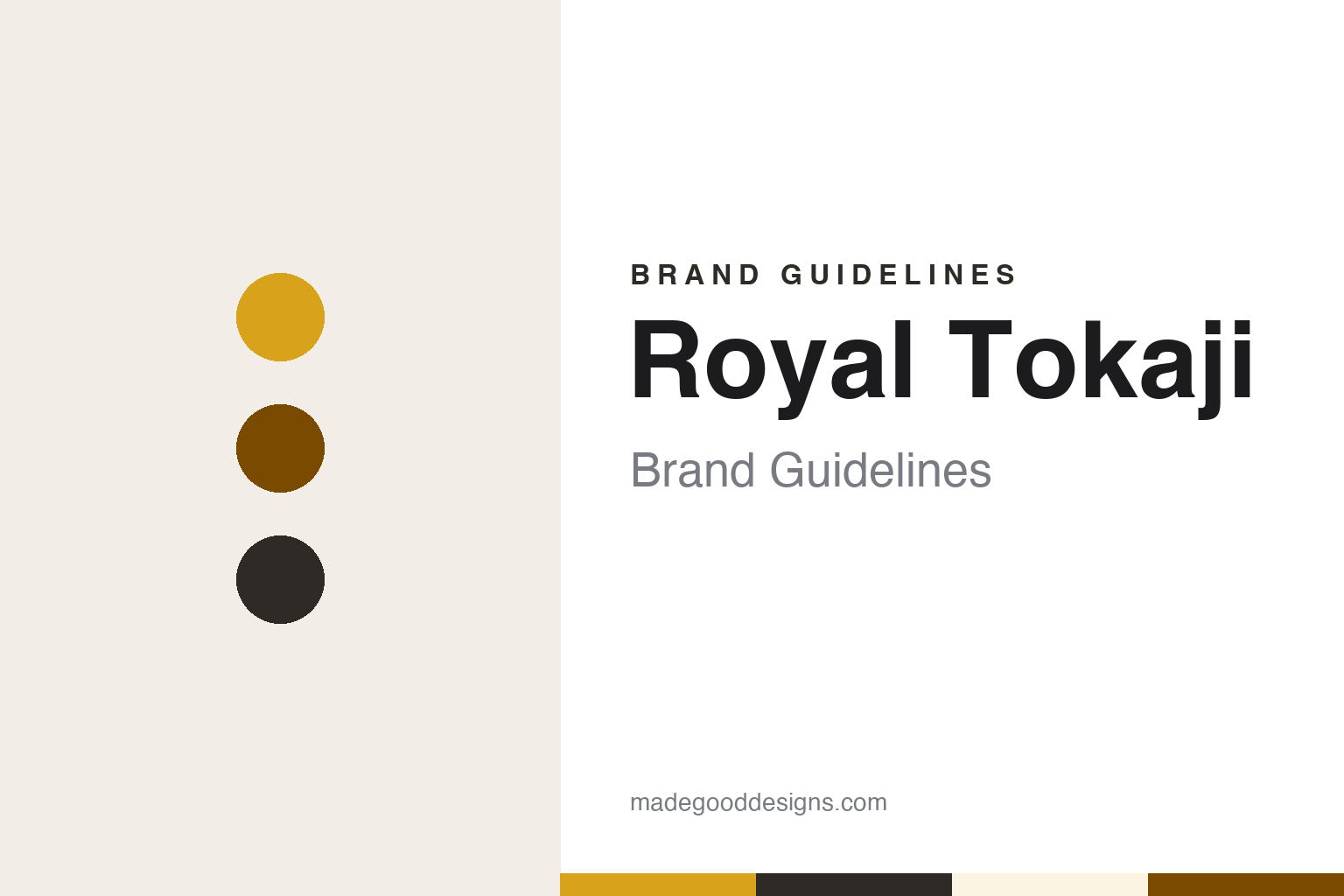
Royal Tokaji Brand Guidelines
Hugh Johnson’s 1990 Mád venture in single-vineyard Aszú.
Aa
Two constants: an Aszú gold, amber and volcanic black palette and an old-style display serif register. Abstract homage — not a Royal Tokaji product or mark; no label, logo or bottle is reproduced.
A wine writer goes to Mád
The border opens, and a collaborative brand is born.
Royal Tokaji was one of the first wine companies in Hungary’s Tokaj region to be built with foreign money after the end of communism. Decanter says it was founded by the English wine writer Hugh Johnson, Peter Vinding-Diers and other investors, who acquired vineyards and hired István Szepsy as consultant winemaker; the magazine notes that Hungary’s wine industry was privatised gradually after 1990 and that Royal Tokaji was among the very first to benefit from international investment. English Wikipedia’s article on Johnson describes him as a co-founder of the Royal Tokaji Wine Company in 1990, “in an attempt to rebuild” the region’s wine industry after communism.
Johnson told the story himself to Neal Martin of Vinous in 2019. He said his interest in Tokaji began in 1970, and that the chance came in 1989, when the Hungarian government opened the border. With friends, including Danish bankers, he went to Mád, a village where the wine dealers were based, and asked the farmers there to help build a collaborative brand. They chose the name Royal Tokaji, he said, because it was catchy and pointed to Hungary’s royal history rather than to the Habsburg emperors.
The local side of the partnership was large. Hungarian Wikipedia, citing the company, says the venture was formed with 62 Mád growers working alongside the foreign businessmen; the company’s Hungarian site, as archived in 2018, gives both 1989 and 1990 as its starting year, and its current site says 1990. The first harvest, in 1990, was supervised by the winemaker Samuel Tinon, Vinous reported, at a time when the company had no winery of its own: the press stood in the open air and cellar space was rented.
Colour
First Growth vineyards, named on the label.
Royal Tokaji’s identity rests on place names. From the start the company decided to concentrate on single-vineyard Aszú, the region’s sweet wine made by adding botrytised berries to a base wine, and Hungarian Wikipedia, citing the company, says it made the first single-vineyard Aszú after the change of regime in 1990. Its current site names four vineyards for these wines: Mézes Mály, which it calls a Great First Growth, in the commune of Tarcal, and the First Growths Szt. Tamás, Nyulászó and Betsek in Mád, with the Second Growth Birsalmás also in Mád. The terms come from Tokaj’s historic vineyard classification, which English Wikipedia says began in 1730 and calls the world’s first appellation control.
Johnson told Vinous that the 1993 Mézes Mály was the vineyard’s first vintage under Royal Tokaji and the first time its name had appeared on a label for perhaps a century. Vinous gave Szt. Tamás as about 12 hectares planted entirely with Furmint and Nyulászó, whose name means roughly “to catch hares,” as about 18 hectares, and described Birsalmás, Hungarian for “quince,” as a half-hectare plot just outside Mád. Johnson told the same interview that the Royal Tokaji harvest traditionally starts on 23 October, late by European standards, with each picker carrying two buckets: one for the botrytised berries, picked one by one, and one for healthy grapes, which are pressed and fermented first. Johnson also said the company at first made only Aszú and later added other wines in poorer years; Harpers reported in December 2023 that the estate had been pushing ahead with dry Furmint.
All of it is made in Mád. The company says it marked its 20th anniversary in 2010 by opening a new winery there designed by the Hungarian architect Csaba Bodonyi, and Hungarian Wikipedia, citing the company, says the wines age in a three-level cellar system dating from the 13th century. The company names Zoltán Adorján Kovács as winery director and Máté Varga, born in nearby Tolcsva, as winemaker.
Typography
Design and documentation.
The seven brands in this group are all wineries: Barkan, Royal Tokaji, Oremus, Tement, Weninger, Jermann and Bründlmayer, from Israel, Hungary, Austria and Friuli. Wineries in general sit at many different points in the trade, from family estates that still carry a founder’s name to labels that now belong to much larger drinks groups, and a single name can be sold everywhere from a corner shop to a restaurant list.
A winery’s identity is usually carried less by a single bottle than by a label, a name and the place it promises, because the company behind the name may have changed hands, moved its production or grown far beyond the place where it started. That makes the questions behind each name worth asking plainly: who started it, who owns it now, and where its wine is actually made and bottled.
Each guide separates what independent sources record from what the company says about itself — its founding story, its owners over time, where its wine is made and how its labels have changed — and marks plainly what rests only on the company’s own word.
Aa
An old-style display serif for a name that leans on royal history. (Specimen set in Cormorant Garamond, a serif STAND-IN; NOT the Royal Tokaji logo.)
Royal Tokaji
A private company with a public mission.
Ownership has stayed private. The company says Royal Tokaji “remains in private ownership,” and when the UK importer John E Fells & Sons took on the range in early 2024, its managing director described Royal Tokaji to Harpers as a family-owned winery. Harpers named Charlie Mount as Royal Tokaji’s managing director in that December 2023 report and said the wines were exported to 41 countries; the company’s own site says more than 30.
The name needs a little care. “Royal Tokaji” is the company’s brand, while Tokaji itself is a protected designation of origin for wine from the Tokaj region, as the company’s site explains; Johnson told Vinous the founders chose “Royal” over “Imperial” on purpose. The company’s site is royal-tokaji.com, run by Royal Tokaji Borászati Zrt. in Mád.
For a design guide, Royal Tokaji shows how a wine brand can lean on two kinds of heritage at once: a royal-sounding name chosen in 1989 for its pull abroad, and vineyard names from an 18th-century classification printed on the label as the real signature. Compare Oremus, another Tokaj wine estate, and Unicum, the Zwack family’s Budapest herbal bitter. For this guide we use Aszú gold, amber and volcanic black with a serif, an unofficial interpretation; no product or logo is reproduced.
Explore & save
Keep Royal Tokaji’s identity on hand — save it to a board in the Made Good inspiration library.
Royal Tokaji identity set
Pin the Royal Tokaji Aszú gold, amber and volcanic black palette and the old-style display serif register to your own board.