Svijany Brand Guidelines
The North Bohemian brewery that counts from 1564.
Aa
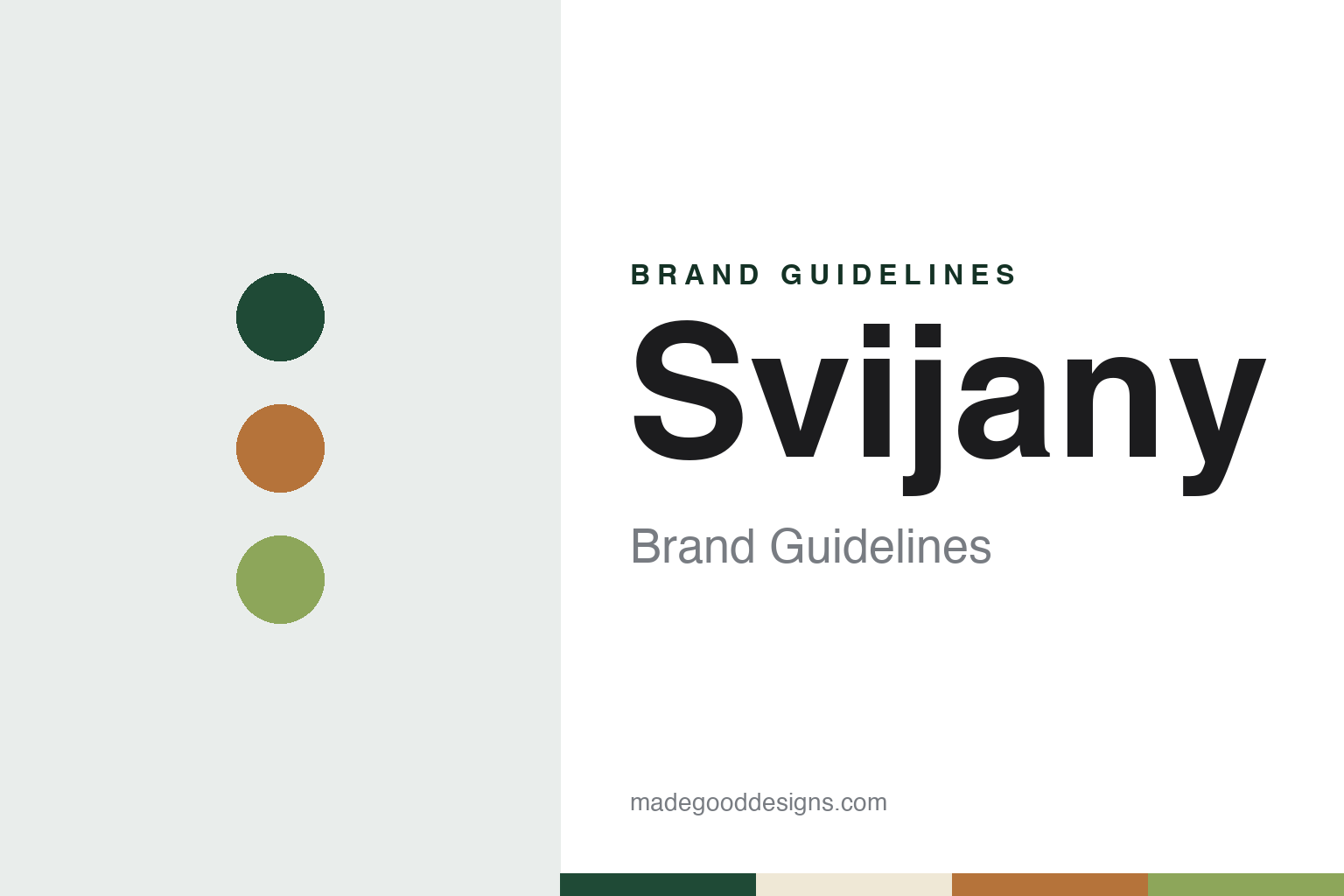
Two constants: a chateau green, copper and hop palette and an old-style book serif register. Abstract homage — not a Svijany product or mark; no label, logo or bottle is reproduced.
A brewery on a Renaissance estate
Vartenberks, a rebel nobleman, the Wallensteins and the Rohans.
Svijany is a village near Turnov in the Liberec region of North Bohemia, and its brewery is one of the oldest in the Czech lands. The company says the village is first mentioned in 1345, when it belonged to the Cistercian monastery at Mnichovo Hradiště, and that it counts the brewery’s history from 1564, when brewing was part of the economy of the estate, run to raise its income. A year later, the brewery says, the village and brewery passed to Jaroslav z Vartenberka, who built a Renaissance fortified manor there.
The estate changed hands with the politics of Bohemia. The brewery’s history says that after Jaroslav’s death in 1602 Svijany went to Jáchym Ondřej Šlik, a leader of the anti-Habsburg revolt, who was executed in Prague’s Old Town Square in June 1621. The estate then passed to the Wallenstein family, who held it until 1814, rebuilt the old manor as a chateau and enlarged the neighbouring brewery. From 1820 it belonged to the Rohan family, who attached Svijany to their Sychrov estate.
In 1912 the brewery’s tenant and brewer, Antonín Kratochvíl, bought it, and his family ran it until 1939, when, the company says, his grandson, also named Antonín, was forced to sell it back to the Rohans. English Wikipedia gives the same sequence, citing the brewery’s own published history.
Colour
Nationalisation, a London brewer’s Prague group and a near-closure.
After 1945 the brewery was confiscated and nationalised, and it became a plant of the state enterprise Severočeské pivovary, the North Bohemian breweries, Czech Wikipedia and the company both say. When that enterprise was wound up after 1989, Svijany became part of a new state enterprise, Pivovary Vratislavice nad Nisou, in 1990; the company says this became a joint-stock company in 1992.
In 1997 the brewery became part of Pražské pivovary, the Prague brewing group whose majority owner was the English brewer Bass, the company says, adding that Svijany was the oldest and smallest brewery in the group. The same group owned Staropramen and, English Wikipedia says, took the name Pivovary Staropramen in 2003. Svijany’s own account is blunt about what followed: because of the commercial policy of its owners, it says, the brewery fell into a sales crisis and was threatened with closure.
The rescue came in 1998. The company says a newly formed firm, Pivovar Svijany s.r.o., became the brewery’s owner that year and that a team led by the director František Horák overcame the crisis. CzechTourism’s Kudy z nudy describes the same moment as the year LIF Group bought the brewery from its English owners. The company became a joint-stock company, Pivovar Svijany, a.s., in 2005, and in 2006, it says, bought a stake in a hop-growing cooperative in Polepské blata to secure its own hops.
How the beer is made is central to the brand. Kudy z nudy says Svijany brews with double decoction, ferments in open vessels, lagers in cold cellars and sells its beer unpasteurised, and it quotes the master brewer Petr Menšík saying that what makes the beer different is that it stays the same. The names on the labels lean on the estate’s noble past: among them are Svijanský Rytíř (the knight), Svijanský Kníže (the prince), Svijanská Kněžna (the princess) and a lager named Šlik.
Typography
Design and documentation.
The seven brands in this group are all Czech beers: Bernard, Krušovice, Gambrinus, Radegast, Primátor, Svijany and Lobkowicz. Between them they cover most of the ways a Czech brewery can be owned today. Finance.cz wrote in March 2024 that Gambrinus and Radegast belong to Plzeňský Prazdroj, whose sole shareholder is Japan’s Asahi; that the Royal Brewery of Krušovice belongs to Heineken; that Svijany and Primátor sit in the Czech holding LIF Group; that the Belgian brewer Duvel Moortgat has held half of the family brewery Bernard since 2001; and that Pivovary Lobkowicz Group belongs to Lapasan, a company under China’s CITIC.
A Czech beer brand’s identity is usually carried by a name, a town and a label rather than by a single bottle, and the brewery behind the name may have changed hands several times, or moved production to another town. That makes the plain questions worth asking: who founded the brewery, who owns it now, and where the beer is actually brewed.
Each guide separates what independent sources record from what the company says about itself — its founding story, its owners over time, where its beer is brewed and how its labels have changed — and marks plainly what rests only on the company’s own word.
Aa
An old-style book serif for a brewery that names its beers after knights and princes. (Specimen set in Libre Caslon Text, a serif STAND-IN; NOT the Svijany logo.)
Svijany
A chateau, a beer spa and a Liberec holding company.
Svijany has spent the years since its rescue turning the old estate into part of the brand. The company says it bought the nearby chateau in 2013 in a derelict state, restored it with the help of EEA grants and opened it to the public in June 2016; a chateau hotel followed in 2017 and a beer spa in 2022. At the end of 2014 it opened the Radniční sklípek in Liberec as its first branded restaurant, and in the summer of that year it set up a distribution branch in Slovakia.
Ownership sits in Liberec. The business finance site finance.cz reported in March 2024 that the Svijany, Rohozec and Primátor breweries all belong to the LIF Group holding, in which Miroslav Kučera and his son Tomáš Kučera hold the largest stake through LIFPRO. Kudy z nudy says LIF Group was founded in Liberec in 1991, that the initials stand for Liberecký investiční fond, and that its interests also include hop growing, property and hotels. The sister breweries share more than a name: ČTK reported in April 2022 that Primátor’s cans were filled at Svijany.
One practical note: Svijany is also the name of the village itself, and the brewery’s official site is pivovarsvijany.cz.
For a design guide, Svijany shows how a regional brewery can build an identity out of its own estate — a Renaissance manor, a chateau and a cast of knights and princes on the labels — while making “unchanged” the promise. Compare Primátor, its sister brewery in Náchod, and Staropramen, the Prague brewery whose group once owned Svijany. For this guide we use chateau green, copper and hop with an old-style serif, an unofficial interpretation; no product or logo is reproduced.
Explore & save
Keep Svijany’s identity on hand — save it to a board in the Made Good inspiration library.
Svijany identity set
Pin the Svijany chateau green, copper and hop palette and the old-style book serif register to your own board.